

Removal Defense | Florida, Texas and New York
Removal Defense and Immigration Law Services
AG Immigration Law P.A. focuses on removal defense, adjustment of status, family petitions, naturalization, removal of conditions on green cards, waivers and BIA appeals for immigrants across the US.
By Adriana Gomez · Published October 30, 2026
Immigration Court Lawyer in Florida | AG Immigration
If you are in immigration court, asylum may be one way to ask for protection. Defensive asylum is a claim you raise inside removal proceedings, before an immigration judge. This page explains how that claim works and what representation involves. AG Immigration Law P.A. focuses its practice on immigration law, including removal defense. Clients across the United States can reach the firm about their cases.
If a Notice to Appear has put you in immigration court and you're weighing an asylum claim, our team can review your hearing dates and deadlines with you. Talk it through with our team — we can walk you through how a situation like yours is usually handled and what your options are.

What Defensive Asylum in Immigration Court Is and Who It Fits
Defensive asylum is a request for protection made to an immigration judge after the government has started removal proceedings. It differs from an affirmative application, which you file with USCIS when you are not already in court. In court, you make the claim on Form I-589.
The claim usually rests on past persecution or a well-founded fear of future harm. The harm must connect to race, religion, nationality, political opinion, or membership in a particular social group. The law says one of these grounds must be at least one central reason for the persecution, according to 8 U.S.C. § 1158.
This path usually fits people who received a Notice to Appear and fear going back to their home country. Timing is the first question to review. Under 8 CFR 1208.4, asylum applications are generally subject to a one-year filing deadline. That period runs from your last arrival in the United States, or from April 1, 1997, whichever is later. Exceptions exist, so review your dates early.
What Our Removal Defense Work Covers in an Asylum Case
Our removal defense work covers the asylum claim from the first filing through any appeal. It includes the following:
- Preparing the Form I-589 and supporting statements, with dates and prior filings checked against each other.
- Gathering evidence, such as identity documents, country conditions reports, police or court records, medical records where relevant, and witness statements.
- Preparing you to testify and to answer questions from the government attorney.
- Representation at hearings in immigration court, including responses to the Notice to Appear.
- Review of related protection requests. An immigration judge may consider withholding of removal and protection under the Convention Against Torture alongside asylum, under 8 CFR 1208.16.
- Appeals to the Board of Immigration Appeals when a decision goes against you.
You have a reasonable opportunity to examine the evidence against you and to cross-examine government witnesses, but these rights do not entitle you to examine national security information the government may offer in opposition to your admission or to an application for discretionary relief, under 8 U.S.C. § 1229a. If the government asks, or upon the judge’s own authority, a judge may also deny an asylum application that does not establish a prima facie claim, under 8 CFR 1208.13, but must give the parties at least 10 days’ notice before doing so on the judge’s own authority. That is why the strength of your written application matters from the start.
How the Process Works, Step by Step
The process moves through intake, hearings, a decision, and possibly an appeal. The court sets the schedule, so timelines vary by docket and by case.
- Intake and review. We review your Notice to Appear, prior immigration filings, and your timeline of events.
- Records request. A records request, often called a FOIA request, can ask agencies for files they hold about you. File it early so the records arrive before you testify.
- Evidence and drafting. We build the Form I-589, your declarations, and your evidence. Foreign-language documents need an English translation with a translator’s certification, under 8 CFR 1003.33.
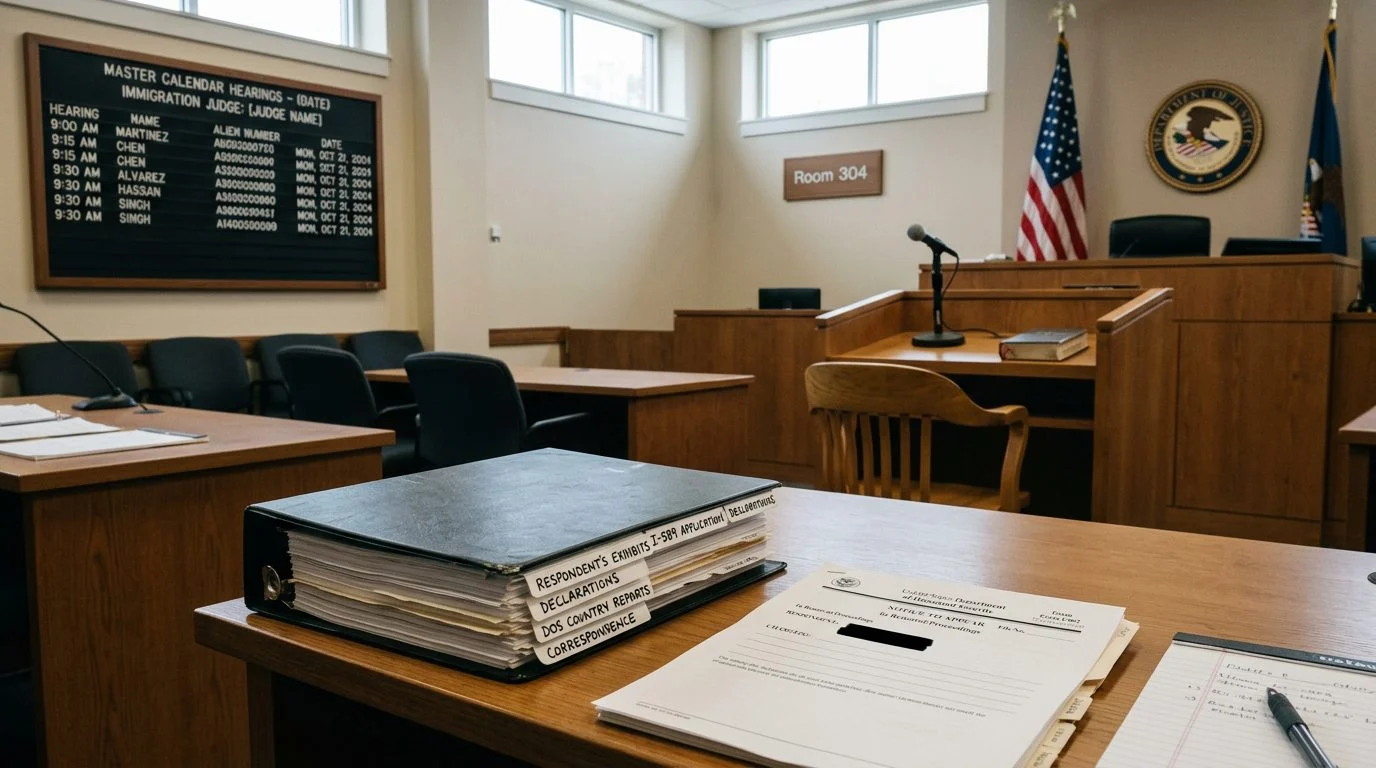
- Master calendar hearings. The judge asks you to admit or deny the factual allegations and your removability, under 8 CFR 1240.10. The judge also sets deadlines and the individual hearing date.
- Individual hearing. Testimony, witnesses, and closing arguments happen at this stage.
- Decision and appeal. A Notice of Appeal (Form EOIR-26) is generally due within 10 calendar days of the decision. In certain asylum cases, the deadline is 30 calendar days, under 8 CFR 1003.38. Any issue left out of the notice is waived.
Preparing Before the Next Hearing: Filings, Continuances, and the File
Preparation before your next hearing centers on consistent filings, a complete record, and clear dates. Judges look closely at consistency. In immigration court, a judge may weigh whether your written and spoken statements match when deciding whether your testimony is credible. The judge may also weigh small inaccuracies. So review every prior form before you testify.
A continuance is a request to move a hearing. A judge may grant one for good cause, under 8 CFR 1003.29. That rule also says a continuance generally cannot push an asylum decision past 180 days without exceptional circumstances.
Gather these items before your first meeting:
- The Notice to Appear and every hearing notice
- Your passport or travel documents
- Prior immigration applications and receipts
- Police, medical, or court records
- Any foreign-language documents, with translations ready
Why Clients Work With AG Immigration Law P.A.
AG Immigration Law P.A. focuses its practice on immigration matters. That work includes removal defense, adjustment of status, family petitions, naturalization, removal of conditions on green cards, waivers, and BIA appeals. Adriana Gomez is the responsible lawyer for this page. The firm’s support staff help with scheduling, document organization, and filing logistics.
Our approach starts with an intake and a document review. We then explain each hearing date and deadline in plain terms. You will know what comes next and what we need from you. Each step builds on the record, so the early work matters.
Not sure what your next step is?
Talk it through with our team — we can walk you through how a situation like yours is usually handled and what your options are.
Serving Immigrant Clients Across the United States
Clients across the United States can contact AG Immigration Law P.A. about removal defense and asylum cases. You can reach the firm through the online contact form, by phone, or by WhatsApp message. Tell the team which court date is coming up and whether you have received a removal order. That helps the team set the right first steps.
Fees and How to Start: The Paid Consultation
The firm offers paid consultations, and the fee is stated before you book. During the consultation, the team reviews your Notice to Appear, your timeline, the asylum filing question, and your next hearing date.
Beyond the consultation fee, you may owe filing fees and other case costs, such as translation costs. The total cost of representation depends on the facts of your case.
Frequently Asked Questions
Can I apply for asylum if I’m already in removal proceedings?
Yes. You can raise asylum as a defense before the immigration judge, subject to the one-year filing rule and its exceptions.
Exceptions can apply.
Will I have to testify?
Asylum hearings usually include your testimony. Preparing you to testify is part of our work.
How long do I have to appeal a denial?
Generally, you have 10 calendar days from the judge’s decision. For certain asylum decisions, the deadline is 30 calendar days.
Is the first meeting paid?
Yes. The firm offers paid consultations, and the fee is stated before you book.
Can a lawyer promise the outcome?
No lawyer can promise or predict an asylum result. A consultation reviews your facts and your options.

Talk With Our Team About Your Case Before the Next Hearing
If a Notice to Appear has put you in immigration court and you are weighing an asylum claim, act before your next hearing date and any filing deadline pass. Reach out through the contact form to book a paid consultation with our team.
How We Can Help
Removal Defense
We represent clients in removal proceedings, preparing defenses and presenting them before the immigration court.
Status and Naturalization
Our work includes adjustment of status, naturalization and removal of conditions on green cards.
Family Petitions and Waivers
We prepare family-based petitions and waiver applications, organizing the evidence and documents each filing requires.
BIA Appeals
When a decision needs to be challenged, we handle appeals to the Board of Immigration Appeals.
Why Clients Work With Us
Focused Practice
Our practice focuses on immigration matters, with removal defense at the center of our work.
Careful Preparation
We build each filing and defense around the facts and documents in your file.
Supported by Our Staff
Our assistants and office staff help keep your case organized from intake through each step.
Reach Us Your Way
Contact us through our online form, by phone or by WhatsApp to start the conversation.
Act Early
Immigration deadlines can be strict, and early planning often makes a difference. If you have received a notice or are worried about your status, contact our office as soon as possible.