

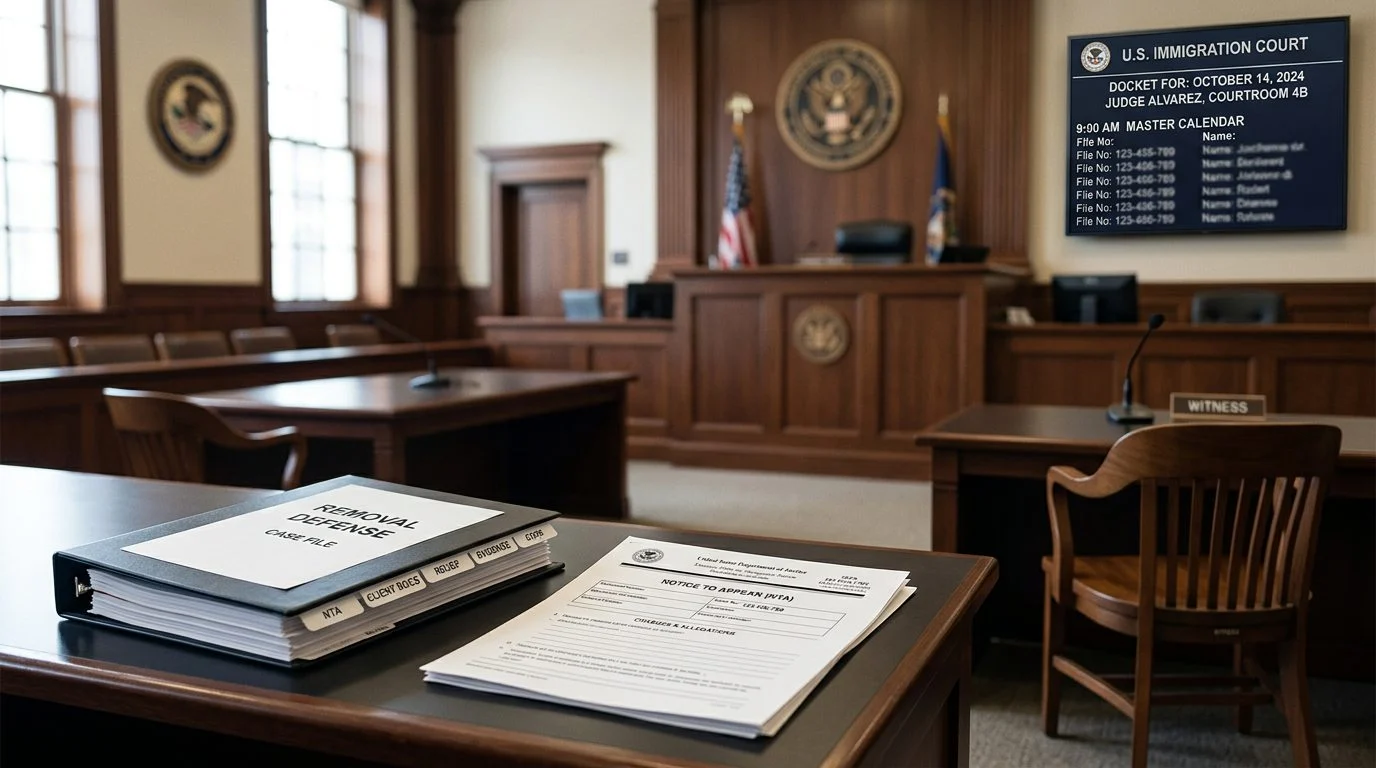
Removal Defense | Immigration Court
Facing Removal Proceedings? Understand Your Court Steps and Options
AG Immigration Law P.A. focuses on removal defense, representing noncitizens in immigration court from the first hearing through any appeal. Adriana Gomez is the responsible lawyer for this page.
By Adriana Gomez · Published October 26, 2026
Removal Defense New York: Court Steps and Options
Removal defense in New York means having a lawyer represent you when the government asks an immigration judge to order you removed from the United States. This page explains how a removal case moves through immigration court, which forms of relief may be raised, and what to do first. AG Immigration Law P.A. focuses on removal defense, and Adriana Gomez is the responsible lawyer for this page.
If a Notice to Appear or a detained family member has you facing hard deadlines, our team is ready to talk through your options with you. Talk it through with our team — we can walk you through how a situation like yours is usually handled and what your options are.

What Removal Defense Means in New York
Removal defense is legal representation for a noncitizen facing removal from the United States. Removal proceedings are immigration cases, not criminal cases. An immigration judge decides whether you may stay or must leave. You may be represented at the hearing by an attorney or another qualified representative (8 CFR 1240.3). Many people hear the word “deportation” and assume a criminal case. The process is civil, but the stakes are high. Our team focuses on removal defense, and this page explains how removal matters generally proceed.
How a Removal Case Moves Through Immigration Court
A removal case usually starts with a Notice to Appear, the written charging document. It must list the charges and the statutory provisions the government says were violated. It also gives you time to find a lawyer. The first hearing cannot be set earlier than 10 days after the notice is served, unless you ask for an earlier date in writing (8 U.S.C. § 1229). Read the notice closely and note every date on it.
Early hearings are usually master calendar hearings. The judge checks the charges, takes your responses, and sets deadlines for filing applications and the next hearing. The individual merits hearing comes later. There, you have a reasonable opportunity to examine the government’s evidence, present your own, and cross-examine its witnesses, but these rights do not entitle you to examine national security information the government offers in opposition to your admission or to an application for discretionary relief (8 U.S.C. § 1229a). Immigration courts sit within the Executive Office for Immigration Review (EOIR).
Missing a hearing is serious. The judge must order you removed in absentia if the government proves removability with clear, unequivocal, and convincing evidence and written notice of the time and place of proceedings and written notice of the consequences of failure to appear were provided to you or your counsel of record (8 CFR 1003.26). Keep every court date and keep your address current.
Common Reasons People Face Removal Proceedings
Removal proceedings often begin with an expired visa, an overstay, an entry without inspection, or a criminal conviction. Each path brings different charges, so the exact wording on your Notice to Appear matters. The government still has to prove its charges.
A criminal case can carry immigration consequences after it closes. Certain convictions after admission to the United States, such as crimes of domestic violence, stalking, or child abuse, child neglect, or child abandonment, can make a person deportable. The statute also directs the government to start removal proceedings as quickly as possible after a conviction that makes a person deportable (8 U.S.C. § 1229). Consequences turn on the exact charge and the full record, so bring every court paper to your lawyer.
Keep copies of every notice, letter, and court paper you receive. Those records help your lawyer see the full history from the start.
Defenses and Forms of Relief From Removal
Relief from removal is a request you make to the immigration judge to let you stay. Which request fits depends on the facts, including your entry history, time in the United States, family ties, criminal record, and country of origin. Common requests include asylum, cancellation of removal, and voluntary departure.
Asylum has a filing deadline. An asylum applicant generally must show by clear and convincing evidence that the application was filed within one year after arrival in the United States, subject to the statute’s exceptions (8 U.S.C. § 1158). At the conclusion of removal proceedings, an immigration judge may grant voluntary departure only if the judge finds that you have established by clear and convincing evidence that you have the means to depart the United States and intend to do so (8 U.S.C. § 1229c).
You carry the burden. You must show you are eligible for the relief you request and that it should be granted as a matter of discretion (8 CFR 1240.8). That evidence must be provided unless you show that you do not have it and cannot reasonably obtain it. Relief is requested through written applications and evidence filed before the judge. Our team prepares that record for the hearing.
Is It Hard to Win Cancellation of Removal?
Cancellation of removal is demanding because the statute sets specific tests, and each one must be met with evidence. This section explains those tests so you can see what a case must prove.
The statute sets time requirements for each category. Continuous physical presence generally ends when you are served a Notice to Appear, with exceptions for certain applications. Committing certain criminal offenses can also end that period, depending on how immigration law classifies the offense. Good moral character is also part of the test (8 U.S.C. § 1229b).
For nonpermanent residents, hardship to a qualifying relative is part of the analysis. For cases under section 240A(b)(2) of the Act, extreme hardship is determined as set forth in 8 CFR 1240.58 (8 CFR 1240.20). The application is submitted on Form EOIR-42 to the immigration court, with the filing fee or a request for a fee waiver (8 CFR 1240.20). Because each element needs proof, the evidence work starts early.
Not sure what your next step is?
Talk it through with our team — we can walk you through how a situation like yours is usually handled and what your options are.
Detention, ICE Custody, and Claims of U.S. Citizenship
If a family member is detained, find out where they are held and contact a lawyer quickly. ICE’s Online Detainee Locator System is the official tool for locating people in ICE detention.
Detention is governed by statute. Under 8 U.S.C. § 1226(c)(4), the Attorney General may release a person described in § 1226(c)(1) only if the Attorney General decides, under section 3521 of title 18, that release from custody is necessary to protect a witness, a potential witness, a person cooperating with an investigation into major criminal activity, or an immediate family member or close associate of one of them, and the person satisfies the Attorney General that he or she will not pose a danger to the safety of other persons or of property and is likely to appear for any scheduled proceeding. It may not provide work authorization unless the person is lawfully admitted for permanent residence or otherwise would, without regard to removal proceedings, be provided such authorization (8 U.S.C. § 1226). The statute also says no court may set aside an Attorney General action or decision under that section regarding the detention of any alien or the revocation or denial of bond or parole. That limit is one reason early legal advice matters.
If someone says they are a U.S. citizen, they should say so clearly. Gather documents such as a birth certificate or passport, and give copies to your lawyer right away. Family members should also write down the detainee’s full name, country of birth, alien registration number if known, and the facility name. Keep copies of every notice received.
Appeals to the Board of Immigration Appeals
An immigration judge’s decision can be appealed to the Board of Immigration Appeals (BIA). The filing deadline is strict. It runs from the oral decision, or from mailing or electronic notice of a written decision (8 CFR 1003.38). If the last day falls on a weekend or legal holiday, it moves to the next business day.
The appeal starts with a Notice of Appeal on Form EOIR-26. Any issue not raised in the notice is deemed waived, so every issue must be named there. A lawyer who represents you before the Board enters an appearance on Form EOIR-27.
Read the decision and the hearing record promptly. BIA appeals are one of the practice areas our team focuses on. A waiver may also be part of the same case plan, so review the full record with your lawyer.

Talk to Our Team About Your Removal Case
If you hold a Notice to Appear, a hearing date, or a removal order that may need a BIA appeal, each date and deadline matters now. Court backlogs also matter for planning. TRAC, from Syracuse University, publishes immigration court backlog data by court, including New York City (TRAC Immigration Court Backlog Tool).
What is removal defense?
Removal defense is representing a noncitizen in removal proceedings before an immigration judge. It covers the hearings, the filings, and any appeal.
Is a Notice to Appear the same as a removal order?
No. A Notice to Appear starts the case and lists the charges. A removal order is the judge’s decision that orders removal.
Can an immigration judge’s decision be appealed?
Yes, decisions of immigration judges can be appealed to the Board of Immigration Appeals. The deadlines are strict, so act quickly.
Contact our office through the contact form, call the office, or message us on WhatsApp about your Notice to Appear or detained family member. Consultations are paid, and the fee is confirmed when you book.
How a Removal Case Typically Moves Forward
The Notice to Appear
A removal case usually begins when the government serves a Notice to Appear, which lists the charges against the noncitizen. Reviewing the charges early shapes every decision that follows.
Master Calendar Hearing
The first court date is typically a master calendar hearing. The judge confirms identity, addresses representation, and sets the schedule for filings and any applications for relief.
Individual Hearing
If the case is contested, the judge may hold an individual hearing to receive evidence and testimony before deciding the case.
Appeals to the BIA
If the immigration judge issues a decision you disagree with, an appeal to the Board of Immigration Appeals may be available. We can review the record and explain the options.
Do Not Ignore Court Notices
Missing a hearing can lead to serious consequences, including an order entered in absentia. If you receive a Notice to Appear or any court notice, contact our office promptly so we can review it with you.
Working With AG Immigration Law P.A.
Careful Review of Your Papers
We review your charging document, court notices, and prior filings so you understand where your case stands.
Clear Communication
We explain each court step in plain language and keep you informed about what comes next.
Supported by Our Staff
Our assistants and office staff help keep your documents organized and your hearing dates on track.
Multiple Ways to Reach Us
Reach out by contact form, phone call, or WhatsApp message to start a conversation about your case.