

Immigration Court Preparation | AG Immigration Law P.A.
Know What to Bring to Your Immigration Court Hearing
A practical guide to organizing your papers before your hearing. Adriana Gomez, responsible lawyer, and our team focus on removal defense and related immigration matters.
By Adriana Gomez · Published October 26, 2026
Here is the short answer to what documents to bring to immigration court hearing: photo identification, the Notice to Appear, every hearing notice, and your immigration records, arranged by date.
Getting a court notice can feel sudden. This guide walks through each category and explains why it matters.
For a broader view of how these cases work, see our removal defense overview.
What Happens at Your First Immigration Court Hearing
The first court date is usually a master calendar hearing. It confirms the basics and sets the next steps. The judge places the respondent under oath at the start (8 CFR 1240.10).
The judge then asks the respondent to plead to the Notice to Appear. The respondent states whether the factual allegations and removability are admitted or denied (8 CFR 1240.10).
A removal case starts when the Notice to Appear is filed with the immigration court (8 CFR 1239.1). That is why the notice is the first paper to bring.
The main evidence usually comes later, at the individual hearing. The first date is about keeping the case on track. Bring papers that show who you are and where your case stands.
Missing the court date can have serious results. A judge shall order removal in absentia when the government establishes by clear, unequivocal, and convincing evidence that the person is removable and that written notice of the time and place and of the consequences of failure to appear was provided (8 CFR 1003.26). An Immigration Judge shall order a person removed in absentia when the government establishes by clear, unequivocal, and convincing evidence that the person is removable and that written notice of the time and place of proceedings and of the consequences of failure to appear was provided to the person or to counsel of record (8 CFR 1003.26). Written notice sent to the most recent address the person provided is considered sufficient, and if the person did not provide an address as required, no written notice is required for the judge to proceed.
If a Notice to Appear just arrived and your court date is close, we can help you sort out your papers so you don't have to face it alone. Talk it through with our team — we can walk you through how a situation like yours is usually handled and what your options are.

Identity and Core Case Papers to Bring
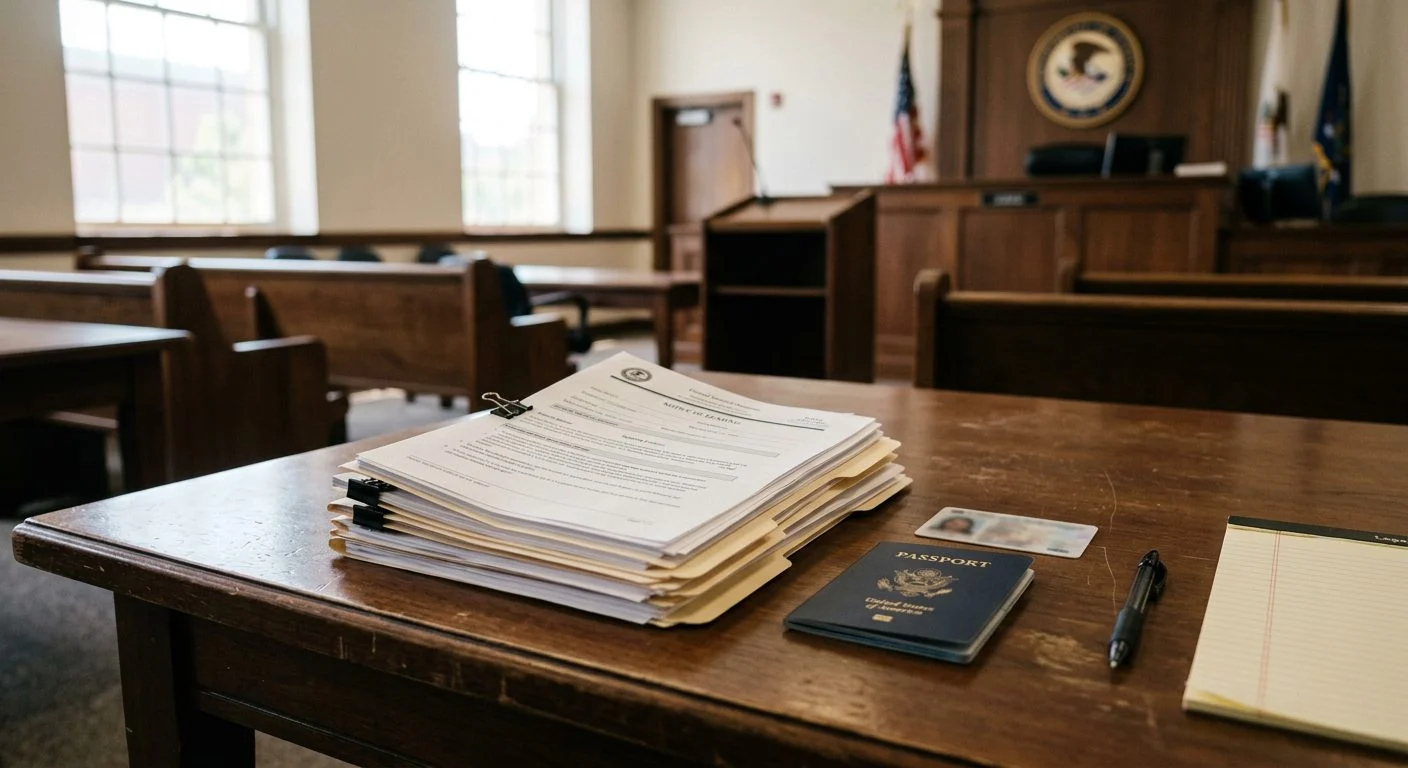
Your first stack should hold the papers that identify you and show the court date. Bring a government-issued photo ID and your passport if you have one.
Bring the Notice to Appear and every hearing notice you received. These show the court address, date, and time. Double-check them before the day.
Write your alien registration number (A-number) on a card or cover sheet. You’ll be able to read it quickly at the window. Bring copies of earlier immigration notices that show the same number.
If a lawyer has already filed a Form EOIR-28, bring that lawyer’s name and contact details. A respondent may be represented at the hearing by an attorney or other qualified representative (8 CFR 1240.3).
Originals matter. The court or the other side can ask to review the original of any filed document (8 CFR 1003.31). Bring originals and keep copies at home. Don’t hand over your only copy.
Immigration History Records
Your history papers show the court how you entered and what you filed before. The judge and your representative need a clear timeline. Bring documents that show each entry, each filing, and each prior decision.
Start with entry and travel records. Passports with admission stamps, Form I-94 records, and visas all belong in this group.
Next, gather prior applications and their receipts. These include petitions, adjustment applications, and work permit applications. Bring the receipt notices and approval notices too. A missing receipt can slow the file, so look for it early.
If you already have an earlier court order, a removal order, or a hearing transcript, bring it. These records can change what the court needs to see next.
Arrange everything in date order. Put the oldest entry first and the newest notice last. A short timeline on top helps the judge and your representative follow the story quickly.
Evidence to Bring or Have Ready for Later Filing
Evidence is any document or statement that supports your identity, your eligibility for relief, or key facts in your case. The judge may receive any oral or written statement that is material and relevant to any issue in the case, if previously made by the respondent or any other person during any investigation, examination, hearing, or trial (8 CFR 1240.7).
Evidence usually enters the record through filing, not by showing up with it. Those who choose to do so must register with EOIR and must then file all documents electronically for that case unless an immigration judge, on their motion showing good cause, lets them opt out (8 CFR 1003.31). If a document is not filed within the time the judge sets, the chance to file it is deemed waived (8 CFR 1003.31). Filing dates matter as much as the court date.
Foreign-language documents need extra work. Foreign-language documents must come with an English translation under 8 CFR 1003.33, and 8 CFR 1003.31 covers the filing of all documents, including motions and applications, before the immigration courts. The translator must sign a certification that says the translator is competent and that the translation is true and accurate to the best of the translator’s abilities (8 CFR 1003.33). Keep the original and the translation together.
Paper filings have a service rule. The filing party must serve a copy on the other side and include a certificate of service. The judge will not consider documents without one, unless service is made on the record during a hearing (8 CFR 1003.32).
Which records matter most depends on the facts. Family ties, work history, tax, medical, and community records may matter, depending on the relief at issue. Review them with a lawyer before anything is filed.
Organizing Your Folder Before the Court Date
A single folder with labeled tabs keeps your papers easy to find. Use tabs for identity, court papers, immigration history, relief filings, translations, and supporting records.
Make two sets of copies of key documents. Keep a digital backup on a phone or drive, and save scans with clear file names.
Write a one-page timeline with entries, filings, notices, and their dates. Include the date of your Notice to Appear and every hearing notice.
List any missing items, such as an old receipt notice or a foreign birth certificate. Request them early, since they can take time to arrive.
Keep every page of each document. Don’t write on, staple over, or alter originals. If you need to mark something up, mark a copy.
If you plan to present written material, use 8½ by 11 inch pages, unless the immigration judge permits otherwise. The judge may require exhibits to be indexed, paginated, and listed in a table of contents (8 CFR 1003.32).
Check the hearing notice for the court address, date, and time. Plan to arrive early.
Frequently Asked Questions About Bringing Documents to Immigration Court
Can a family member bring papers for me?
A relative can help gather and carry papers. At the hearing, the respondent may be represented by an attorney or other qualified representative (8 CFR 1240.3).
What if a document is in Spanish?
Bring the original with an English translation. The translator’s signed certification must state that the translator is competent to translate the document, and that the translation is true and accurate to the best of the translator’s abilities (8 CFR 1003.33).
What if a document has not arrived yet?
Bring what you have and tell the court or your representative which items are pending. The judge may grant a continuance for good cause shown (8 CFR 1003.29).
Can I bring a copy instead of the original?
Copies work for filing. Originals must still be available for review when someone asks (8 CFR 1003.31).
Not sure what your next step is?
Talk it through with our team — we can walk you through how a situation like yours is usually handled and what your options are.

Talk Through Your Own Papers With Our Office
If a Notice to Appear has arrived, your court date may be close, and sorting papers can feel overwhelming. You may be gathering records for someone you love while trying to understand what the court will ask. It gives general information, and your own facts shape what you need. You can reach our office through the contact form, by phone, or on WhatsApp. You can also book a paid consultation to review your papers in detail.
Why Preparation Matters
Organized Records
Clearly sorted papers help you and your legal team find what is needed quickly during the hearing.
Complete Copies
Bring originals together with copies so that every document can be reviewed and shared as needed.
Time to Review
Reviewing your file ahead of the hearing gives you time to ask questions and resolve gaps.
Clear Communication
Sharing your full history with your lawyer early helps shape how your documents are used.
Do Not Sign What You Do Not Understand
Before signing any form or statement at or around your hearing, ask your lawyer to explain it. Keep copies of everything you sign.
Common Categories of Documents
Identity Papers
Passports, birth certificates, national identity cards and any prior immigration-related identification you hold.
Government Notices
Any notices you have received from immigration authorities, including hearing notices and prior filings.
Supporting Evidence
Records that relate to your case history, such as family, employment, residence or other documents your lawyer identifies.
Translations
Foreign-language documents with certified English translations prepared as your lawyer directs.