

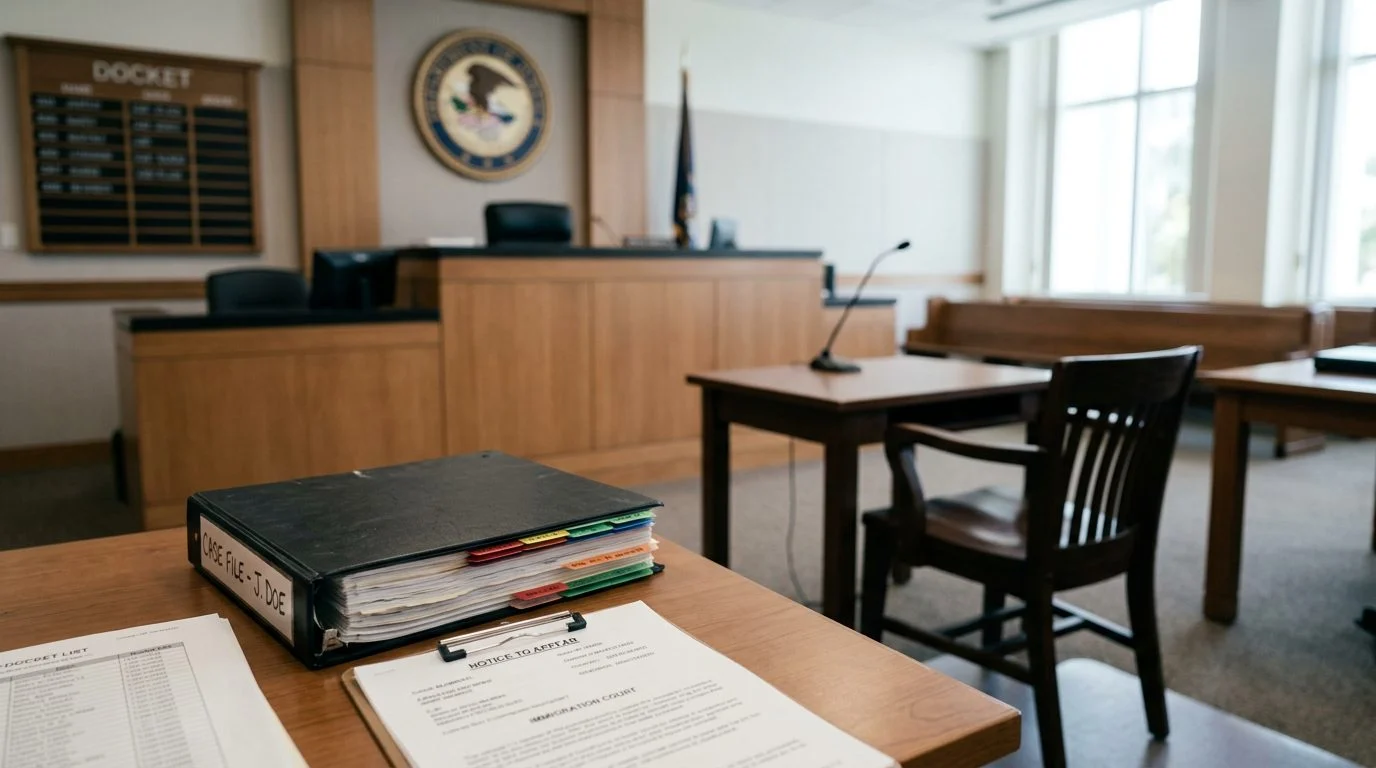
Removal Defense | Florida
Motion to Terminate Immigration Court Case in Florida
If your case is in removal proceedings, a motion to terminate may be an option to examine. AG Immigration Law P.A. Contact our office to discuss your record and your options.
By Adriana Gomez · Published October 30, 2026
Can You File a Motion to Terminate Immigration Court Case in Florida?
Yes, a person in removal proceedings can ask the immigration judge to end the case. Whether that request fits turns on the facts of the case.
A motion to terminate is a written request. It asks the court to end removal proceedings instead of deciding the case on the merits. Pre-decision motions must be in writing. They must state the grounds in detail, the relief sought, and the jurisdiction (8 CFR 1003.23(a)). 8 C.F.R. § 1003.23 reads: “Unless otherwise permitted by the immigration judge, motions submitted prior to the final order of an immigration judge shall be in writing and shall state, with particularity the grounds therefor, the relief sought, and the jurisdiction.”
Termination is not the same as a removal order. A removal order directs removal. The judge’s order may also direct the termination of proceedings or another disposition (8 CFR 1240.12).
If you already have a removal order, read the removal order section below. For the wider process, see our removal defense overview.
If a notice to appear or a hearing date has left you or your family worried, our team can talk through the facts of your case with you. Talk it through with our team — we can walk you through how a situation like yours is usually handled and what your options are.

When Can an Immigration Judge Terminate Removal Proceedings?
An immigration judge can end proceedings when the record shows a legal ground to do so. The first place to look is the charging paperwork.
Removal proceedings under section 240 of the Act start when a notice to appear is filed with the immigration court (8 CFR 1239.1(a)). That notice is the charging document. It must show that the other side was served. It must also identify the court where it was filed (8 CFR 1003.14(a)). Jurisdiction starts when that filing happens, though no charging document is required to be filed with the Immigration Court to commence bond proceedings (8 CFR 1003.14).
So one key question is simple. Was the charging document filed with the right court, and does it include a certificate of service? Those details sit in your file, and a reviewer checks them there.
The government also has to prove its case. In a deportability case, DHS must prove removability by clear and convincing evidence (8 CFR 1240.8(a)).
Other grounds may apply, including a charge that does not fit the facts. Any motion should point to specific facts in the record. It should also tie those facts to the legal ground you raise.
How DHS Agreement, Joint Motions and Pending Applications Fit In
A motion to terminate can be filed by the respondent alone. It can also be a joint motion, which both sides sign.
A joint motion means DHS agrees to ask the court to end the case. The respondent does not control DHS’s position. Agreement is never certain, so plan for the chance that DHS opposes the request.
A pending application can change how the case is viewed. An adjustment of status request or a family petition may be part of the picture. How it fits depends on the stage of each filing and on the court’s handling of the case.
If you ask for any benefit, you carry the burden. You must show you are eligible and that the benefit should be granted in the court’s discretion (8 CFR 1240.8(d)).
How Termination Differs From Administrative Closure and Dismissal
Termination ends the proceedings. Administrative closure takes a case off the active calendar without a final decision.
Administrative closure pauses a case. It does not decide the case. Termination is different, because the judge’s order ends the proceedings (8 CFR 1240.12).
Dismissal is another term people use. Online forums often mix these words together. Read the exact wording of any order you receive, because the wording shapes what happens next.
The motion itself also matters. It must state the relief you seek (8 CFR 1003.23(a)). Ask for the exact outcome you need, and say why the record supports it.
What Changes If a Removal Order Already Exists?
Appeals and reopening motions take over.
An appeal lies from an immigration judge’s decision to the Board of Immigration Appeals. No appeal lies from an order of removal entered in absentia (8 CFR 1240.15). Failure to state the reasons for the appeal in the Notice of Appeal may constitute a ground for dismissal of the appeal by the Board.
Motions to reopen and reconsider have their own clocks. A motion to reopen generally must be filed within 90 days of the date of entry of a final administrative order of removal, subject to exceptions in the rule (8 CFR 1003.23). A motion to reopen before the Board must state new facts and include supporting evidence (8 CFR 1003.2).
The exception is cases involving in absentia orders (8 CFR 1003.23). 8 C.F.R. § 1003.23 reads: “Except in cases involving in absentia orders, the filing of a motion to reopen or a motion to reconsider shall not stay the execution of any decision made in the case.”
How Filing Works in Florida Immigration Courts
Before the immigration courts, eligible cases use EOIR’s online filing platform: DHS and attorneys of record must submit documents electronically, while other parties may choose to do so but are not required to. Paper filings need a certificate of service.
Florida removal cases are heard in immigration courts, including courts in Miami and Orlando. DHS and attorneys of record must file electronically in cases eligible for electronic filing (8 CFR 1003.31).
Service of filings with the immigration courts depends on whether the documents are filed through EOIR’s electronic filing application or in paper; rules for serving paper filings on the other side, including the certificate of service, are in 8 CFR 1003.32. The judge will not consider a document without one, unless service is made on the record during a hearing (8 CFR 1003.32). Unless the immigration judge permits otherwise, documents must also be on 8½ by 11 inch pages, whether filed electronically or in paper. 8 C.F.R. § 1003.32 reads: “Unless otherwise permitted by the immigration judge, all written material presented to immigration judges including offers of evidence, correspondence, briefs, memoranda, or other documents must be submitted on 8 1/2″ x 11″ size pages, whether filed electronically or in paper.”
Deadlines matter. A document not filed within the time the judge sets is deemed waived (8 CFR 1003.31).
Federal appeals from Florida cases follow a regional pattern. For a state overview, see our Florida removal defense page.
Not sure what your next step is?
Talk it through with our team — we can walk you through how a situation like yours is usually handled and what your options are.

Common Mistakes and Your Next Step
The biggest mistakes are missing a hearing, missing an appeal deadline, and filing without proof. Each one can narrow the options that remain.
A missed hearing can be serious.
Another mistake is assuming a pending motion stops enforcement. In most cases, it does not: under 8 CFR 1003.23, filing a motion to reopen or a motion to reconsider does not stay execution of the decision, except in cases involving in absentia orders.
If a relative may be in ICE custody, the ICE Online Detainee Locator System is the official tool for locating people held in ICE detention.
Consultations are paid, and the fee is confirmed before any service begins. If a notice or hearing date has you or your family worried, reach out through our contact form, by phone, or on WhatsApp. We can talk through the facts of your case.
Frequently Asked Questions
Can an immigration judge end my case without a removal order?
Yes, the judge’s order may direct the termination of proceedings instead of removal. Whether that applies turns on the record in your case.
Does filing a motion to reopen stop deportation?
In most cases, no. A motion to reopen or reconsider does not stay the decision, except in cases involving in absentia orders.
How We Approach Your Case
Careful Review of Your Record
We begin with the charging documents, prior filings and the status of your proceedings so that any motion is grounded in the facts of your own case.
Support From Our Team
Our team of assistants and office staff helps keep your documents organized and your communication with the office clear from start to finish.
Clear Communication
You can reach us by phone, through our contact form or by WhatsApp, and we explain each step in terms you can follow.
Every Case Turns on Its Own Record
Whether a motion to terminate fits your situation depends on the specific facts and procedural history of your case. Reading general information is not a substitute for advice on your file. Do not assume a motion will apply to you without a review of your documents.
What the Process Can Involve
Reviewing Your Court Record
We examine your notices, filings and hearing history to understand where your case stands in the immigration court system.
Identifying the Legal Grounds
We analyze the issues raised in your proceedings and evaluate whether a motion to terminate is appropriate for your circumstances.
Preparing the Filing
When a motion is appropriate, we prepare the supporting arguments and documents with attention to the details the court will review.
Preparing for Hearings
We help you understand what to expect at each stage so you are informed as your case moves forward.