

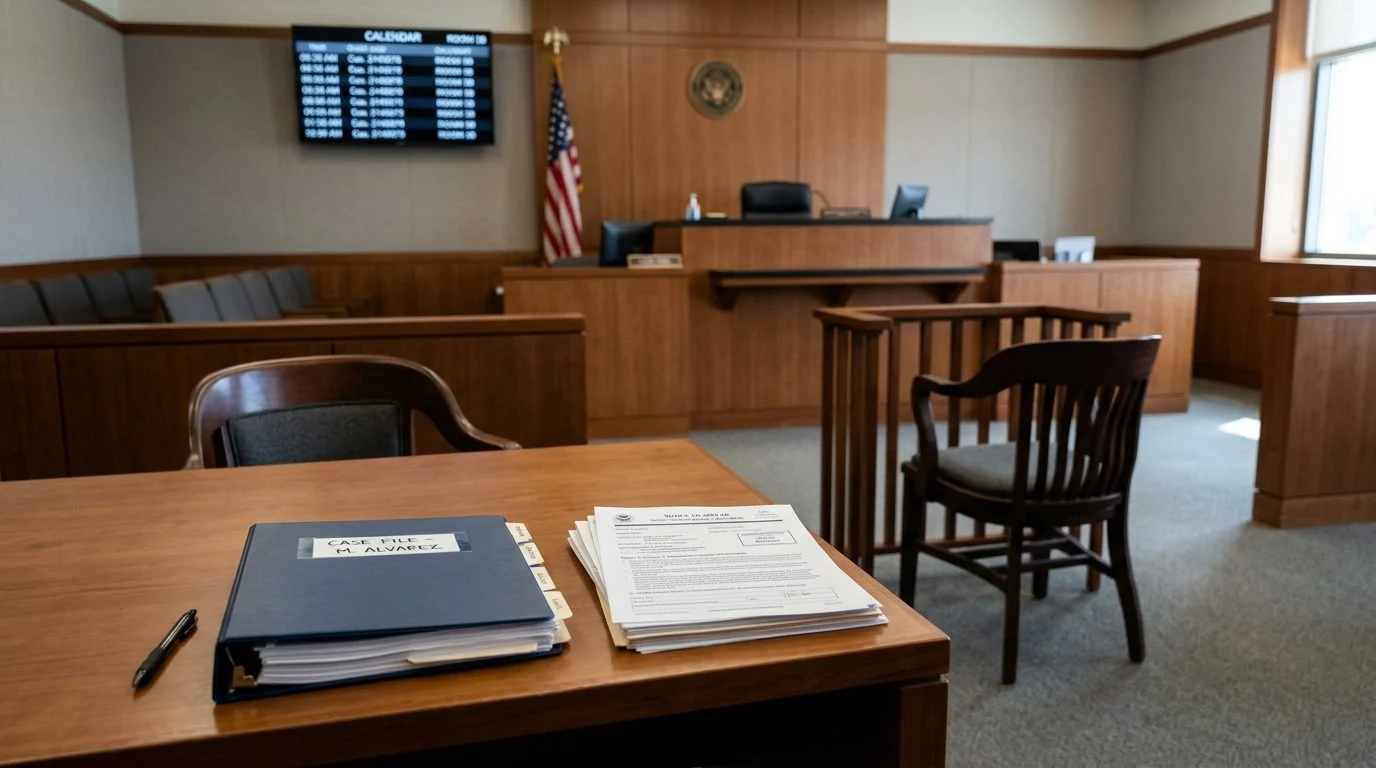
Removal Defense | Immigration Court
Individual Hearing in Immigration Court: What to Expect
A clear, step-by-step guide to what happens at your individual hearing, what the judge may decide, and how to prepare with the team at AG Immigration Law P.A.
By Adriana Gomez · Published October 27, 2026
An individual hearing is the immigration court session where a judge decides the issues still in dispute in a case. It usually comes after a shorter master calendar hearing. At the individual hearing, the judge can hear testimony, review documents, and decide whether the person is removable and whether any relief requested should be granted.
If you want to know what to expect at an individual hearing in immigration court, this guide walks through the day step by step. It also explains how the hearing differs from the master calendar hearing and how hearing dates get checked and changed. The rules cited here are federal rules that apply across the country.
What Is an Individual Hearing in Immigration Court?
An individual hearing is the session where the judge decides the contested issues in one case. Contested issues can include whether the person is removable and whether they qualify for any relief they have asked the court to grant.
Most individual hearings are set after the person has told the court they plan to contest removal or ask for relief. The date appears on the notice of hearing. That notice shows the date, the time, and the court address. Read it as soon as you receive it, and put the date on a calendar you check often. Missing a hearing can have serious results, as explained below.
Getting a hearing notice can be stressful, especially when it's a relative's case you're trying to understand. If you have one in hand, our team can talk through what comes next. Talk it through with our team — we can walk you through how a situation like yours is usually handled and what your options are.

What Is a Master Calendar Hearing?
A master calendar hearing is a shorter court session where the judge handles the basic steps and the schedule. It is not usually where the main evidence is presented.
At this hearing, the judge asks the respondent to plead to the Notice to Appear. The respondent states whether they admit or deny the factual allegations and removability. The immigration judge’s opening duties in a removal hearing include placing the respondent under oath, as described in 8 CFR 1240.10.
If the respondent admits everything and the judge sees no issues of law or fact left, the judge may find removability established, except that the judge shall not accept an admission of removability from an unrepresented respondent who is incompetent or under the age of 18 and is not accompanied by an attorney or legal representative, a near relative, legal guardian, or friend; nor from an officer of an institution in which the respondent is an inmate or patient. If not, the judge directs a hearing on the issues. That hearing is the individual hearing.
Many cases share the same session, so the judge often moves through several cases in one sitting. At this stage, the respondent may tell the judge they intend to seek relief. That statement often leads to an individual hearing being scheduled.
How Does an Individual Hearing Differ From a Master Calendar Hearing?
The master calendar sets the path forward, and the individual hearing decides the disputed issues on the evidence. That is the main difference.
The two hearings also differ in length and format. A master calendar hearing is brief and shared with other cases. An individual hearing is a dedicated session for one case, so the judge has time to hear testimony and review documents.
Evidence is the other big difference. Witness testimony and documents are usually presented at the individual hearing, not at the master calendar. The respondent testifies under oath, and the other side can question them.
The results also differ. A master calendar hearing usually ends with a next date or the scheduling of an individual hearing. An individual hearing ends with the judge’s decision. The decision can be given orally at the hearing or in writing later. Under 8 CFR 1240.12, the decision of the immigration judge shall include a finding as to inadmissibility or deportability, and it shall also contain reasons for granting or denying the request.
What Happens Step by Step at an Individual Hearing?
At an individual hearing, the case moves from opening to decision, with each side taking its turn. Arrive early. Expect a security check and a sign-in before the courtroom.
Once the hearing starts, the judge confirms the language of the proceeding. If an interpreter is needed, the interpreter must be sworn to interpret and translate accurately, unless the interpreter is an employee of the United States Government, in which event no such oath shall be required, under 8 CFR 1240.5. The judge also reviews the pending applications and any issues still open.
Next, the respondent gives testimony under oath. Under 8 CFR 1240.7, testimony of witnesses at the hearing must be under oath or affirmation. Your lawyer can ask questions first. The government attorney can then cross-examine you. The judge may also ask questions.
Documents are offered and the judge decides whether to admit them. The hearing ends with the judge’s decision or a schedule for the next step. If more time is needed, the judge may grant an adjournment under 8 CFR 1240.6, but nothing in this section shall authorize an adjournment that causes the adjudication of an asylum application to exceed 180 days in the absence of exceptional circumstances.
How Do Testimony, Evidence, and Cross-Examination Work?
Your own testimony and your documents are the core of most individual hearings. The judge then decides what to believe.
The person seeking relief carries the burden. Under 8 CFR 1240.8, the respondent must show eligibility for the benefit and that it should be granted. If grounds for mandatory denial may apply, the respondent must prove by a preponderance of the evidence that they do not. In a deportability case, DHS must prove removability by clear and convincing evidence.
Because of this, listen to each full question, answer only what was asked, and ask for a repeat if you need one. Your answers should match your written filings. The evidence you need depends on the relief at issue and the facts of your case.
Can You Win in Immigration Court?
An individual hearing can end in a grant of relief, a denial, or a decision that is appealed. The result depends on the law and the record in your case, so general stories about outcomes can mislead.
If the decision goes against you, the appeal path runs to the Board of Immigration Appeals. Under 8 CFR 1240.15, an appeal lies from an immigration judge’s decision to the Board. No appeal lies from an order of removal entered in absentia.
The deadlines are short. Under 8 CFR 1003.38, the Notice of Appeal generally must be filed within 10 calendar days of the decision. In certain asylum cases described in the regulation, the period is 30 calendar days. The Notice of Appeal must come with the fee or a fee waiver request. Any issue not raised in the notice is deemed waived. For more on appeals, see the office’s BIA appeals page.
Not sure what your next step is?
Talk it through with our team — we can walk you through how a situation like yours is usually handled and what your options are.
How Do I Check My Immigration Hearing Date, and How Do I Postpone It?
Check the date, time, and court address on your hearing notice first. Keep your address current with the court.
If your address changes, you must notify the Immigration Court in writing within five days, as required by 8 CFR 1003.15(d)(2). Under 8 CFR 1003.15, within five days of any change of address, you must provide written notice of the change on Form EOIR-33 to the Immigration Court where the charging document has been filed. Notices sent to an old address can cause you to miss a hearing.
Postponing a hearing is possible but not automatic. The immigration judge may grant a motion for continuance for good cause shown, under 8 CFR 1003.29. The judge decides, so timing and stated reasons matter.
Missing a hearing carries serious risk. If you have missed a date or fear you will, act quickly.
How Should You Prepare for an Individual Hearing?
Preparation means knowing your filings, practicing your testimony, and arriving on time with your documents. Start early and do not rely on memory alone.
Build a simple checklist. Arrive early. Bring your identification and every document listed in your filings. Plan transportation and a backup route. Dress and act with respect for the court.
Review your filed application and any earlier written or spoken statements. The judge may receive any prior statement that is material and relevant. Your testimony must match those statements. Practice answering questions out loud. Practice the calm habit of pausing before you answer.
If your lawyer changes, plan the transition carefully. Notices go to the attorney or representative of record, under 8 CFR 1292.5. Where an examination is provided for in this chapter, a person has the right to be represented by an attorney or representative under 8 CFR 1292.5, but applicants for admission at primary or secondary inspection have that right only if they have become the focus of a criminal investigation and have been taken into custody. Ask about the timing of any new filing before the next hearing date.

Talk With Our Team About Your Hearing
If you have an individual hearing notice in hand, you may be asking hard questions. What will the government attorney ask? How should you answer? What if you need more time? Those questions are common when a case is contested and the date is close.
Family members often face this stress while helping someone else understand the process. Our office can help you think through the next steps for your own case, including removal defense and appeals. To talk with the office, use the contact form, call the office, send a WhatsApp message, or book a paid consultation with Adriana Gomez, who is responsible for this page. Consultations with the office are paid.
Frequently Asked Questions
What happens at an individual hearing?
The judge confirms the issues, hears testimony and reviews documents, then decides the contested matters or sets the next step.
Can the judge decide my case the same day?
The judge can decide orally at the hearing or issue a written decision later.
How long do I have to appeal?
The Notice of Appeal generally must be filed within 10 calendar days of the decision, with some exceptions.
Do I need an interpreter?
An interpreter must be sworn to translate accurately, so ask the court if you need one.
How We Support You Before and During Your Hearing
Case Review and Preparation
We review your file, identify the contested issues, and help you gather the documents and testimony the judge will need to see.
Support for Your Family
Our team focuses on family-based cases, adjustment of status, and related petitions, so we can address how each part of your case fits together.
Removal Defense Focus
Our practice centers on removal defense, and we work to protect your position at every stage of proceedings.
Clear Communication
We explain each step in plain language and keep you informed about what to expect, in English or Spanish.
Do Not Miss Your Hearing
Missing an immigration court hearing can have serious consequences, including an order entered in your absence. If you have a scheduling conflict, a change of address, or a question about your notice, contact our office right away.
Ways to Reach Our Office
Fill Out a Contact Form
Share a brief summary of your case and we will follow up to schedule next steps.
Call the Office
Speak with our staff about your hearing date, your case status, or how to get started.
Message Us on WhatsApp
Send a message with your questions and our team will respond through the office.
Book a Paid Consultation
Meet with the responsible lawyer to discuss your hearing, the issues in your case, and your options.
Prepare for Your Hearing With Guidance You Can Rely On
Related practice areas
- Removal Defense in Florida
- One Year Asylum Deadline Immigration Court Explained