


Removal Defense
Missed Your Immigration Court Date? Contact Our Office Right Away
AG Immigration Law P.A. focuses on removal defense and related immigration matters. Adriana Gomez and our team can review what happened and discuss your options.
By Adriana Gomez · Published October 25, 2026
If you miss your immigration court date, the judge can order you removed in absentia, meaning without you in the room. That order is not automatic. The government must prove you received proper notice and that you can be removed. This page explains what happens if I miss my immigration court date, which records matter, and which deadlines may still help.
What Happens When Someone Misses an Immigration Hearing?
Missing a hearing without permission is called failure to appear. The judge can then move forward without you, and that can lead to a removal order.
The main risk is an order entered in absentia. Under 8 U.S.C. § 1229a, a person who does not attend after written notice shall be ordered removed in absentia if the government proves notice and removability by clear, unequivocal, and convincing evidence.
A missed hearing can also hurt a pending application. Under 8 C.F.R. § 1208.10, missing a scheduled hearing without prior authorization may lead to dismissal of the application and an order of removal in absentia. 8 C.F.R. § 1208.10 reads: “Failure to comply with processing requirements for biometrics and other biographical information within the time allowed will result in dismissal of the application, unless the applicant demonstrates that such failure was the result of good cause.”
How this plays out depends on the facts of each case. Your notices, your reason for missing court, and what your file already shows all matter.
Our removal defense overview explains how we handle these cases, from the first notice to any motion that follows.
If a missed hearing has you worried, you don't have to sort it out alone; our team can talk it through with you by phone, WhatsApp, or the contact form. Talk it through with our team — we can walk you through how a situation like yours is usually handled and what your options are.
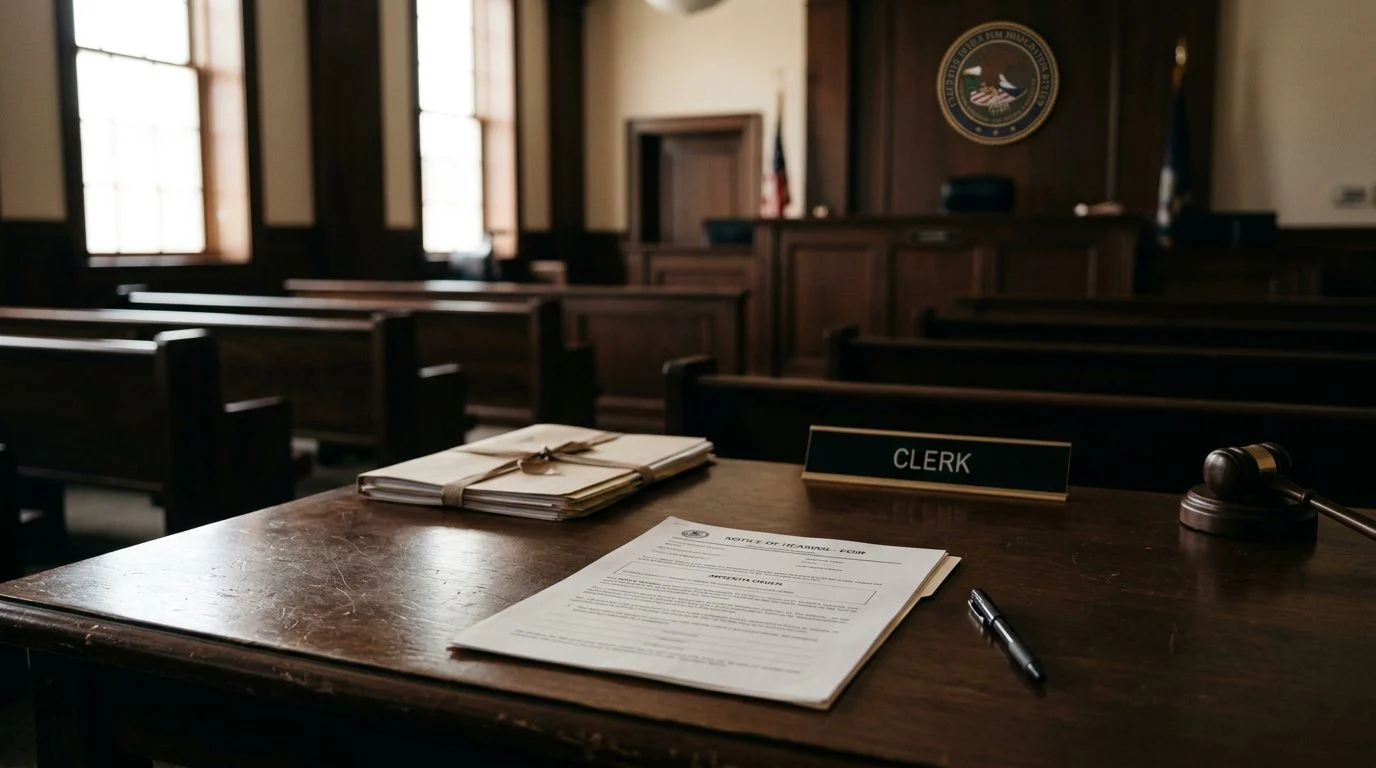
How an In Absentia Removal Order Is Entered
Under 8 U.S.C. § 1229a, an alien who does not attend a proceeding after written notice has been provided to the alien or the alien’s counsel of record shall be ordered removed in absentia if the Service establishes by clear, unequivocal, and convincing evidence that the written notice was so provided and that the alien is removable. Both must be shown by clear, unequivocal, and convincing evidence.
The judge must be satisfied that written notice of the hearing, and of the consequences of missing it, reached you or your lawyer of record, though no written notice is required if you have failed to provide the address the law requires. 8 C.F.R. § 1003.26 sets out these steps for removal proceedings.
Under 8 U.S.C. § 1229a(b)(7), someone removed in absentia after receiving oral notice of the hearing’s time, place and consequences shall not be eligible for certain relief for 10 years after the final order of removal, unless exceptional circumstances apply.
Enforcement is a real risk. Under a warrant issued by the Attorney General, immigration law allows arrest and detention of an alien while a removal decision is pending, under 8 U.S.C. § 1226. People already ordered removed fall under a separate statute, 8 U.S.C. § 1231. Treat any order as a serious step, and act quickly.
Notice, Address Records and Proof of Delivery
Hearing notices go to the address you last gave the court, so that address matters a great deal.
Under 8 C.F.R. § 1003.26, written notice is sufficient for an in absentia hearing if it was provided at your most recent address. Mail is enough when there is proof of attempted delivery to the last address you provided, under 8 U.S.C. § 1229.
You must keep your address current. The statute requires an immediate written record of any change. The regulation requires written notice of a change on Form EOIR-33 within five days, filed with the immigration court holding your case (8 C.F.R. § 1003.15). Don’t assume a move was recorded. File the change.
Check four things: when you received the notice, the address printed on it, the envelope, and any returned mail. Keep every piece of proof. A notice to appear is the first charging document that starts removal proceedings, so start there when you review the file.
Can an In Absentia Order Be Rescinded?
The deadline and the grounds depend on why you missed the hearing.
If you missed court because of exceptional circumstances, 8 C.F.R. § 1003.23 allows a motion to reopen within 180 days after the order. Under 8 U.S.C. § 1229a(e)(1), the term “exceptional circumstances” refers to circumstances such as battery or extreme cruelty to the alien or any child or parent of the alien, serious illness of the alien, or serious illness or death of the spouse, child, or parent of the alien, but not including less compelling circumstances.
A different path applies if you did not receive notice. The same regulation allows a motion at any time if you show lack of notice. It also allows one if you were in federal or state custody and missing court was through no fault of your own.
Two limits matter. A motion filed under this provision stays removal while the judge decides it. You may file only one motion under this provision.
Under 8 C.F.R. § 1003.23, an order entered in absentia may be rescinded upon a motion to reopen filed within 180 days after the date of the order of removal, if the failure to appear was because of exceptional circumstances. No particular result can be promised, because the judge weighs your evidence and reasons.
Evidence That Explains a Missed Hearing
Strong evidence is dated, official, and matches the day you missed court.
Records that may help include medical or hospital records from the hearing period, death certificates if a close family member died near that time, travel records, and proof of the address on file, such as mail or a lease. Keep every notice, envelope, and court document you already have.
Timing matters. Records from the days around the hearing are easier to tie to the reason you missed court. When your own testimony needs support, the immigration judge may determine that corroborating evidence should be provided, and such evidence must be provided unless you show that you do not have it and cannot reasonably obtain it.
Write down the key dates now: the hearing date, when you learned of it, when you moved, and when you filed any address change. A simple timeline helps. To confirm what the court recorded, see our guide on checking immigration court case status.
How Criminal Cases Can Trigger Immigration Court Problems
A criminal case can carry immigration consequences. A missed date in either court can cause problems in the other.
Under 8 U.S.C. § 1226(c)(1)(E), the Attorney General shall take into custody any alien who is inadmissible under paragraph (6)(A), (6)(C), or (7) of 8 U.S.C. § 1182(a) and who is charged with, is arrested for, is convicted of, admits having committed, or admits committing acts which constitute the essential elements of any burglary, theft, larceny, shoplifting, or assault of a law enforcement officer offense, or any crime that results in death or serious bodily injury to another person, when the alien is released, without regard to whether the alien is released on parole, supervised release, or probation. Release is permitted only under the narrow witness-protection conditions of § 1226(c)(4).
The two systems run on separate schedules, so check both. A missed criminal date is its own problem, separate from a missed immigration date.
If a family member is held in ICE custody, the ICE Online Detainee Locator System is the official tool for finding people in ICE detention. When a new date may be requested, our postponement guide explains the process.
Not sure what your next step is?
Talk it through with our team — we can walk you through how a situation like yours is usually handled and what your options are.

Take Control Before It’s Too Late
Gather your notices, confirm the address on file, and write down your dates first.
Many people learn about a missed hearing from a family member, or from a notice that arrives late. Facing that alone is hard, and it’s normal to feel rushed.
If you want to talk through what a missed date means for you, our team is here to help. You can call the office, message us on WhatsApp, or use the contact form to book a paid consultation. Consultations are paid, and the fee is stated when you book.
Frequently Asked Questions
Your case may also be affected if you have a pending application.
Can an in absentia order be reopened?
It can often be reopened by motion, but the deadline depends on the reason you missed court. Some motions must be filed within 180 days, and others can be filed at any time when notice was not received.
Does a notice to appear mean deportation?
In removal proceedings under section 1229a of this title, written notice, called a “notice to appear,” shall be given. It starts the case; it does not by itself end it.
What if I never got the notice?
A motion to reopen can be filed at any time if you show you did not receive notice, under 8 C.F.R. § 1003.23.
Responsible lawyer: Adriana Gomez, AG Immigration Law P.A.
How Our Team Can Help
Review Your Court Notices
We look at your hearing notices and case history to understand what happened and what steps may be available.
Removal Defense Strategy
We work to protect your position in removal proceedings and explain each option before you decide how to proceed.
Motions to Reopen
When a case has been ordered without your appearance, we evaluate whether a motion may be filed and what it would require.
Support for Your Family
We keep your family informed and help them understand how a missed hearing may affect your case.
Do Not Ignore a Missed Hearing
A missed immigration court date can lead to serious consequences. Do not wait to act. Gather your paperwork and contact our office as soon as possible so we can review your situation.
Steps to Take Now
1. Keep Every Notice
Gather all court notices, letters and receipts you have received, including any that were sent to your address.
2. Write Down What Happened
Note the date of the hearing, where you were, and the reason you could not attend. Details help us review your case.
3. Contact Our Office
Reach out by phone, contact form or WhatsApp so our team can begin reviewing your matter.
4. Book a Consultation
Schedule a paid consultation with Adriana Gomez to discuss your options in detail and plan your next steps.