


Immigration Law | Florida, Texas & New York
Pending Asylum and a Green Card: Understanding Your Options
AG Immigration Law P.A. focuses on removal defense, adjustment of status, family petitions, naturalization and BIA appeals. Talk with Adriana Gomez about how a pending asylum case fits into your path to permanent residence.
By Adriana Gomez · Published October 29, 2026
The Short Answer: Not Through the Asylum Application Alone
No. A pending asylum application does not, by itself, let you file for a green card. Several different routes may be available, depending on a person’s circumstances. Each route has its own rules and timing.
Many people hear “pending” and assume the case is already moving toward a green card. It is not. Waiting for an asylum decision is one step. Getting a green card is another. This page explains each route, how your entry history can change the answer, and who decides each part.
If a spouse or parent is waiting on an asylum decision, you don't have to sort out the green card question alone. Our team can review your documents with you. Talk it through with our team — we can walk you through how a situation like yours is usually handled and what your options are.
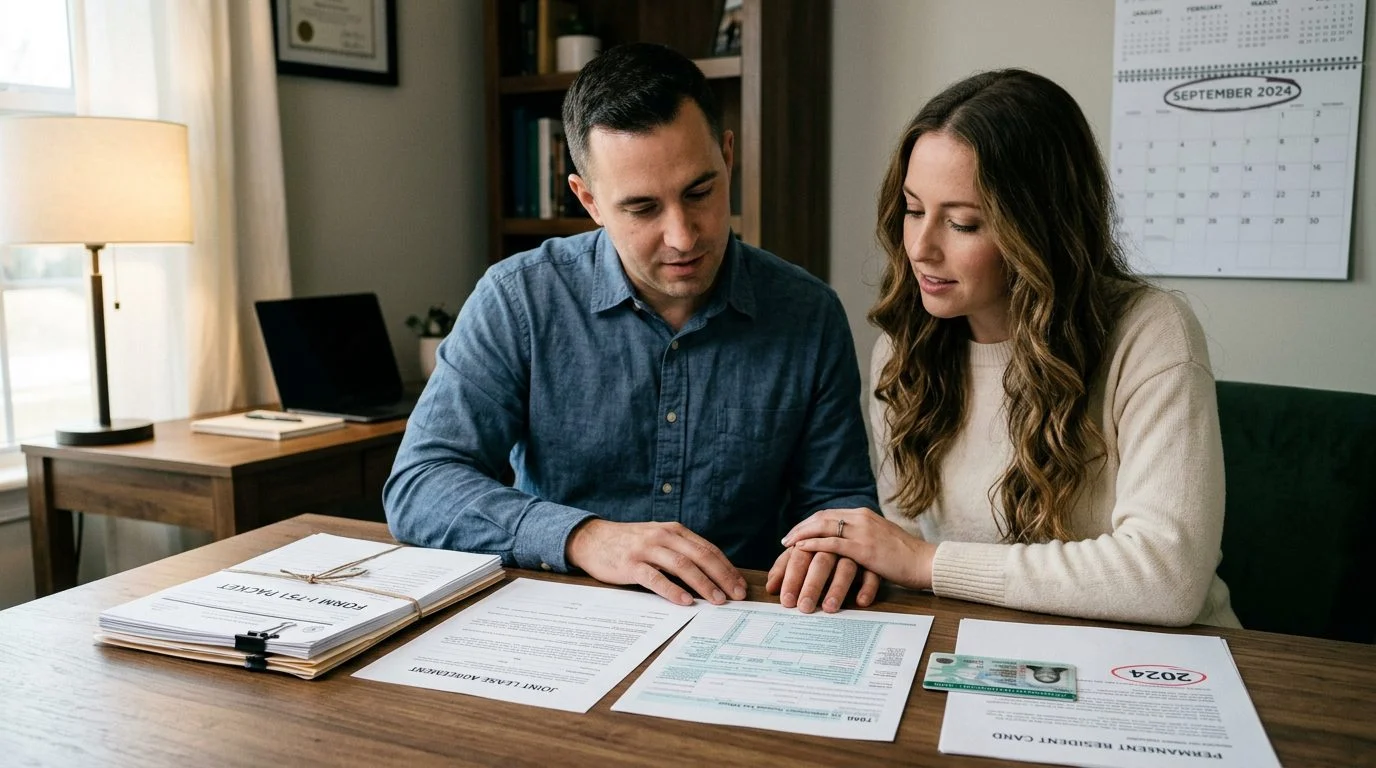
Why a Pending Asylum Application Is Not Legal Status
A pending asylum application means you are waiting for a decision. It is not a green card, and it is not a grant of asylum. Asylum granted under this section does not convey a right to remain permanently in the United States.
Asylum also cannot be granted until your identity is checked against the required records. Those records include the Automated Visa Lookout System. This check is part of the process, and it can take time.
Three stages often get mixed up: pending asylum, granted asylum, and lawful permanent residence. Check your papers. A receipt for your asylum application shows that it was filed. It does not show that it was granted. Your asylum approval notice, if you get one, is a different document from a green card.
Getting a Green Card After Asylum Is Granted: The One-Year Path
Under 8 U.S.C. § 1159, the Secretary of Homeland Security or the Attorney General may, in their discretion, adjust the status of a person granted asylum to that of an alien lawfully admitted for permanent residence if the person applies for such adjustment, has been physically present in the United States for at least one year after being granted asylum, continues to be a refugee within the meaning of section 1101(a)(42)(A) of this title or a spouse or child of such a refugee, is not firmly resettled in any foreign country, and is admissible as an immigrant at the time of examination for adjustment. Under 8 U.S.C. § 1159, you must be physically present in the United States for at least one year after the asylum grant.
You must also keep meeting the statute’s conditions. You must still be a refugee, or the spouse or child of one. You must not be firmly resettled in any foreign country. You must be admissible as an immigrant when you are examined, unless subsection (c) of this section provides otherwise.
Adjustment for asylees is discretionary. The statute says the government may adjust status “in the Secretary’s or the Attorney General’s discretion.” Approval also sets your permanent residence date back to one year before the approval date. Some admission grounds do not apply to asylees, and others can be waived for humanitarian reasons, family unity, or the public interest, under the conditions set out in section 1159(c) of this title.
Your spouse and children may be able to be included in your case. Whether they can depends on whether they continue to be a refugee within the meaning of section 1101(a)(42)(A) of this title or a spouse or child of such a refugee.
Marriage to a U.S. Citizen or Green Card Holder While Asylum Is Pending
A spouse of a U.S. citizen may be able to start a green card case through a family petition. Under 8 U.S.C. § 1151, the children, spouses, and parents of a U.S. citizen are immediate relatives, except that, for parents, the citizen must be at least 21 years of age. That status can matter a great deal for timing, because the yearly numbers in this section apply to family-sponsored immigrants, in a number not to exceed in any fiscal year the number specified in subsection (c) for that year.
A spouse of a green card holder follows a different path. That category is subject to yearly numerical limits, and the wait can be longer. The same asylum case may still be pending while the family petition moves forward. Coordinating both cases helps you avoid missed deadlines and conflicting filings.
Your marriage history and your immigration history both matter. A past status problem, or questions about how a marriage was entered, can affect eligibility. These points need a review of your full timeline, not a quick reading of the marriage certificate alone.
Employer Sponsorship While an Asylum Case Is Pending
An employer can sponsor a worker for a green card. That process runs on its own track, separate from the asylum claim. The employer petition, the labor steps, and the green card filing all have their own forms and deadlines.
Do not assume a job offer creates a path by itself. The category you fall under, and your work history, decide the route. Employment-based green cards also have eligibility rules that must be tracked alongside your asylum case.
Work history can cause a problem. Under 8 U.S.C. § 1255, the general adjustment rule does not apply to an alien (other than an immediate relative as defined in section 1151(b) of this title or a special immigrant described in section 1101(a)(27)(H), (I), (J), or (K) of this title) who continues in or accepts unauthorized employment before filing an application for adjustment of status, other than an alien having an approved petition for classification as a VAWA self-petitioner. Immediate relatives are treated differently under that section. Before you take any job while your case is pending, get advice on how it may affect your options.
How Your Entry Into the United States Affects Adjusting Here
For the general adjustment rule, how you entered the United States is a central question. Under 8 U.S.C. § 1255, adjustment is available to a person who was inspected and admitted or paroled, or to any other alien having an approved petition for classification as a VAWA self-petitioner. The person must also be eligible for an immigrant visa and admissible, and an immigrant visa must be immediately available when the application is filed.
The same section bars adjustment for some people who are in unlawful status on the filing date. It also covers people who failed, other than through no fault of their own or for technical reasons, to keep a lawful status since entry. Some categories have exceptions, including immediate relatives.
These rules are technical. Mistakes people often make include letting a status lapse, working without permission, and losing track of travel and filing dates. Gather your entry records, prior filings, and every notice you received. A full timeline lets a reviewing lawyer see the issues early.
Not sure what your next step is?
Talk it through with our team — we can walk you through how a situation like yours is usually handled and what your options are.
Who Decides: USCIS or the Immigration Judge
When your asylum or green card case is with USCIS, USCIS generally makes the decision. The federal rules that govern USCIS applications are published in the eCFR, Title 8.
When you are in removal proceedings, the immigration judge controls the case. Relief, including adjustment, may be requested inside that proceeding. Missing a hearing changes everything. Under 8 U.S.C. § 1229a, a person who does not attend after required written notice may be ordered removed in absentia. The government must prove notice and removability by clear, unequivocal, and convincing evidence.
If a final order of removal is entered against you in absentia (because you did not appear at your hearing), and you had been given oral notice, in a language you understand, of the hearing’s time and place and the consequences of not attending, you may be ineligible for certain forms of relief for a 10-year period after that in absentia order is entered, unless your failure to appear was because of exceptional circumstances (as defined in subsection (e)(1)). Contact our team to discuss your case. Readers facing a court date can review our removal defense practice and our page on withholding of removal requirements.
Board of Immigration Appeals and Attorney General decisions also shape how adjustment is applied in immigration court. The EOIR precedent decisions page lists them.

Talk Through Your Situation With AG Immigration Law P.A.
Many readers are looking at this question for someone else. You may be a spouse, parent, or friend of a person waiting on an asylum decision. You may have just received a court notice you did not expect. Either way, the green card question can feel urgent and confusing.
Whether a green card is possible now, later, or through another route turns on your own timeline. Gather these items before you reach out: your asylum filing receipt and any approval notice, passports, entry records, prior USCIS filings, and all court papers.
You can contact our office by the contact form, by phone, or by WhatsApp. Consultations are paid, and the fee is explained before you book. Adriana Gomez is the responsible lawyer for this page, and our team can review your documents with you.
This page is general information, not legal advice. No result can be promised, and each case is decided on its own record.
Common Questions
Can I file for a green card while my asylum case is pending?
Not on the asylum application alone. You need a separate legal basis, such as a grant of asylum or a family or employer petition.
How long after asylum approval can I get a green card?
Under 8 U.S.C. § 1159, you generally must be physically present for at least one year after the asylum grant before you apply.
Can my spouse get a green card too?
Possibly. Derivative family members may be included in some cases, and it depends on their relationship to you and its timing.
Questions to Raise When Your Asylum Case Is Pending
What happens after a grant?
Timing after an asylum grant can affect when a green card application may be filed. Each case turns on its own dates and records.
Could removal proceedings be involved?
If your case is in immigration court, filing choices can carry consequences. Our removal defense work is built around protecting your position while you pursue relief.
Does family status matter?
Family petitions and adjustment of status can intersect with an asylum case. Reviewing your relationships and filing history helps identify the options that fit your situation.
Do Not File Without Reviewing Your Case
Filing the wrong application or missing a key step can affect your immigration case in ways that are hard to reverse. Speak with our office before you submit forms or respond to a notice.
How to Get Started With Our Office
Message on WhatsApp
Send a quick message to start a conversation about your situation and the next steps.
Submit a Contact Form
Share basic details about your case through our online form and our team will follow up.