

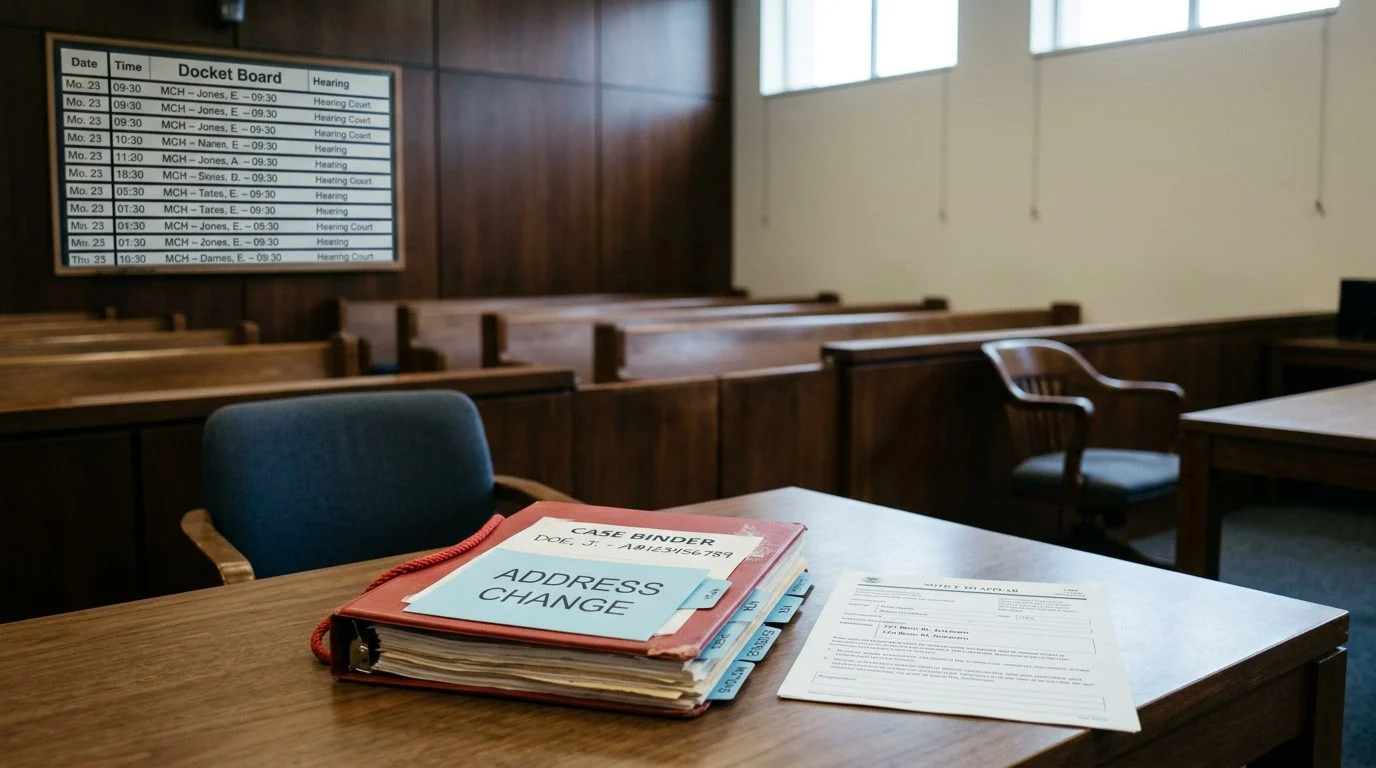
Removal Defense | Immigration Court
Moved? Make Sure Immigration Court Has Your Current Address
A change of address is easy to overlook, but the immigration court and USCIS each keep their own records. Here is how the court update works and why it matters for your case.
By Adriana Gomez · Published October 27, 2026
How do I change my address in immigration court? File Form EOIR-33 with the immigration court that has your case, within five days of the change. Missing that window can lead to a hearing held without you, so act quickly after any move.
Why your address with the immigration court matters
Immigration court sends hearing notices and orders to the address it has on file. If that address is old, the notice goes to a home you no longer live in. That is how people miss hearings they never meant to skip.
The rule sits in federal regulation. 8 CFR 1003.15 says that within five days of any change of address, you must give written notice on Form EOIR-33 to the immigration court where your case is filed.
In that case, you have five days from service of that document to send the court a correct address and phone number.
Someone else can help you fill out the form. The duty still belongs to you, the person in the case.
The stakes are real. Under 8 U.S.C. § 1229a, a person who does not attend after written notice can be ordered removed in absentia. That means removed without being present, if the government proves the notice was given and that the person is removable.
If you moved while your removal case is pending, you don't have to sort out the court forms alone; contact our office or book a paid consultation to talk through your case. Talk it through with our team — we can walk you through how a situation like yours is usually handled and what your options are.
Changing an address is not the same as changing court location
Changing your home address does not move your case to a different immigration court. Court location is a separate question.
Your case is tied to one court where it is pending. Under 8 CFR 1003.20, a judge can change venue only for good cause. The change must come on a motion from one of the parties, after the charging document is filed. The other side gets notice and a chance to respond.
A venue change also needs a fixed street address, including city, state and ZIP code, where you can be reached for hearing notices.
So start with one question: which court has your case right now? Check your charging document or your latest hearing notice. Then send your address update to that court.
Step-by-step: how do I change my address in immigration court?
File Form EOIR-33 with the court that has your case, following the court’s current filing instructions. Here is the order most people follow.
- Confirm the court that has jurisdiction over your case.
- Write your full name and any other names you use.
- Add your registration number, often called an A-number.
- Write your old address, your new address, and the date you moved.
- Add your telephone number. Under 8 CFR 1003.20, a venue change requires a fixed street address, including city, state and ZIP code, where you can be reached for further hearing notification.
- Sign the form. The court accepts an original ink signature, an encrypted digital signature, or an electronic signature, under 8 CFR 1003.31.
- File the form and keep a copy with proof that it was submitted.
It is optional for unrepresented respondents or applicants, reputable individuals and accredited officials who are representatives of record, other authorized individuals, and practitioners filing an EOIR-61 to file electronically, but once they opt in for a case, they must electronically file all documents for that case unless an immigration judge, only upon a motion filed by the individual with good cause shown, grants leave to opt out.
Common mistakes that can lead to removal orders
The most costly mistake is missing the five-day window. Five days run from the change itself, not from the day you notice a missed letter.
Watch for these other errors:
- Reporting only to other agencies. An update to USCIS does not replace the Form EOIR-33 the immigration court needs.
- Updating the address but not the phone number. The form asks for both.
- Assuming a relative’s notice is enough. A family member can help, but the form must be filed with the court.
- Ignoring a failure to report. Under 8 U.S.C. § 1306, an alien, or a parent or legal guardian in the United States of an alien, who fails to give written notice to the Attorney General, as required by 8 U.S.C. § 1305, can be convicted of a misdemeanor, with a fine up to $200, up to thirty days in jail, or both. The same subsection provides that, irrespective of whether a conviction results, any alien who fails to give written notice to the Attorney General, as required by 8 U.S.C. § 1305, shall be taken into custody and removed, unless the alien establishes to the satisfaction of the Attorney General that the failure was reasonably excusable or was not willful.
Do I have to tell the immigration court if I move?
Yes. Under 8 CFR 1003.15, within five days of any change of address, you must give written notice on Form EOIR-33 to the Immigration Court where the charging document has been filed, or, if venue has been changed, to the Immigration Court to which venue has been changed.
Does changing my USCIS address also update my court address?
No. The immigration court needs its own Form EOIR-33, and USCIS updates follow USCIS instructions.

Update other agencies separately, then reach out to our team
Updating the immigration court does not update your address with USCIS or other agencies. Each agency has its own rules. Under 8 U.S.C. § 1305, each alien required to be registered under this subchapter who is in the United States must notify the Attorney General in writing of each change of address and new address within ten days from the date of the change, and furnish any additional information the Attorney General requires by regulation.
Here is a short checklist:
- Confirm the court with your case.
- Complete Form EOIR-33 with your new address and phone number.
- File within five days and keep proof.
- Report the change to USCIS and other agencies under their instructions.
If you moved while your removal case is pending, you may be juggling court forms, a new address, and a hearing date all at once. Contact our office through the contact form, by phone, or on WhatsApp. You can also book a paid consultation to talk through your case.
Updating Your Address with the Court
Prepare Form EOIR-33
The court's Change of Address form is EOIR-33. Fill it out completely with your new physical address and any mailing address you use.
File It with the Right Court
Send the form to the Immigration Court where your charging document was filed, or to the court your case was moved to if venue has changed.
Keep Proof of Filing
Keep a copy of the completed form and any proof of delivery in your own records so you can show what was sent and when.
Update USCIS Separately
Your court address and your USCIS address are not linked. Updating one does not update the other.
Do Not Assume One Update Covers Everything
Changing your address with USCIS, the Department of State or another agency does not change your address with the Immigration Court. Missing a court notice can cause serious problems in your case.
How Our Office Can Help
Address Filings Reviewed
We review your Form EOIR-33 and related filings so the court has accurate information for your case.
Removal Defense Focus
Our practice focuses on removal defense and related matters, including adjustment of status, family petitions, naturalization, waivers and BIA appeals.
Support From Our Team
Our team of assistants and office staff helps track filing details and keep your case information organized.
Reach Us Your Way
Contact us by phone, through our contact form or by WhatsApp to discuss your situation with our office.