

Removal Defense | Immigration Court
Asylum Defense for Non-Detained Cases
Adriana Gomez and our team help people who are not in detention prepare and present their asylum claims in immigration court.
By Adriana Gomez · Published October 27, 2026
Asylum Defense Attorney Orlando for Non-Detained Cases
Asylum defense is a request for protection that you raise inside immigration court as a defense to removal. If you are not in ICE custody but hold a hearing notice, every date and deadline matters. If you need help with an asylum defense case, this page explains how the case works, what the representation covers, and how to reach our office.
If a hearing notice from the Orlando Immigration Court has you watching the calendar, contact our office to start with a paid consultation. Talk it through with our team — we can walk you through how a situation like yours is usually handled and what your options are.

Who Asylum Defense Is For
Asylum defense is for people in removal proceedings who want an immigration judge to grant asylum. There are two routes. Affirmative asylum starts with a filing with USCIS. Defensive asylum starts after the government places you in removal proceedings, and you raise your claim before the judge.
“Non-detained” means you are not held in ICE custody. You still must attend every hearing at the Orlando Immigration Court. Being out of custody doesn’t lower the importance of each date.
This defense often fits three groups:
- People who received a Notice to Appear.
- People with a hearing notice for a master calendar or merits hearing.
- Family members whose status depends on the main applicant’s claim.
Asylum eligibility rules explain how the judge weighs that claim.
The filing clock matters too. Limited exceptions exist, and the court decides whether one applies. One-year filing rule
What the Representation Covers
Representation covers the application, the evidence, the hearings, and the review of any decision. Here is what that includes:
- Preparing Form I-589 and checking every answer against your account. Inconsistent answers cause real problems later.
- Gathering evidence, such as identity documents, country condition reports, medical or police records, and sworn declarations.
- Preparing you and any witnesses to testify at the individual merits hearing.
- Appearing for you at master calendar hearings and the merits hearing in Orlando.
- Reviewing the decision and your Board appeal options if the judge rules against you.
You may be represented in immigration court by an attorney of your choice. Immigration Court representation rule confirms that right. Our team handles the file so you can focus on your testimony.
How the Process Works, Step by Step
The case moves from a consultation to a filing, then through hearings to a decision.
- Paid consultation. You describe your notice, your entry history, and your reason for fear. The office identifies deadlines and the documents you’ll need. The consultation is paid, and the office confirms the fee in writing before you engage the firm. Government filing fees are disclosed in writing before anything is filed.
- Engagement and documents. You sign the engagement agreement and provide your passport, prior filings, and the Notice to Appear or hearing notice.
- Filing. For cases before the immigration court, your application counts as filed on the date the court receives it. One-year filing rule
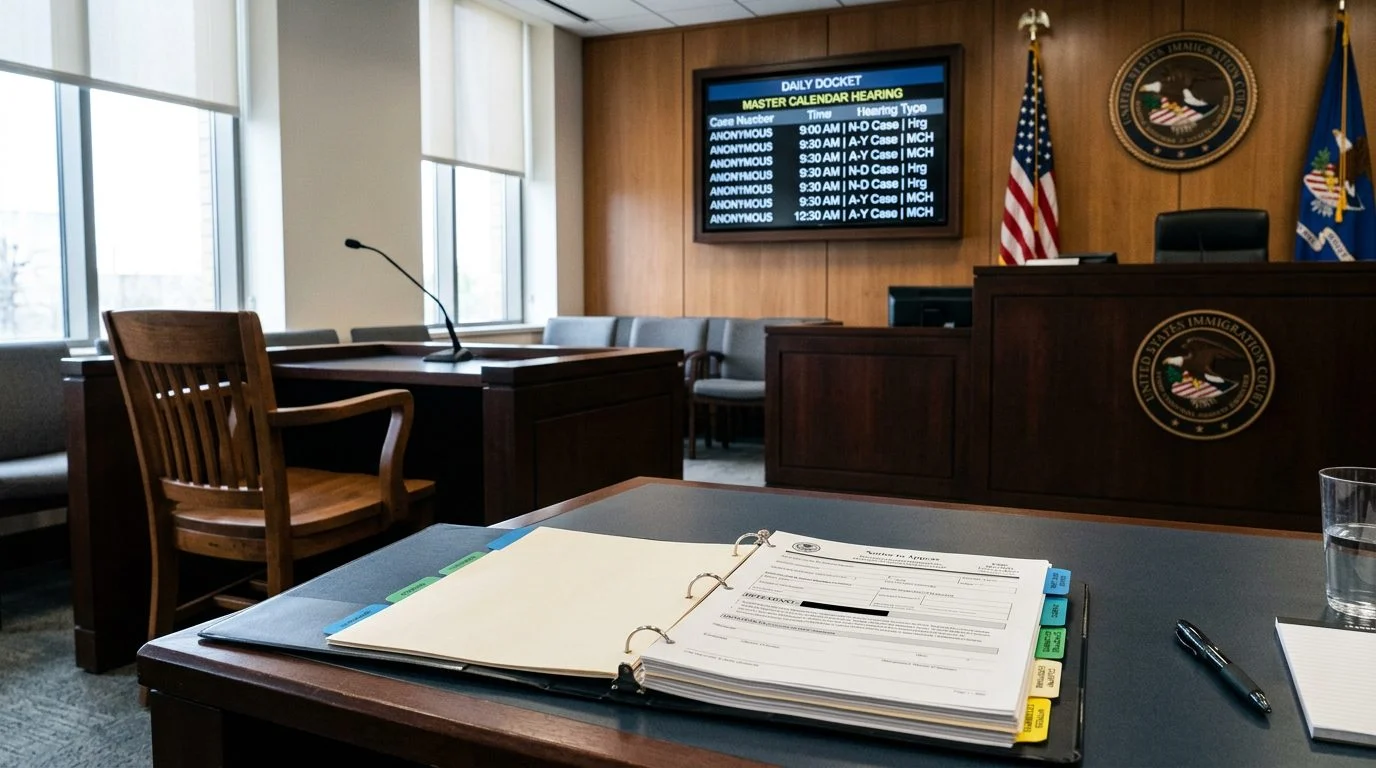
- Master calendar hearings. These short hearings track progress, confirm filing status, and set the merits hearing date.
- Individual merits hearing. The judge hears your testimony and evidence. The judge may weigh your demeanor, the plausibility of your account, and whether your written and spoken statements match. Removal proceedings statute
- Decision and appeal. The office explains the appeal deadline in your case.
Timing depends on the court’s docket and the facts of your case.
Staying on Track While Your Case Is Non-Detained
Staying on track means attending every hearing and keeping the court’s address current.
- Attend every hearing. A missed hearing can lead to dismissal of your application and an order of removal in absentia. Failure to appear rule
- Keep copies. Save every notice, receipt, and filing. Bring originals to hearings when asked.
- Report new contact quickly. Tell the office about any arrest, new notice, or contact from immigration authorities.
The most avoidable problem in these cases is an address the court doesn’t have. Court notices go to the last address on file, so a move without an update can cost you a hearing.
Why Work With This Practice
AG Immigration Law P.A. focuses on removal defense. The practice also handles adjustment of status, family petitions, naturalization, removal of conditions on green cards, waivers, and BIA appeals.
Adriana Gomez is the responsible lawyer for this page. Our team includes support staff who help with file preparation, deadlines, and document organization. Our lawyers and staff work from the same case file.
At intake, the paid consultation reviews your notice, your timeline, and your documents. The office then outlines the next steps in your case.
Asylum can connect to later steps, such as BIA appeals and, where eligible, adjustment of status. Each path has its own requirements. No one can promise a particular outcome, because each case turns on its own facts and the law that applies.
Not sure what your next step is?
Talk it through with our team — we can walk you through how a situation like yours is usually handled and what your options are.
Common Questions About Asylum Defense in Orlando
Do I need a lawyer if I’m not in detention?
You may be represented by an attorney of your choice in immigration court. Counsel helps you prepare for each hearing and file on time.
The one-year period is calculated from the date of the applicant’s last arrival in the United States or April 1, 1997, whichever is later (8 C.F.R. § 1208.4). Bring your entry dates to the consultation.
Can my family be included?
Family members named in the main application can be included. A spouse or child left out may be sought later through a separate Form I-730, generally within two years of the asylee’s grant, unless extended for humanitarian reasons. Derivative asylum rules
How long does the case take?
The court’s docket sets much of the pace. The office explains the expected steps at intake.
What if the judge denies my claim?
A Notice of Appeal (Form EOIR-26) generally must reach the Board within 10 calendar days of the judge’s decision, and within 30 calendar days for certain asylum decisions under 8 C.F.R. § 1003.38(b)(2). Appeal deadline rule

Contact the Office About Your Orlando Hearing Notice
If a hearing notice from the Orlando Immigration Court has you counting days, you don’t have to sort out the deadlines alone. Bring your Notice to Appear or hearing notice and your identity documents to the consultation.
You can reach our office four ways:
- Fill out the contact form.
- Call the office.
- Message us on WhatsApp.
- Book a paid consultation.
Reach out now so your next hearing is planned, not rushed.
How We Work With You
Focused Practice
Our practice focuses on removal defense, including asylum claims raised in immigration court.
Organized Preparation
We help you gather, organize, and review the documents and evidence your case may require.
Clear Communication
We explain each step of the process so you know what to expect before each hearing.
Easy Ways to Reach Us
Call our office, send a WhatsApp message, or fill out our contact form to get started.
Keep Your Address and Contact Information Current
Immigration court sends notices to the address on file. Update your address with the court and tell your attorney right away about any change so you do not miss an important notice or hearing.
Non-Detained Asylum Cases: What We Handle
Case Consultation
We review your history, documents, and timeline with you during a consultation with our office.
Hearing Preparation
We prepare you for each immigration court hearing, including how to present your testimony and answer questions.
Filing and Evidence
We help organize and file your application and the supporting evidence your case needs.
Representation in Court
You may choose an attorney of your choice to represent you in immigration court, and we appear with you at your hearings.