

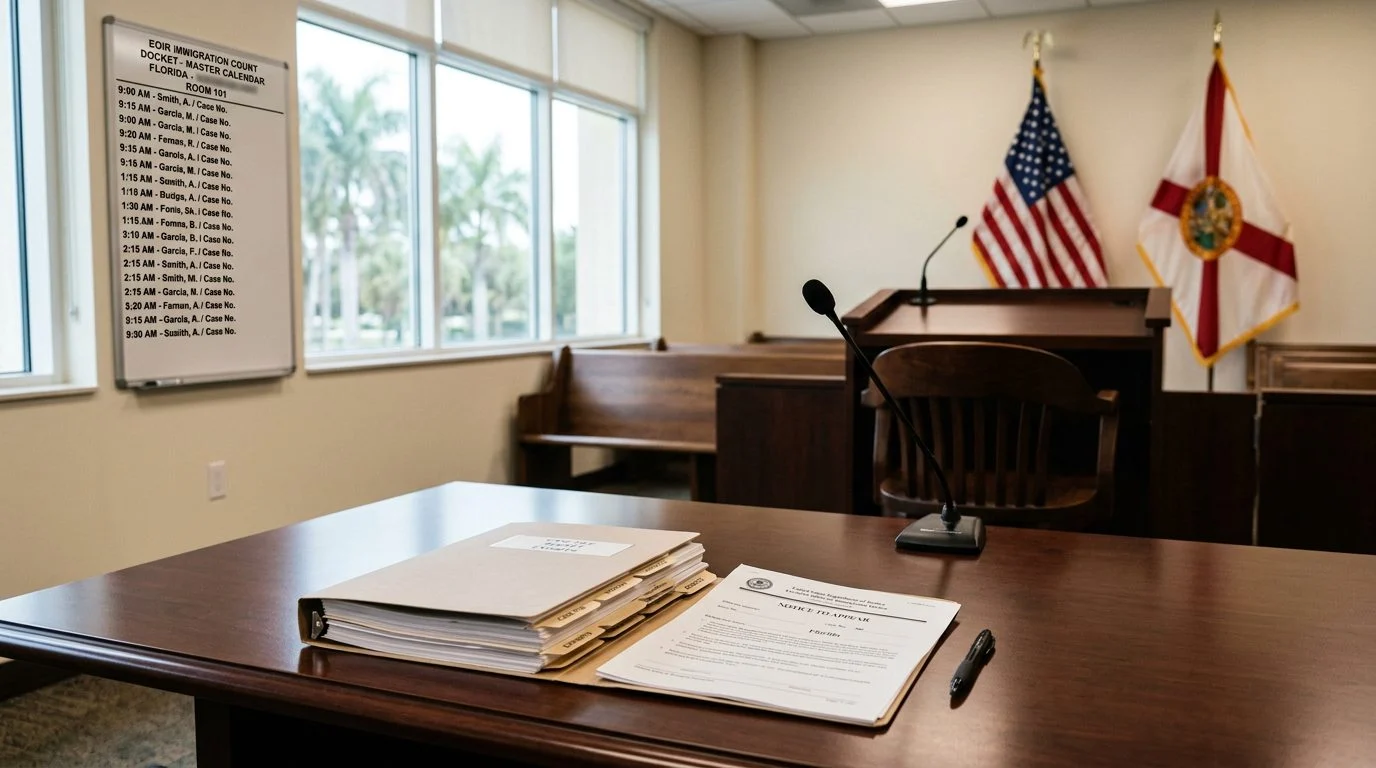
Removal Defense | Florida
Attending Your Immigration Court Hearing by Video in Florida
Not sure whether your hearing will be by video or in person? Learn how to read your notice, and contact AG Immigration Law P.A. before your hearing date. Adriana Gomez is the lawyer responsible for this page.
By Adriana Gomez · Published October 27, 2026
The short answer: the court decides how your hearing is held
Yes, you may be able to attend an immigration court hearing by video in Florida. The immigration judge may hold hearings through video conference to the same extent as in-person hearings, under 8 C.F.R. § 1003.25. 8 C.F.R. § 1003.25 reads: “An Immigration Judge may also conduct a hearing through a telephone conference, but an evidentiary hearing on the merits may only be conducted through a telephone conference with the consent of the alien involved after the alien has been advised of the right to proceed in person or, where available, through a video conference, except that credible fear determinations may be reviewed by the Immigration Judge through a telephone conference without the consent of the alien.” Whether your own hearing is by video depends on the facts of your case, so start with your hearing notice.
This page explains the rules, what to check on your notice, and how to prepare. For the bigger picture of defending a removal case, read our removal defense overview.
If your hearing notice leaves you unsure whether to appear by video or in person, you don't have to sort it out alone. Our team can talk it through with you. Talk it through with our team — we can walk you through how a situation like yours is usually handled and what your options are.
How video hearings work in Florida immigration courts
A video hearing means you, your lawyer, and the immigration judge connect remotely while the court runs the case. The judge still places you under oath at the opening of the proceeding. At the opening of a removal proceeding, 8 C.F.R. § 1240.10 requires the immigration judge to advise you of your right to representation, at no expense to the government, by counsel of your choice, and to ascertain that you have received a copy of appeal rights.
Some hearings can also be held by telephone. An evidentiary hearing on the merits by phone needs your consent. You must first be told you can proceed in person or by video, where available. 8 C.F.R. § 1003.25 says so.
Court practices for virtual hearings have changed in recent years. Don’t assume an earlier hearing followed the same rules. Florida cases are heard in courts such as Miami, Broward, and Orlando. Our Florida removal defense page covers the state in more detail.
Checking your hearing notice for the hearing mode
Your hearing notice shows the date, the time, and how the hearing will be held. Read it line by line before you plan anything. A courtroom address points to an in-person hearing. Video connection details, a link, a meeting code, or joining instructions point to video.
If the notice lists both, follow the court’s current instructions and confirm them early. Don’t guess. If you can’t tell from the notice, ask your lawyer to confirm the hearing mode well before the date.
Check the address and phone number the court has on file too. Under 8 C.F.R. § 1003.15, the notice must warn that failing to keep the court informed may lead to an in absentia hearing. Within five days of any change of address, you must give written notice on Form EOIR-33.
Bring the notice to every conversation about your case.
How to ask the court to change the hearing to video or in person
Questions about how your hearing is held can be discussed with our team. The immigration judge makes that decision. Put your request in writing, state a specific reason, and file it early so the court has time to act.
Timing matters. The judge sets filing deadlines. 8 C.F.R. § 1003.31 says that if a document isn’t filed within the time the judge sets, the opportunity to file it is deemed waived. The same rule requires attorneys of record to file electronically in cases eligible for electronic filing.
Vague requests are harder to act on than specific ones. Name the actual problem you face. Don’t count on a change until the court has ruled on it.
Preparing for a video hearing from home
A video hearing works best with a steady connection, a quiet private room, and your papers within reach. Test your device and the video link days before the hearing. Join early so you aren’t fixing problems when the case starts.
Use a device with a working camera and microphone, and charge it fully. Sit in a quiet room with a plain background. Keep your hearing notice, identity documents, and copies of anything you’ve already filed in front of you.
If you need an interpreter, know the rule. Under 8 C.F.R. § 1003.22, an interpreter must swear or affirm to interpret and translate accurately, unless the interpreter is a U.S. Government employee. 8 C.F.R. § 1003.22 reads: “Any person acting as an interpreter in a hearing shall swear or affirm to interpret and translate accurately, unless the interpreter is an employee of the United States Government, in which event no such oath or affirmation shall be required.” Read more about interpreter needs in Florida immigration court. If you want to review your file first, see requesting your immigration file before a hearing.
If your connection drops, follow the court’s instructions. Contact your lawyer right away.
When a video appearance may not be the right fit
Some hearings are better handled in person, especially when testimony, documents, or interpreter needs are complex. Video can make it harder to hand over papers, work through a long exhibit, or follow a difficult exchange. Talk through these points with your lawyer before you choose.
A continuance is another tool. 8 C.F.R. § 1003.29 lets an immigration judge grant a motion for continuance for good cause shown, but not a continuance that causes the adjudication of an asylum application to exceed 180 days in the absence of exceptional circumstances. 8 C.F.R. § 1240.6 allows a reasonable adjournment after the hearing has started, either on the judge’s own instance or, for good cause shown, on application by you or the Department of Homeland Security, but not one that causes an asylum application to exceed 180 days in the absence of exceptional circumstances.
Missing a hearing carries serious risk.
Who decides if my hearing is by video?
The immigration judge decides how the hearing is held. Your notice shows how your own hearing is set.
What if I can’t tell from my notice?
Ask your lawyer to confirm the hearing mode well before the hearing date.
Not sure what your next step is?
Talk it through with our team — we can walk you through how a situation like yours is usually handled and what your options are.
Talking through your hearing with our team
If you’re preparing for a hearing you didn’t choose, you don’t have to work out the video question alone. You may be helping a parent, spouse, or child who received the notice. That is a hard position to be in.
Maybe your notice doesn’t clearly say whether the hearing is by video. Maybe you want to ask the court to change the mode, or the video link hasn’t arrived yet. Those are good reasons to get a clear answer before the date.
Reach out through the contact form, by phone, or on WhatsApp. Consultations with the firm are paid. Our team will confirm the details when you reach out.
Responsible lawyer: Adriana Gomez, AG Immigration Law P.A.
How our office can help with your video hearing
Review your hearing notice
We help you read the notice from the court and confirm how your hearing is set up, including whether it will be held by video.
Clear answers in plain language
We explain what to expect at a video hearing, what you need to have ready, and what to bring up with your lawyer.
Time to prepare
Because hearing details can change, we encourage you to contact us well before your hearing date so we can confirm the details with you.
Support from our staff
Our assistants and office staff help keep your questions, documents and scheduling organized throughout your case.
Do not guess about your hearing format
Your hearing notice shows how your own hearing is set. If you cannot tell whether your hearing is by video or in person, ask your lawyer to confirm well before the hearing date.
Ways to get in touch
Fill out the contact form
Share a few details about your case and the date of your hearing, and our office will follow up with you.
Call the office
Speak with our staff about your hearing notice and the next steps for your removal defense matter.
Message us on WhatsApp
Send a message with your questions about attending your hearing by video, and we will respond through our office.
Book a paid consultation
Meet with our lawyers to review your situation in detail and plan for your hearing.
Have questions about your video hearing?
Contact AG Immigration Law P.A. today and let us help you prepare.