

Adjustment of Status | AG Immigration Law P.A.
Adjustment of Status Help for Green Card Applicants
Find out whether filing from inside the United States fits your history, your current status and your work record.
By Adriana Gomez · Published November 9, 2026
Adjustment of Status Cases | AG Immigration Law P.A.
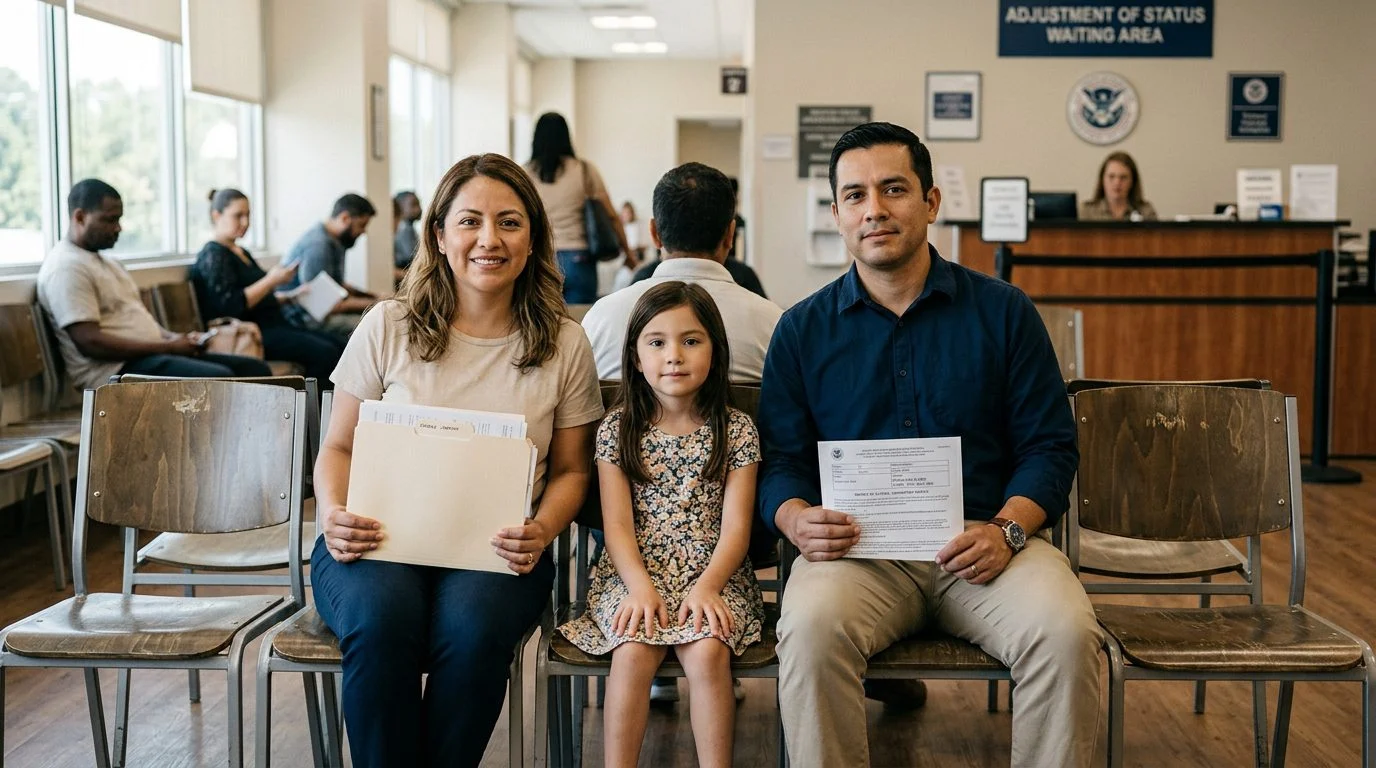
If you are already in the United States, you may be able to get a green card without leaving the country. Adjustment of status lets a person physically present in the United States apply for a green card without going to a U.S. consulate abroad, unless the person is ineligible to apply for adjustment of status under the exceptions in paragraph (b) or (c) of the regulation, provided the applicant is eligible to receive an immigrant visa and an immigrant visa is immediately available at the time of filing. You file Form I-485 with USCIS, and the case is approved only if the legal requirements are met. This page explains the basics of adjustment of status and how AG Immigration Law P.A. handles these cases.
Not sure what your next step is?
Talk it through with our team — we can walk you through how a situation like yours is usually handled and what your options are.
What Adjustment of Status Is and Who It Is For
Adjustment of status is the process of applying for a green card from inside the United States. The Migration Policy Institute lists adjustment from another status among the main federal green-card pathways.
Adjustment of status to lawful permanent residence is addressed in 8 U.S.C. § 1255. It says the status of a person who was inspected and admitted or paroled into the United States, or who has an approved VAWA self-petition, may be adjusted to lawful permanent resident, at the Attorney General’s discretion, if three things are true. The person applies, the person is eligible for an immigrant visa and admissible for permanent residence, and an immigrant visa is immediately available when the application is filed.
The regulation adds that a person physically present in the United States may apply, unless an exception applies. See 8 C.F.R. § 1245.1.
This route may fit people who:
- Were inspected and admitted or paroled into the United States
- Have a U.S. citizen or permanent resident family member who can file a petition
- Have an employer who can file a petition for a permanent job
- Are in removal proceedings and need to ask for a green card before an immigration judge
The right path depends on the facts of each case.
Common Pathways to Adjustment of Status
Adjustment usually rests on an immigrant petition or another category the law allows. Each pathway has its own filing steps.
- Some relatives are immediate relatives.
- Employment-based: An approved or pending Form I-140 can support an adjustment case for an eligible worker.
- Concurrent filing: The regulation says that if approval of a visa petition filed for classification under section 201(b)(2)(A)(i), section 203(a) or section 203(b)(1), (2) or (3) of the Act would make a visa immediately available, the adjustment application is properly filed whether it is submitted with the petition or after it, provided that it meets the filing requirements contained in parts 103 of 8 CFR chapter I and 1245 of this chapter. For other classifications, the applicant may file only after the petition is approved. See 8 C.F.R. § 1245.2.
- Priority dates and visa availability: Your priority date sets your place in line for a visa. Under 8 C.F.R. § 1245.1(g)(1), if the applicant is a preference alien, the current Department of State Bureau of Consular Affairs Visa Bulletin will be consulted to determine whether an immigrant visa is immediately available. See 8 C.F.R. § 1245.1.
- Bars and exceptions: Section 1255(c) lists people who cannot use the main rule. These include some who accept unauthorized employment before filing, and some who are in unlawful status on the filing date. Immediate relatives are treated differently under the employment bar.
- Waivers: Some grounds of inadmissibility can be waived. A waiver is a separate request that needs its own review.
What Our Adjustment of Status Work Covers
Our team reviews your immigration history, prepares the filing package, and supports you through each stage after filing. Work includes these parts:
- Review of prior entries, filings, denials, and notices
- Preparation of Form I-485, plus Form I-765 for work permission and Form I-131 for travel when those apply
- Coordination of the medical exam. Applicants must have one by a designated civil surgeon, and the report goes into the record. A medical examination is not required of an applicant who entered the United States as a nonimmigrant spouse, fiancé(e), or child of a U.S. citizen under section 101(a)(15)(K), if the applicant was medically examined before and as a condition of the visa, and the exam was no more than 1 year before filing. 8 C.F.R. § 1245.5 reads: “A medical examination shall not be required of an applicant for adjustment of status who entered the United States as a nonimmigrant spouse, fianceé, or fianceeé of a United States citizen or the child of such an alien as defined in section 101(a)(15)(K) of the Act and § 214.2(k) of 8 CFR chapter I if the applicant was medically examined prior to, and as a condition of, the issuance of the nonimmigrant visa; provided that the medical examination must have occurred not more than 1 year prior the date of application for adjustment of status.” See 8 C.F.R. § 1245.5. See 8 C.F.R. § 1245.5.
- Civil documents and translations
- Interview preparation. Each applicant is interviewed by an immigration officer, though the regulation allows waivers in some cases. See 8 C.F.R. § 1245.6.
- Responses to Requests for Evidence and Notices of Intent to Deny
- Strategy when a prior order or a removal case affects the filing
How the Process Works, Step by Step
The process moves in five stages, from case review to a decision.
- Case review: Your case starts with a paid consultation. We review your documents, entries, prior filings, and any notices.
- Plan: We confirm the eligible category, the filing order, and what the case will require.
- Build the package: You gather evidence, we complete the forms, and we prepare the filing for review.
- File and track: We file with USCIS, then track receipt notices and any requests for more information.
- Biometrics and decision: We prepare you for the biometrics appointment, the medical exam, and the interview, and then the decision follows.
USCIS processing times vary by office and category. Treat any timeline as an estimate, not a fixed schedule.
Adjustment of Status When Removal Proceedings Are Open
When removal proceedings are open, an immigration judge decides any adjustment application. The regulation says the immigration judge hearing the case has exclusive jurisdiction over that application, with exceptions for arriving aliens. See 8 C.F.R. § 1245.2.
If USCIS denies the application, no appeal lies from that denial. A non-arriving applicant may still renew the application in removal proceedings under the same regulation.
Removal defense and adjustment can run together in one plan. Cancellation of removal is a separate request, filed with the immigration court on Form EOIR-42. See 8 C.F.R. § 1240.20.
If an immigration judge rules against you, the case may go to the Board of Immigration Appeals. The Executive Office for Immigration Review publishes BIA and Attorney General precedent decisions. Removal cases carry strict deadlines, so early review matters.
Not sure what your next step is?
Talk it through with our team — we can walk you through how a situation like yours is usually handled and what your options are.
Why Choose AG Immigration Law P.A. for Your Green Card Case
AG Immigration Law P.A. focuses on immigration law. Its work includes removal defense, adjustment of status, family petitions, naturalization, removal of conditions on green cards, waivers, and BIA appeals.
Adriana Gomez is the responsible lawyer for this page. Our team includes assistants and office staff who support each case file.
The firm represents immigrants across the US. You can reach our team by phone, through the contact form, or by WhatsApp. A case review begins with a paid consultation, where we look at your facts before any filing decision.
Frequently Asked Questions About Adjustment of Status in Broward County
Can I apply for adjustment of status if I entered on a visitor visa?
Entering on a visitor visa does not end the question. Section 1255 has bars and exceptions tied to status and employment, so the entry facts need review.
Do I need to leave the United States to adjust my status?
Adjustment of status lets eligible people apply from inside the United States if they were inspected and admitted or paroled into the United States, or if they have an approved petition for classification as a VAWA self-petitioner. You do not need to leave to file the I-485.
What is the difference between adjustment of status and consular processing?
Adjustment is filed with USCIS inside the United States. Consular processing is completed through a U.S. consulate abroad.
How long does adjustment of status take?
Processing time varies by office and category, so there is no fixed answer. Any timeline is an estimate.
What happens if USCIS sends a Request for Evidence or denies my case?
A Request for Evidence asks for more proof, and it sets a response deadline. If USCIS denies the case, the applicant may renew it in removal proceedings.
Can a pending removal case be used to pursue adjustment of status?
When removal proceedings are open, the immigration judge decides any adjustment application.
Can a lawyer promise approval?
No lawyer can promise approval. Each case is reviewed on its own facts.
What happens after I reach out?
The office reviews your history in a paid consultation before any filing begins.

Next Step: Contact the Office About Your Green Card Case
If your family or employment petition is pending or approved, or your removal case needs a decision now, the next step is a conversation about your facts. Contact AG Immigration Law P.A. through the contact form, by phone, or on WhatsApp, or book a paid consultation to review your case.
How We Approach Your Adjustment of Status Case
Review of your entry history
We look at how and when you entered, and at any prior filings, before recommending a path forward.
Attention to status and work issues
Changes in status and employment can affect an adjustment application, so we examine them early.
Coordination with family petitions
When an adjustment case is tied to a family petition, we review both together so the filings line up.
Several ways to reach us
Contact our office by phone, through our contact form or on WhatsApp to start the conversation.
Do not rely on guesses about your status
Online checklists cannot account for your full record. Entry history, prior filings and employment can all change whether adjustment of status is available, so review your facts before you file anything.
Common Questions About Adjustment of Status
Can I apply after entering on a visitor visa?
Entering on a visitor visa does not end the question. Adjustment rules include bars and exceptions tied to status and employment, so the entry facts need review.
Do I need to leave the United States?
Adjustment of status lets eligible people apply from inside the United States. Whether it fits your case depends on the facts of your history.
How does adjustment connect to a family petition?
Many adjustment cases depend on an approved family-based petition. We review the petition and the adjustment filing together.
What happens after I file?
We explain what to expect during processing and what documents may be requested, so you know what to watch for.