

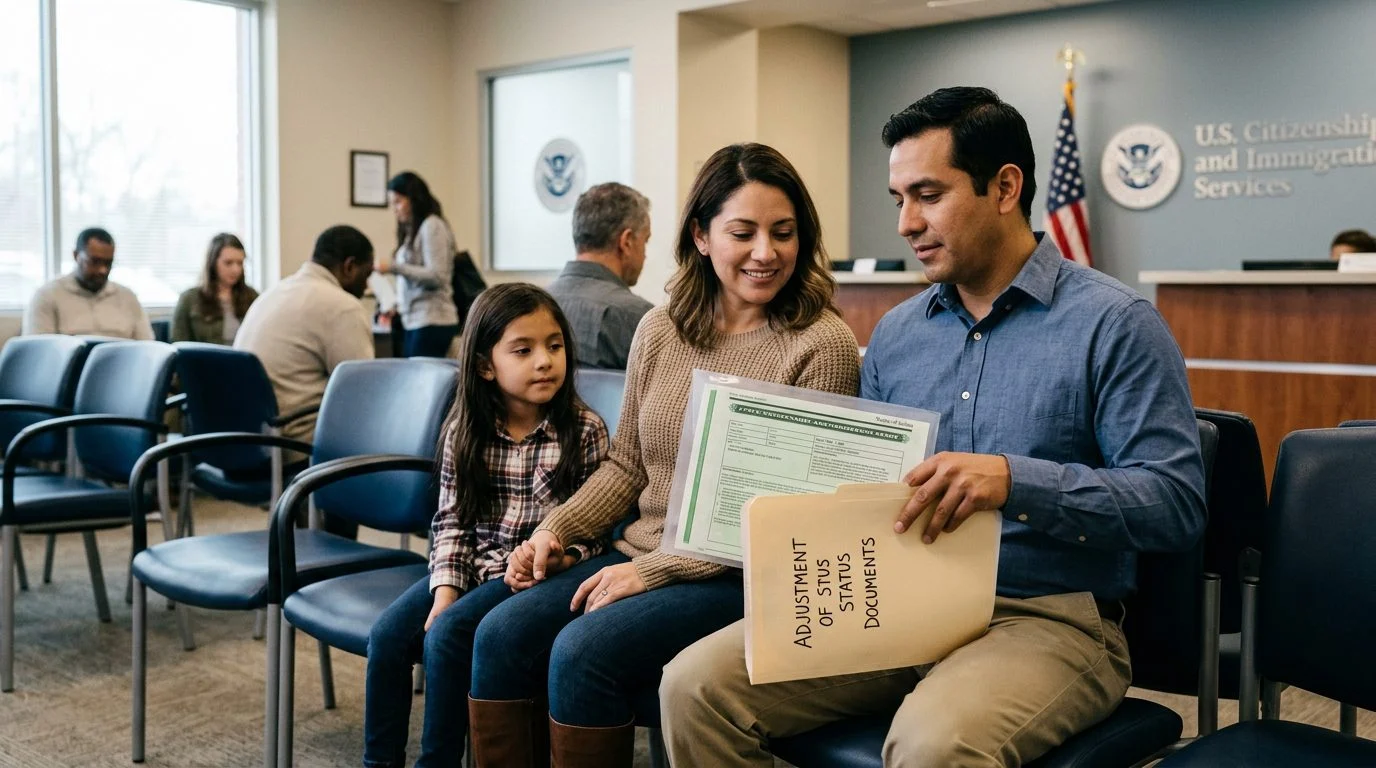
Adjustment of Status | Florida, Texas & New York
Green Card Through Adjustment of Status: Get Clear Guidance From Inside the U.S.
AG Immigration Law P.A. focuses on adjustment of status, removal defense, family petitions, naturalization, and related immigration matters for clients in Florida, Texas and New York. Reach out to discuss your situation with Adriana Gomez and our team.
How We Work With You
Review Your Filing Path
We look at your immigration history, your current status and your family ties to help you understand whether adjustment of status is a path to consider.
Prepare Your Case Carefully
Our team organizes your forms, supporting evidence and interview preparation so that each step is documented and reviewed before filing.
Stay Informed at Each Stage
We explain what USCIS requires at each step, including inspection, interview and any requests for evidence, so you know what to expect.
Reach Us Your Way
Use the contact form, call the office, or message us on WhatsApp to start the conversation about your case.
By Adriana Gomez · Published November 4, 2026
Adjustment of status is the process of getting a green card while you stay inside the United States. You file Form I-485 with USCIS. If it’s approved, you become a lawful permanent resident without leaving the country first. The rules come from 8 U.S.C. § 1255, and they have conditions.
This guide explains the basics in plain words. It covers eligibility, filing, timing, interviews, travel, and cases where removal proceedings are already open. It also links to our deeper pages on each part. AG Immigration Law P.A. focuses on removal defense, adjustment of status, family petitions, naturalization, removal of conditions on green cards, waivers, and BIA appeals.
What Adjustment of Status Means and How It Differs From Leaving the US
Adjustment of status lets you change to permanent resident status without going abroad first. The other route is consular processing, where you finish the case at a U.S. consulate outside the country.
With adjustment, you ask USCIS to change your status while you are inside the United States. You might be in a visa status, a student status, or another lawful status. The core test is set out in 8 U.S.C. § 1255.
The trade-off is simple. Adjustment lets you stay home during the process, but the bars are strict. Consular processing usually means leaving the country for an interview abroad. Some people who cannot adjust still have a consular route. Under 8 C.F.R. § 245.1, you must be physically present in the United States to apply, you must not fall into a group the regulation makes ineligible, and you must be eligible to receive an immigrant visa with an immigrant visa immediately available when you file. Choosing between the two paths depends on your history and goals, and that choice shapes every step after it.
If you're living in the US and wondering whether an I-485 fits your case, we'd be glad to talk through your facts with you. Talk it through with our team — we can walk you through how a situation like yours is usually handled and what your options are.

Who Can Apply for Adjustment of Status
Most people can apply if they meet three basic conditions. Adjustment of status is generally available to a person who was inspected and admitted or paroled into the United States. Certain VAWA self-petitioners with an approved petition can also apply.
You must also be eligible for an immigrant visa and admissible for permanent residence. An immigrant visa must be immediately available when you file. 8 C.F.R. § 245.1 says a person physically present in the United States who is not barred may apply if eligible to receive an immigrant visa and a visa is immediately available at filing.
A petition filed years ago can still control your timing today.
Some rules block adjustment. 8 U.S.C. § 1255(c) covers, among others, unauthorized employment before filing, being in unlawful status on the filing date, and failing (other than through no fault of your own or for technical reasons) to keep lawful status since entry, other than an alien with an approved VAWA self-petitioner petition. Whether any bar applies depends on your history, so it needs a close look at your facts. For more detail, see our page on what disqualifies a person from a green card.
How Do You Apply for Adjustment of Status?
You apply by filing Form I-485 with USCIS, along with supporting documents and a medical exam. Each part of the package should match the rest of your record. Small errors can create delays.
The medical exam is required. Plan for this early, because the exam takes time to schedule.
Most packages include proof of your current status, identity documents such as a passport and birth certificate, passport-style photos, and the filing fee. You also need a copy of any approved petition that gives you a priority date. Each case needs its own list, so build yours from your own file.
After filing, USCIS normally sends a receipt notice. It may then schedule biometrics, which means fingerprints and photos. Keep copies of everything you send. People often lose time because a signature is missing, a date does not match, or a fee is wrong.
Which Gets Approved First: I-130 or I-485?
The I-130 and the I-485 are separate filings with separate decisions. The I-130 is the family petition, and the I-485 is the adjustment application. You can file them together or one after another.
The petition sets your place in line. Under 8 C.F.R. § 245.1, if you are seeking an immigrant visa number under one of the preference classes in section 203(a) or 203(b) by virtue of an approved petition, your priority date is fixed by the date the approved petition was filed. You then check the Visa Bulletin to see whether a visa is available in your category.
Approval has a hard limit. Under 8 C.F.R. § 245.2, a preference applicant’s adjustment cannot be approved until the Department of State has allocated an immigrant visa number. Concurrent filing has its own timing rules, so the order matters. For a deeper look, read our page on I-130 and I-485 filing order.
How Long Does Adjustment of Status Take?
Timing varies with the case type, the agency’s workload, and whether USCIS asks for more evidence. USCIS publishes processing-time estimates on its website. Those are estimates, not fixed dates.
During processing, you can expect a receipt notice, biometrics, and possibly a request for evidence. Many applicants also attend an interview. The case ends with a decision. If USCIS approves the application, permanent residence is recorded as of the date of the order approving adjustment, under 8 C.F.R. § 245.2.
Address changes matter. Under 8 U.S.C. § 1305, a person who must register has to notify the government in writing of a change of address within ten days. Many delays happen when someone moves and the agency sends a notice to an old address. For more on timing, see our page on I-485 processing time.
The Green Card Interview and What to Bring
Most adjustment applicants are interviewed by an immigration officer. The agency can waive the interview in some cases. USCIS may waive the adjustment of status interview in certain cases under 8 C.F.R. § 245.6.
Bring the interview notice and valid identity documents. Bring originals of documents you submitted, and any extra evidence the officer asks for. Bring copies of your filed forms so you can check your answers.
Consistency counts most. Your answers should match the forms you filed. Small differences in dates, addresses, or travel history can raise questions. Keep answers short, honest, and accurate. The officer may ask about your marriage, work, travel, and past status. For a step-by-step review, see our page on green card interview preparation.
Not sure what your next step is?
Talk it through with our team — we can walk you through how a situation like yours is usually handled and what your options are.
Can You Travel While Your I-485 Is Pending?
Travel can put a pending I-485 at risk. The effect depends on the law under which you are applying, as 8 C.F.R. § 245.2 explains. That regulation names limited exceptions.
Under 8 C.F.R. § 245.2, travel outside the United States by an applicant for adjustment of status who is not under exclusion, deportation, or removal proceeding and who is in lawful H-1 or L-1 status shall not be deemed an abandonment of the application if, upon returning to this country, the alien remains eligible for H or L status, is coming to resume employment with the same employer for whom he or she had previously been authorized to work as an H-1 or L-1 nonimmigrant, and is in possession of a valid H or L visa (if required).
Before you leave, ask about your options. Do not plan a trip and hope the application survives it. Your return can also affect how you are admitted. We handle travel questions with care. Our page on travel while an I-485 is pending covers the details.
Rules, Status and Obligations After You Receive a Green Card
A lawful permanent resident is a person who lives in the United States with permanent resident status. The approval order records your residence as of its date, under 8 C.F.R. § 245.2.
Your status comes with ongoing duties. Keep your address current, and remember the ten-day notice rule in 8 U.S.C. § 1305. Long trips abroad can raise questions about where you live, so plan trips carefully. Keep your records of time spent in the United States.
Some green cards are conditional. If your card has an expiration date close to a condition deadline, act early. Our page on removal of conditions on a green card explains the process in more detail.
Adjustment of Status When You Are in Removal Proceedings
Yes, you may be able to ask for adjustment while a removal case is open. USCIS generally decides adjustment applications. An immigration judge can have jurisdiction in some cases, as 8 C.F.R. § 245.2 explains.
If USCIS denies the application, the denial itself cannot be appealed to the immigration court. The applicant can still renew the application in removal proceedings under 8 CFR part 240, if the applicant is not an arriving alien. Many people miss this point. A denial is not always the end of the path.
An immigration judge’s decision can be appealed to the Board of Immigration Appeals. The regulations set deadlines for those appeals, and they are strict. The Executive Office for Immigration Review publishes BIA and Attorney General decisions, including decisions on adjustment before the immigration court. Our pages on removal defense, BIA appeals, and motions to reopen and reconsider cover these steps.
Fees, Forms and Costs to Budget For
Adjustment carries government fees, and the amounts can change. Under 8 U.S.C. § 1812, a fee applies to an application to adjust status filed with an immigration court. That fee is paid at filing or before the court decides the case.
The same section sets separate fees for other filings. These include applications for a waiver of a ground of inadmissibility, appeals from an immigration judge, and motions to reopen or reconsider. Each filing can add to your total.
USCIS sets its own filing fees, and those amounts change over time. Use the current numbers when you budget. Other costs often include the medical exam, translations, passport-style photos, certified copies, and mailing. Attorney fees are separate from government fees.
Adjustment of Status: An Overview
A green card case does not follow different rules just because you live in a different state.
Some logistics can vary by location. Where you attend an interview, and how you get there, can differ from one place to another. Those details are practical, not legal.
We offer pages for readers in Florida, Texas, and New York. We also have pages for Miami, Broward County, Orlando, Houston, San Antonio, and New York City. Each regional and city page covers the same practice areas discussed here. None of them changes the federal rules on this page. You can find them through Florida, Texas, New York, Miami, Broward County, Orlando, Houston, San Antonio, and New York City.
If you're living in the US and wondering whether an I-485 fits your case, we'd be glad to talk through your facts with you. Talk it through with our team — we can walk you through how a situation like yours is usually handled and what your options are.

Talk With the Firm About Your Adjustment of Status Case
If you’re living in the US and wondering whether an I-485 fits your situation, the next step is a conversation about your facts. Many readers are weighing an approved family petition, a travel question, or a removal order they need to address.
Frequently asked questions
Can I apply for adjustment of status from inside the US?
Yes, if you meet the conditions, including inspection and admission or parole.
Is an interview always required?
Usually yes, but 8 C.F.R. § 245.6 allows waivers in limited cases.
Does a change of address matter?
Yes. If you are required to register, you must notify the government in writing of each change of address within ten days of the change.
Are there fees for filing in immigration court?
Yes. 8 U.S.C. § 1812 sets fees for those filings.
If you have an approved family petition and a question about filing an I-485, or you face removal and wonder whether adjustment is possible, we can review your facts. Reach out by phone, WhatsApp, or through our contact form to book a paid consultation. The firm does not promise any particular outcome, but it can explain which path may fit your facts.
Common Questions About Adjustment of Status
Can I apply for adjustment of status from inside the US?
In many cases, yes, if you meet the conditions, including inspection and admission or parole. Whether this route fits your situation depends on your full history, so schedule a consultation to review it.
Is an interview always required?
Usually, yes. Under 8 C.F.R. § 245.6, waivers of the interview are possible in limited cases. We can explain how the interview process applies to your case.
Does a change of address matter?
Yes. Address information can affect notices and your case record, so keep your contact details current and speak with us before making a move.
What if my case is outside our practice areas?
If a matter falls outside the areas we handle, we may refer you to another lawyer or firm. We will tell you so clearly at the outset.
Important: Address Changes Can Affect Your Case
Notices and decisions are sent to the address on file. Before you move or change your mailing address, talk with your attorney so that your case information stays accurate.