

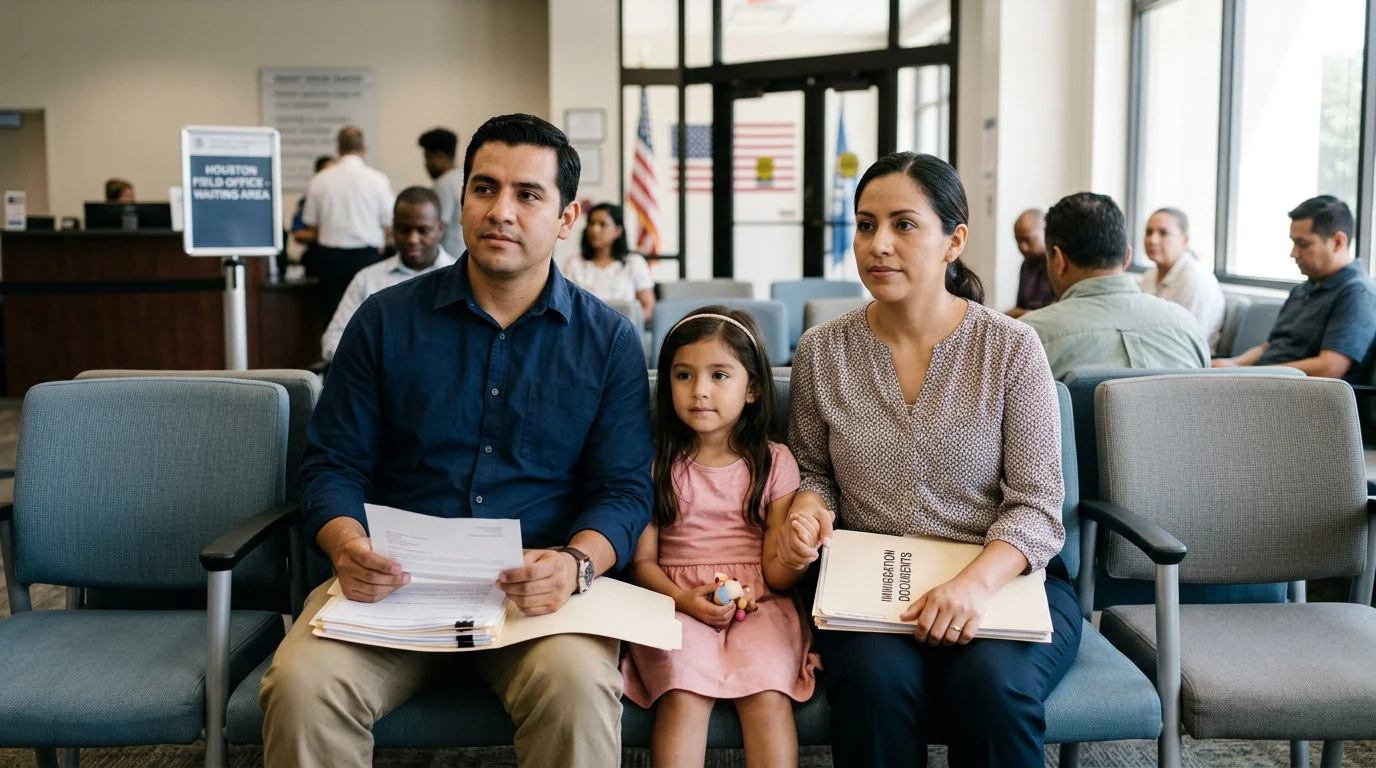
Houston | Green Card Interviews
Prepare for Your Green Card Interview with Confidence
Learn how the interview room works, which papers to organize, and when it makes sense to bring a lawyer into your case.
By Adriana Gomez · Published November 10, 2026
If you have a notice for your green card interview, you probably want to know what happens in the room and what to bring. USCIS rules say each applicant for adjustment of status shall be interviewed, with only a few limited exceptions. The notice sets the date, time and place, and that is where preparation starts.
This guide explains what the interview covers, what to bring, when a waiver question can come up, and what happens after the interview. It is written for people who already have a Form I-485 on file.
What the Green Card Interview Is and Who Attends
The green card interview is the in-person meeting with a USCIS officer that is part of an adjustment of status case.
Adjustment of status lets a person who is physically in the United States apply for a green card. The Migration Policy Institute notes that adjustment from another status is one of several green card pathways.
The interview rule is firm. 8 C.F.R. § 245.6 says each applicant shall be interviewed by an immigration officer. The interview may be waived only for a child under 14, when the applicant is clearly ineligible, or when USCIS decides an interview is unnecessary.
Preparation matters most when your case has a prior immigration history, a waiver filed, or family-based or employment-based facts that take some explaining.
If your notice names the Houston or San Antonio field office and a waiver is part of your file, our team can help you prepare before the interview date. Talk it through with our team — we can walk you through how a situation like yours is usually handled and what your options are.

What the Interview Covers at the Houston and San Antonio Field Offices
The officer reviews your identity and the facts behind your filed application. An officer can ask you to explain details on your forms, so your answers need to match what you filed.
USCIS sends the date, time and location of any required appearance, as 8 C.F.R. § 103.2 provides. Check the field office named on your notice before you plan the trip, since that is the location USCIS assigned.
The burden of proof sits with you. 8 U.S.C. § 1361 places the burden on the person seeking the status to show eligibility and that they are not inadmissible. Be ready to support each answer with records.
An interview can stay on the forms you filed. It can also move to a new question, such as a past entry, a job, or a gap in your documents. When that happens, the officer may ask for more evidence, which is covered below.
Documents to Bring Against Your Interview Notice
The notice controls your list. Start there and check every item it names.
Common categories include:
- The interview notice itself
- A valid photo ID and your passport or other identity documents
- A copy of the filed Form I-485 and its supporting forms
- Civil documents that show the family relationship or other basis for the case
- Proof of any waiver filed, with receipts
- Any other evidence the notice asks you to bring
Keep notes on what you filed. If a fact on your forms has changed since filing, bring the paperwork that explains why.
When a Waiver Question May Come Up
A waiver question can come up when the officer needs more information about a ground of inadmissibility that your waiver addresses. The provisional unlawful presence waiver rules in 8 C.F.R. § 212.7(e) cover certain applicants who are pursuing consular immigrant visa processing, and USCIS has exclusive jurisdiction to grant that waiver. The application goes on the form USCIS designates, with the fee and under the form instructions.
Waiver questions often focus on the history behind the ground and on the reasons the waiver should be granted. Under 8 U.S.C. § 1255, for a special immigrant described in section 1101(a)(27)(J), the government may waive some grounds of inadmissibility for humanitarian purposes, to assure family unity, or when otherwise in the public interest.
Whether a waiver is granted depends on the facts of your case. Preparation helps you keep your answers consistent with the waiver record you filed, so the officer hears the same account from the file and from you.
If the Interview Ends in a Request for Evidence or Denial
After an interview, the officer may approve the case, ask for more evidence, or deny it. A request for evidence pauses the processing clock. Under 8 C.F.R. § 103.2, if USCIS requests additional evidence or a response other than initial evidence, the time limit on USCIS processing is suspended as of the date of the request and resumes at the same point where it stopped when USCIS receives the requested evidence or response, or a request for a decision based on the evidence. If required initial evidence is missing, or an applicant, petitioner, sponsor, beneficiary, or other individual who requires fingerprinting asks to reschedule the fingerprinting appointment or interview, the time period starts over from the date USCIS receives the required initial evidence or the rescheduling request.
If the adjustment application is denied, the rules differ. 8 C.F.R. § 245.2 says no appeal lies from the director’s denial. The applicant, if not an arriving alien, keeps the right to renew the application in proceedings under 8 CFR part 240, and a parolee who meets the two conditions in § 245.2(a)(1) may also renew a denied application in those proceedings to determine admissibility, but nothing in this section entitles anyone to those proceedings who is not otherwise entitled to them.
Our practice covers removal defense and BIA appeals. If a denial leads to proceedings before an immigration judge, that is a matter we can discuss.
Keep every notice. When a notice comes by mail, 8 C.F.R. § 103.8 adds 3 days to any period you have to act after service. Those days matter when you are working against a deadline.
How Interview Preparation Works With Our Team
Preparation runs in four steps, from first contact through follow-up after the interview. The timing depends on the interview date USCIS sets and how complex your file is.
- Intake. You send the interview date, field office, and filing history through the contact form, by phone, or by WhatsApp.
- File review. We compare the Form I-485 record, any waiver filing, and the interview notice side by side.
- Practice session. We walk through likely questions on your forms, your waiver record, and your timeline, with time for your questions.
- Follow-up. If a request for evidence or another notice arrives, we help you respond within the time the notice allows.
Start as soon as you have the notice. Early review leaves time to gather records that take weeks to obtain.
Not sure what your next step is?
Talk it through with our team — we can walk you through how a situation like yours is usually handled and what your options are.
Why Work With AG Immigration Law P.A.
AG Immigration Law P.A. focuses on removal defense, adjustment of status, family petitions, naturalization, removal of conditions on green cards, waivers, and BIA appeals.
Adriana Gomez is the responsible lawyer for this page. Our team also includes support staff who handle scheduling, document organization, and intake, so you will hear from them as well.
The practice covers both the filing stage and the defense stage. That matters when an interview leads to a request for evidence or to proceedings before an immigration judge.
Frequently Asked Questions
Do I need a lawyer for my green card interview?
Whether to bring a lawyer is your choice. Preparation matters most when a waiver, prior history, or possible denial is part of your case.
What if I lost my interview notice?
Check your USCIS account and your mail. Act before the interview date, since the notice sets the time and place.
Review any request with a lawyer before you send it.
What should I bring to a consultation?
Bring your interview notice, a copy of the filed Form I-485, any waiver filing, and your identity documents.

Book Your Interview Preparation Consultation
If your notice names the Houston or San Antonio field office and your file includes a waiver, a paid consultation with our team is the next step. Use the contact form, call the office, or send a WhatsApp message with your interview date and notice details ready. Consultations are paid.
How Our Team Supports Your Interview Preparation
Document Review
We go through your filed forms, supporting evidence and prior submissions so nothing surprises you at the interview.
Question Preparation
We talk through the questions you may be asked about your marriage, your history and your application, so your answers are clear and consistent.
Attention to Prior History
If an arrest, a prior immigration filing or a possible denial is part of your file, we address it before you walk into the office.
Family Petition Support
For family-based cases, we help couples and family members understand what the officer will review and how to present it.
Do Not Ignore Your Interview Notice
Your interview notice sets the date, time and location. If you cannot attend, or you have not received the notice, contact our office right away instead of waiting to see what happens.
What to Expect on the Day
Arrive Prepared
Bring the original notice, your identification, and the documents listed on your appointment instructions. Arrive with enough time to clear security.
The Officer Review
The officer will verify your identity, review your file and ask questions about your application. Answer truthfully and briefly, and ask for clarification if a question is unclear.
Possible Requests
The officer may ask for additional documents, request a second interview or raise concerns about your case. Do not sign anything you do not understand.
After the Interview
You may receive a decision that day or later by mail. Keep copies of everything you were given and share them with your lawyer.