


Adjustment of Status | Florida & Texas
Your I-485 Is Approved. What Comes Next?
Approval is a major milestone, but the path from notice to permanent residence has steps that deserve careful attention. Here is how to read your paperwork and plan ahead with confidence.
By Adriana Gomez · Published November 11, 2026
An I-485 approval notice is a significant step, and it’s natural to wonder what it means for your green card.
The approval and the card are not quite the same thing. The approval records your permanent residence as of the approval date. The physical green card is a separate document, and it usually arrives later.
This page is written by Adriana Gomez of AG Immigration Law P.A. It explains the difference between the approval and the card, and what can change the timeline.
Short answer: approval and the green card are not the same document
An I-485 approval means the government granted your adjustment of status. Under 8 U.S.C. § 1255, your lawful admission for permanent residence is recorded as of the date the approving order is made.
Adjustment of status lets certain people already in the United States apply for permanent residence. The government may grant it in its discretion. The applicant must be eligible for an immigrant visa and admissible, and a visa must be immediately available when the application is filed.
The green card is different. It is the physical proof of your status, often called Form I-551. It is produced and mailed after the decision, and the timing varies.
Many people see the word “approved” and assume the card is already in the mail. Read the notice carefully and keep it with your other papers.
If you are holding an I-485 approval notice and wondering what it means for your next steps, our team can talk it through with you. Talk it through with our team — we can walk you through how a situation like yours is usually handled and what your options are.
What the I-485 approval notice shows and what it does not replace
The approval notice is the written record that USCIS decided your case in your favor. It shows that the decision was made. It is not the card itself.
Notices usually arrive by ordinary mail. Under 8 C.F.R. § 103.8, routine service means mailing to the affected party and to the attorney or representative of record. When a notice is served by mail, 3 days are added to any time limit that starts with that notice.
That is why you should keep every USCIS notice in one folder. Keep the envelopes and receipts too.
What typically happens after the I-485 is approved
After approval, the next step is usually production and mailing of your card. USCIS sends it to the address it has on file. The timing varies, and it can be different in every case.
Your address is the main thing you control during the wait. Under 8 C.F.R. § 265.1, people required to register must report each change of address within 10 days, following USCIS instructions. The same 10-day rule appears in 8 U.S.C. § 1305.
If you move during the wait, the card goes to the old address unless you report the change.
To check where your case stands, use the USCIS case status tool on the official website. Your residence date stays the approval date, even if the card arrives later.
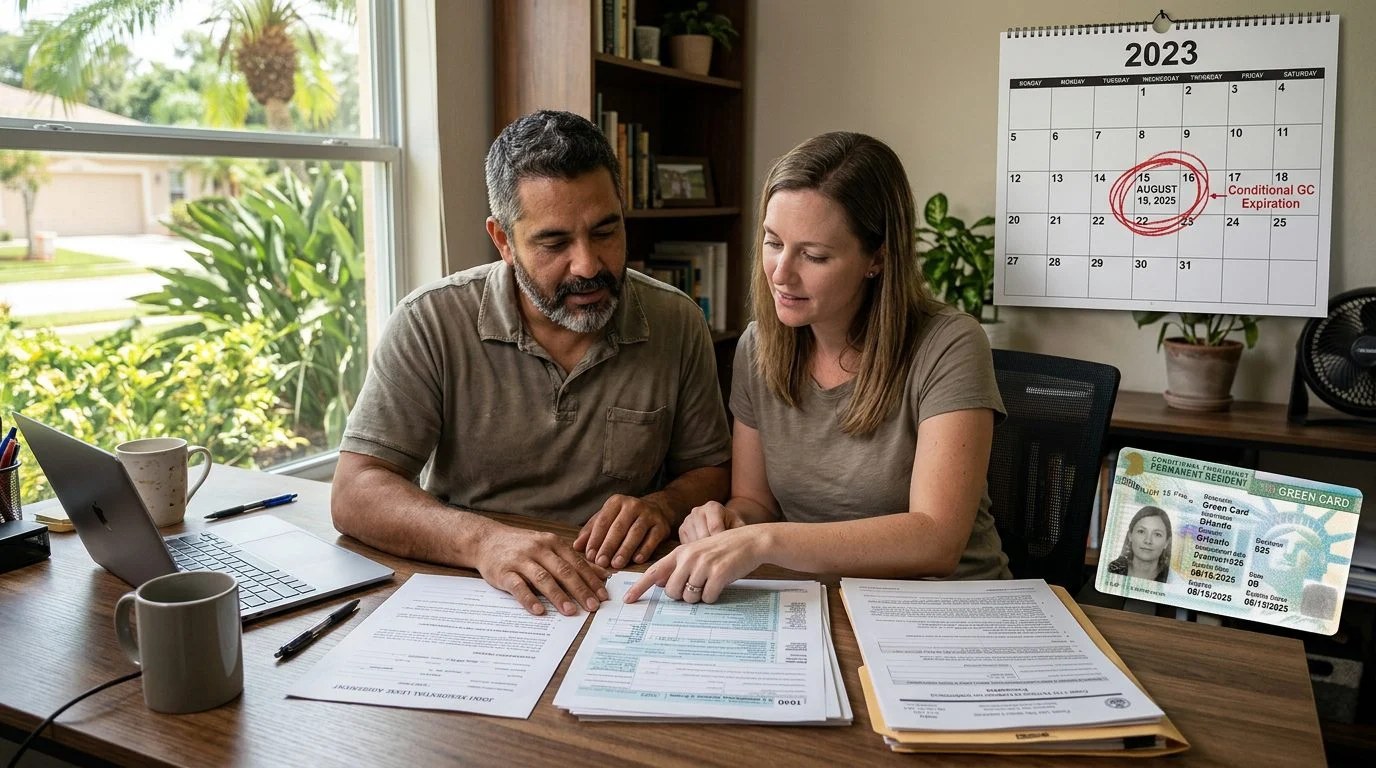
Conditional green cards and other cases that change the timeline
Some green cards are conditional, and that changes the timeline. Under 8 U.S.C. § 1186a, a spouse or child who gets permanent residence through a qualifying marriage obtains it on a conditional basis. The condition is removed as of the second anniversary if the facts check out.
Under 8 C.F.R. § 216.4, failure to properly file Form I-751 within the 90-day period immediately before the second anniversary of getting conditional residence results in automatic termination of permanent residence and the start of removal proceedings. A late filing is possible only if the applicant establishes to the director’s satisfaction, in writing, that there was good cause.
Other facts can change the picture. Exceptional circumstances are the exception.
If USCIS denies an adjustment application, no appeal lies from the director’s denial. A non-arriving applicant can still renew the application in removal proceedings, under 8 C.F.R. § 245.2.
Questions about removal defense can arise at different stages of an immigration case. Missed conditional filing deadlines are covered on our removal of conditions on green cards page.
Common questions about citizenship and wait times
A green card does not make you a U.S. citizen. Citizenship requires a separate application.
Does a green card make me a U.S. citizen?
No. Under 8 U.S.C. § 1427, naturalization generally requires at least five years of residence after lawful admission. Learn more on our naturalization page.
Can someone with a conditional green card apply for citizenship?
Yes, if otherwise eligible. Under 8 C.F.R. § 216.1, conditional permanent residents keep the right to apply for naturalization if they are otherwise eligible. 8 C.F.R. § 216.1 reads: “All references within this chapter to lawful permanent residents apply equally to conditional permanent residents, unless otherwise specified.” 8 C.F.R. § 216.1 reads: “Unless otherwise specified, the rights, privileges, responsibilities and duties which apply to all other lawful permanent residents apply equally to conditional permanent residents, including but not limited to the right to apply for naturalization (if otherwise eligible), the right to file petitions on behalf of qualifying relatives, the privilege of residing permanently in the United States as an immigrant in accordance with the immigration laws, such status not having changed; the duty to register with the Selective Service System, when required; and the responsibility for complying with all laws and regulations of the United States.”
How long does the green card take to arrive?
Processing times change, so check the USCIS processing time information for current figures.
When you have an approved or pending case and need help sorting out next steps
Readers in this situation may have different needs. Some hold an approval notice and are waiting for the card. Some have a pending case while a removal concern is open. Others are explaining a notice to a family member.
Each group depends on facts that do not appear on the notice. These include how the status was obtained, whether a conditional period applies, and what the immigration record shows. The answer depends on the facts in your file.
If you are holding that approval notice and unsure what it means for the months ahead, reach out to our team. You can call the office, send a WhatsApp message, use the contact form, or book a consultation.
How AG Immigration Law P.A. Can Help
Adjustment of Status
We guide clients through the I-485 process, from filing to the steps that follow approval.
Removal Defense
We defend clients in removal proceedings and work to protect their immigration status.
Family Petitions
We help U.S. citizens and permanent residents petition for qualifying family members.
Naturalization
We prepare clients for the citizenship application process and what follows.
Removal of Conditions
We assist conditional residents with removing conditions on their green cards.
Waivers and BIA Appeals
We handle waiver applications and appeals before the Board of Immigration Appeals.
Before You Travel or Respond to a Notice
Approval paperwork and card timing can be confusing, and mistakes can affect your case. Contact our office before you travel, respond to a government notice or make a major filing.
Ways to Reach Our Office
Fill Out Our Contact Form
Tell us about your situation and we will follow up with next steps.
Call the Office
Speak directly with our team about your approval notice and questions.
Message Us on WhatsApp
Send a quick message to start a conversation with our staff.
Book a Paid Consultation
Schedule a paid consultation for a detailed review of your case with our attorneys.