

Removal Defense
Facing a Removal Order? Learn What a Motion to Reopen Can and Cannot Do
The type of order you received, where your case stands today, and whether a stay is in place all shape the path forward, so it helps to plan with a clear picture.
By Adriana Gomez · Published November 9, 2026
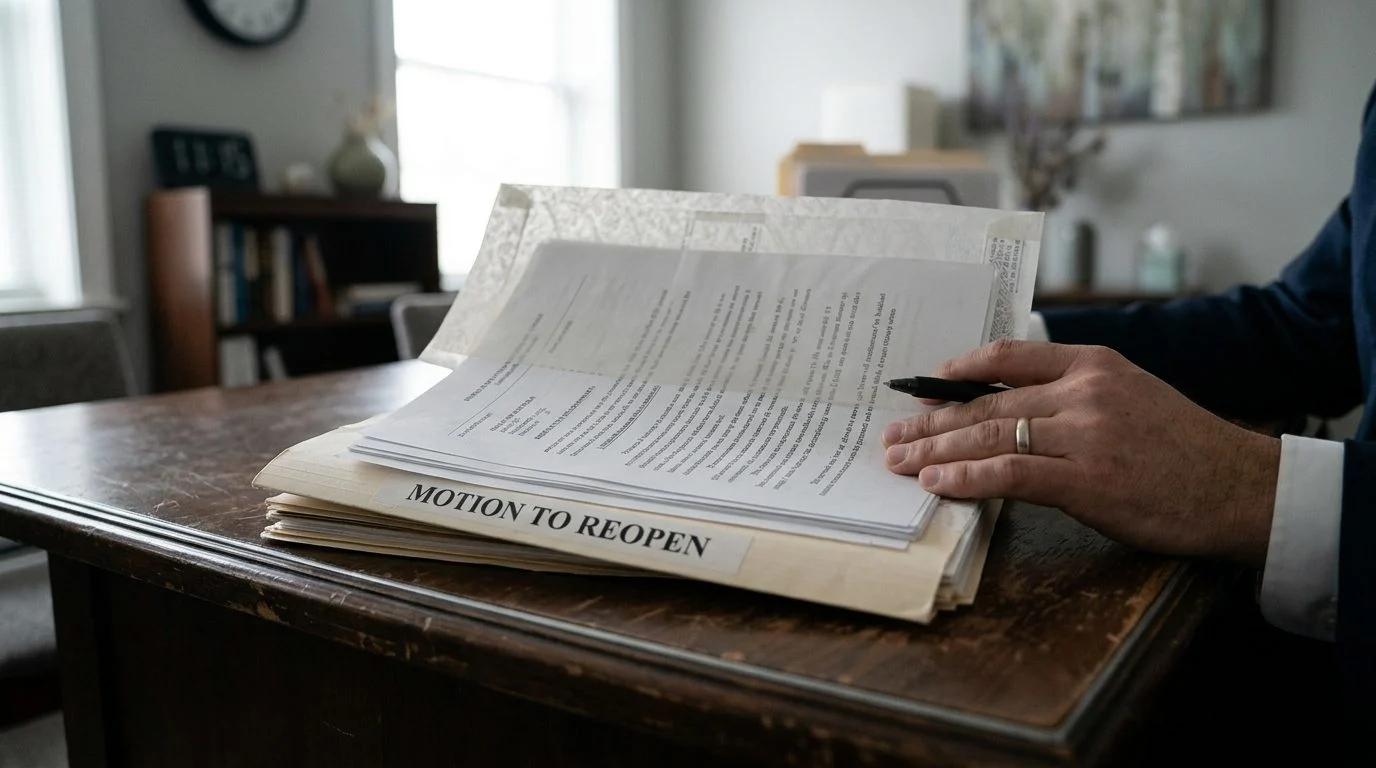
If you already have a removal order, you may be asking whether a motion to reopen will pause it. It will not, by itself. Under 8 C.F.R. § 1003.23, except in cases involving in absentia orders, the filing of a motion to reopen or a motion to reconsider does not stay the execution of a decision made in the case. Here is what they say and what to do about it.
A Pending Motion Does Not Automatically Pause Removal
Filing a motion to reopen does not, on its own, stop an order from being carried out. Removal can proceed while the motion waits for a decision. Except where a motion is filed pursuant to the provisions of 8 C.F.R. § 1003.23(b)(4)(ii) and (b)(4)(iii)(A), execution goes ahead unless a stay is specifically granted by the immigration judge, the Board of Immigration Appeals, or an authorized DHS officer. A pending motion is not a stay. It is only a request, and you still need a decision that pauses the order. Many people assume the filing itself offers protection. Results depend on the facts of your case, including the type of order and where it was issued. The rules that control this appear in two places: one for the immigration court and one for the Board.
If you're weighing a pending motion to reopen against a stay request, we can talk through your situation and your options with you. Talk it through with our team — we can walk you through how a situation like yours is usually handled and what your options are.

What 8 CFR 1003.23 Says About Motions Before the Immigration Court
Except in cases involving in absentia orders, a motion to reopen filed with the immigration judge does not stay execution of the decision. 8 CFR 1003.23 makes that rule clear, except in cases involving in absentia orders. The same section sets procedure. Unless the immigration judge permits otherwise, the motion must be in writing and must state its grounds with particularity, the relief sought, and the jurisdiction. It must be filed with the immigration court that has administrative control over the Record of Proceeding. Confirm the correct court before you file, because a filing sent to the wrong place can slow the motion. A represented party must file Form EOIR-28 with the motion. A missed step can delay the motion, and delay matters when removal could happen. Treat the filing checklist as part of the stay strategy, not as paperwork to finish later.
What 8 CFR 1003.2(f) Says About Motions Before the Board
Except in in absentia cases, filing a motion to reopen or a motion to reconsider does not stay execution of the decision, and execution proceeds unless a stay is specifically granted. Subsection (f) of 8 CFR 1003.2 provides that execution proceeds unless the Board, the immigration judge, or an authorized DHS officer specifically grants a stay. The main exception is the in absentia rule discussed below. The forum matters because the decision-maker for a stay depends on where the case sits. Check the case history before you choose a forum, since the rules differ by where the case was decided. The Board also holds discretion. It may deny a motion to reopen even when the moving party makes a prima facie case for relief. A motion to reopen must state the new facts that will be proven at a hearing to be held if the motion is granted and be supported by affidavits and other evidentiary material. Any motion and submission must be in English or come with a certified English translation. Keep a copy of every Board filing and the proof of service.
How a Stay Is Requested and Why the Request Must Be Specific
A stay must be asked for on purpose, and an adjudicator decides it. The request should say why a pause is needed and what relief you want. A request that is vague or buried in a long motion is easy to overlook, so state it early. The Board may, in its discretion, stay deportation while an appeal is pending from an immigration judge order denying a motion to reopen or reconsider, if no stay has been granted by the Immigration Judge or a Service officer, under 8 CFR 1003.6. Even if DHS denies a stay, an immigration judge or the Board can still grant a stay connected to a previously filed motion to reopen or reconsider, under 8 CFR 1241.6. A denial of a stay by DHS does not prevent an immigration judge or the Board from granting a stay in connection with a previously filed motion to reopen or reconsider. That applies when no stay was granted earlier, under 8 CFR 1003.6. Enforcement timing can change the practical situation quickly. Each request turns on its own record.
The In Absentia Exception and Rescission Motions
A motion to reopen filed to rescind an in absentia order is the main exception. Under 8 CFR 1003.23, filing a motion to reopen under paragraph (b)(4)(iii)(A) to rescind a deportation in absentia order halts deportation while the motion is decided and any properly filed administrative appeal is adjudicated, and filing a motion under paragraph (b)(4)(ii) to rescind a removal order entered in absentia or in removal proceedings under section 240(b)(5) of the Act also halts removal until the immigration judge disposes of that motion. An in absentia order is entered when a person does not appear for the hearing. Whether your order fits this group turns on the record. Check the hearing notices, the address they were sent to, and whether you received notice of the hearing date. Gather proof of where notices went, since that record matters in these cases. These facts decide whether the exception fits. A common mistake is to assume every removal order is in absentia without reading the record. Another is to overlook the notice history that could support a rescission motion. AILA’s federal summary of motions to reopen removal cases covers motions that follow in absentia orders, along with deadlines and numerical limits.
Timing Limits That Shape the Filing Decision
Motions to reopen have deadlines and limits on how many you can file. Under 8 CFR 1003.23, a motion to reopen generally must be filed within 90 days of the date of entry of a final administrative order of removal, deportation, or exclusion, or on or before September 30, 1996, whichever is later. That time limit does not apply to motions by DHS in removal proceedings under section 240 of the Act. It also does not apply to a motion to reopen to apply for asylum, withholding of removal, or protection under the Convention Against Torture based on changed country conditions in the country of nationality or the country to which removal has been ordered, subject to the regulation’s further conditions. It does not apply to a motion to reopen filed under the regulation’s provision for rescinding an order entered in absentia in deportation proceedings, or to a motion to reopen agreed upon by all parties and jointly filed. A motion to reconsider must be filed within 30 days. A party may file only one of each, subject to listed exceptions. Under 8 CFR 1003.23, an immigration judge may reopen or reconsider any case in which the judge has rendered a decision, unless jurisdiction is vested with the Board of Immigration Appeals. Subject to the exceptions in this paragraph (b)(1) and paragraph (b)(4), a party may file only one motion to reconsider and one motion to reopen proceedings. These time and numerical limitations do not apply to motions by DHS in removal proceedings pursuant to section 240 of the Act. Two more rules affect timing. A motion cannot be made by or on behalf of a person who has left the United States while in removal proceedings. Any departure after filing withdraws the motion. A late or second motion can affect both the merits and any stay request, so review dates early. Dates also affect later relief options, so write them down in one place. Keep the order, filing receipts, and every notice together, because dates drive the analysis.
Not sure what your next step is?
Talk it through with our team — we can walk you through how a situation like yours is usually handled and what your options are.

Next Steps If You Have a Removal Order and a Motion to Reopen
Your next step is to decide, with your records in hand, whether a stay request belongs in your filing. Start by confirming the order type, the key dates, and whether the order was entered in absentia. Often, a motion, a stay request, and other relief arguments interact, so plan them together. Related relief matters too. So the timeline needs an early review. Adjustment of status has its own limits. For the broader picture, read our removal defense overview.
If you’re weighing a pending motion to reopen and whether to request a stay, you can reach out through our contact page, by phone, or on WhatsApp. Adriana Gomez is the responsible lawyer for this page.
Frequently asked questions
Does a motion to reopen stop deportation?
Not by itself. Execution proceeds unless a stay is specifically granted, except for certain in absentia motions.
How long do I have to file a motion to reopen?
Generally within 90 days of the final order. A motion to reconsider generally must be filed within 30 days.
Who can grant a stay?
The immigration judge, the Board, or an authorized DHS officer can grant one.
Can I file a motion after leaving the United States?
Generally no. The rule bars a motion made by or on behalf of a person who left while in removal proceedings.
Stay requests and motions
A stay generally takes effect only if the decision-maker specifically grants it, although certain in absentia motions stay removal when they are filed.
Do Not Assume a Filing Will Pause Your Case
Submitting a motion does not always stop enforcement of an order. Before you take any step or miss a deadline, speak with our team about your specific situation.
How Our Practice Can Help
Removal Defense Focus
Our practice focuses on removal defense, including motions to reopen, motions to reconsider and BIA appeals.
Related Immigration Matters
We also handle adjustment of status, family petitions, naturalization, removal of conditions on green cards and waivers.
Clear Communication
Our team keeps you informed about each step, so you know what is happening and what comes next.
Easy Ways to Reach Us
Call the office, send a message on WhatsApp or complete our contact form to get started.
Questions to Bring to Your Consultation
Which Order Did You Receive?
Bring any decision or notice you have so we can review the exact type of order in your case.
Where Is Your Case Now?
Tell us about any hearings, filings or appeals that are already pending or have been decided.
Has a Stay Been Requested?
Let us know whether a stay has been filed, granted or denied, and when that happened.
What Documents Do You Have?
Gather your immigration paperwork, prior applications and any relevant records to share with us.