

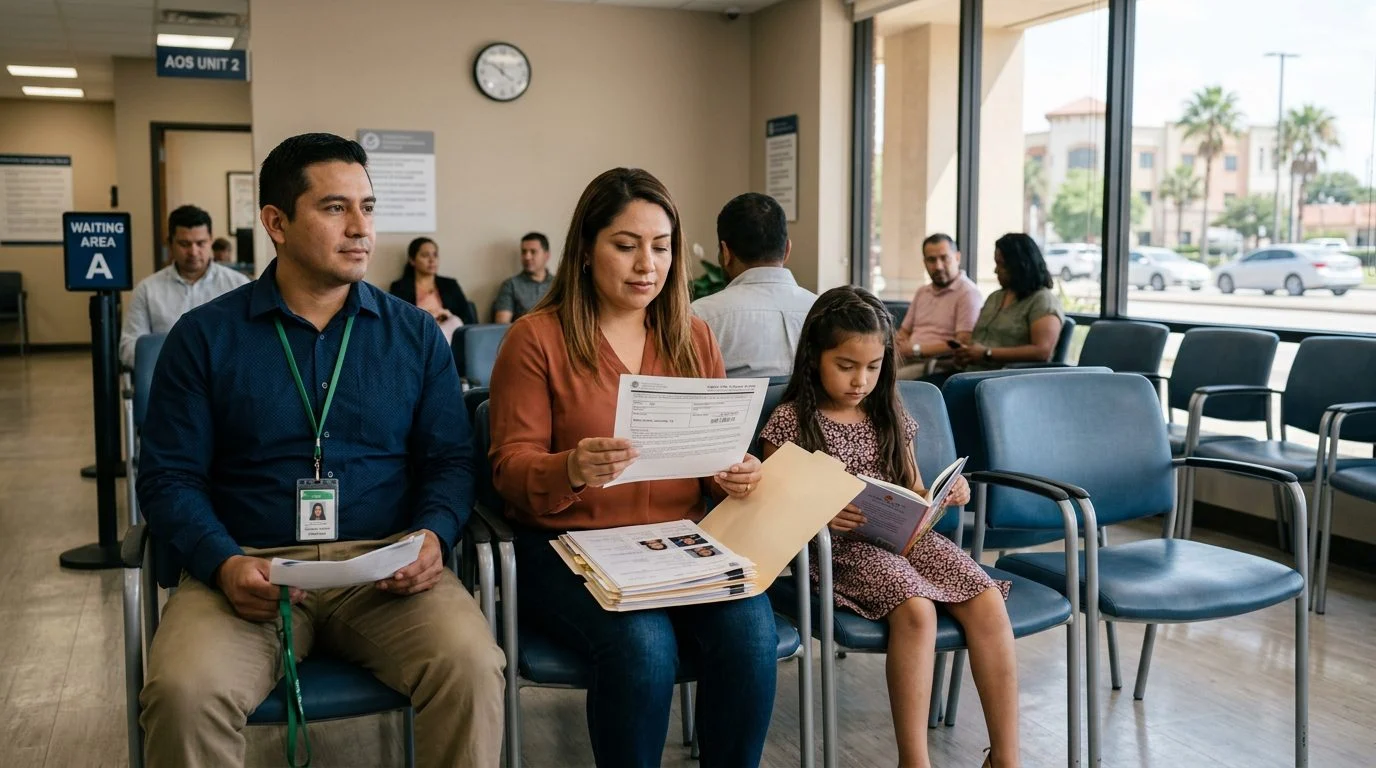
Adjustment of Status | Texas
Adjustment of Status Help for Immigrants in Texas
Turn a complicated path to a green card into a plan you can follow, with a lawyer who reviews your full history before you move forward.
By Adriana Gomez · Published November 12, 2026
Adjustment of Status Matters for San Antonio, Texas Clients
You’re living in the United States with a family petition or job approval in hand. You want to know if you can get your green card without leaving the country. Adjustment of status may be your path.
This page explains who can file, what the case involves, and what affects timing and risk. AG Immigration Law P.A. focuses on removal defense, adjustment of status, family petitions, naturalization, removal of conditions on green cards, waivers, and BIA appeals.
Not sure what your next step is?
Talk it through with our team — we can walk you through how a situation like yours is usually handled and what your options are.

What Adjustment of Status Is and Who It Helps
Adjustment of status is an application for a green card filed from inside the United States. It is an alternative to applying at a consulate abroad. Under 8 U.S.C. § 1255, the status of a person who was inspected and admitted or paroled may be adjusted to permanent residence if three things are true. The person files an application, is eligible for an immigrant visa and admissible, and an immigrant visa is immediately available when the application is filed.
The main form is Form I-485. Under 8 C.F.R. § 245.1, a person who is physically present in the United States may apply if they are eligible and a visa is ready at filing, unless they are ineligible to apply for adjustment of status under paragraph (b) or (c) of that section. Migration Policy Institute explains that federal law offers several green card pathways, including adjustment from another status and sponsorship by family or an employer.
This route often helps:
- Spouses, children, and parents of U.S. citizens or green card holders, when a family petition supports the case.
- Workers with an employer-sponsored petition.
- People who entered on a visa and now qualify under a category that allows filing.
Your basis for the green card, your admission history, and visa availability all affect whether you can file.
What Our Adjustment of Status Services Cover
Our adjustment work covers the filing itself and the steps USCIS requires after it. Services include:
- Eligibility review: finding which filing basis applies and what your entry history means for you.
- The I-485 package: preparing the form with supporting documents, including affidavit of support paperwork and proof of your family or job basis.
- Medical exam: under 8 C.F.R. § 245.5, an applicant must have a medical exam by a designated civil surgeon, unless they entered as a nonimmigrant spouse, fiancé(e), or child of a United States citizen under section 101(a)(15)(K) of the Act and were medically examined before the visa was issued (not more than 1 year before applying), and the report goes into the record. 8 C.F.R. § 245.5 reads: “A medical examination shall not be required of an applicant for adjustment of status who entered the United States as a nonimmigrant spouse, fianceé, or fianceeé of a United States citizen or the child of such an alien as defined in section 101(a)(15)(K) of the Act and § 214.2(k) of this chapter if the applicant was medically examined prior to, and as a condition of, the issuance of the nonimmigrant visa; provided that the medical examination must have occurred not more than 1 year prior the date of application for adjustment of status.”
- Interview preparation: under 8 C.F.R. § 245.6, each applicant is interviewed by an immigration officer unless the rules allow a waiver of the interview.
- Biometrics and notices: scheduling support, requests for evidence, and responses to USCIS notices.
- Related filings: family petitions and removal of conditions on a green card, which often run alongside adjustment.
- Adjustment in removal cases: requests made during removal proceedings, handled as part of our removal defense work.
Some matters may need to be referred to another lawyer or firm. If yours does, we’ll tell you.
How the Adjustment of Status Process Works
Adjustment moves in clear steps, from review to decision. Here is what to expect:
- Consultation. We review your immigration history, entries, current status, and the petition or job approval behind your green card.
- Document gathering. You collect civil records, passports, tax and financial records, and past immigration filings. We give you a checklist.
- Filing. We prepare and file the I-485 package with your supporting evidence.
- Biometrics and evidence requests. USCIS may schedule fingerprints or ask for more proof. We respond for you.
- Interview. If USCIS schedules one, we prepare you for it.
- Decision. Under 8 C.F.R. § 245.2, USCIS must tell the applicant its decision and, if the application is denied, the reasons. We then review your next steps with you.
Timing depends on USCIS processing and visa availability. We give you a range during your consultation rather than a fixed date.
Common Questions About Filing From Inside the United States
Your entry history and status decide whether you can file, and when. Here are the questions we hear most often in this area.
What if you entered without inspection or overstayed?
8 U.S.C. § 1255 bars adjustment for some people who are in unlawful status on the filing date, or who have not kept lawful status since entry. The statute has exceptions for immediate relatives in some of these bars. Each history needs its own review.
Filing alongside a petition:
Under 8 C.F.R. § 245.2, if approval of a visa petition in certain family and employment-based classifications would make a visa immediately available at the time of filing, the adjustment application is considered properly filed whether submitted concurrently with or after the visa petition, provided it meets the filing requirements in parts 103 and 245. For any other classification, the adjustment application may be filed only after the visa petition has been approved. The filing requirements for that category must still be met, as 8 C.F.R. § 245.2 explains.
What happens if you travel?
The effect of leaving the United States depends on the law under which you’re applying. Check before you travel.
What if you’re in removal proceedings?
You can seek adjustment in immigration court when the immigration judge has jurisdiction to adjudicate the application under 8 CFR 1245.2(a)(1). The ICE adjustment of status guide explains that an application made in removal proceedings is filed before an immigration judge. Timing matters, too.
What if your visa isn’t ready?
You generally can’t file until an immigrant visa is immediately available. Your priority date and visa availability answer that question.
Why Work With AG Immigration Law P.A.
AG Immigration Law P.A. focuses on the immigration areas listed above. Its practice covers adjustment, family petitions, waivers, and removal defense, so your case can follow one coordinated plan.
Adriana Gomez is the responsible lawyer for this page. Our team and support staff divide the work. Staff organize documents, track deadlines, and keep communication moving. Our attorneys review eligibility and risk before anything is filed.
- Written fees: we explain government filing fees in writing before filing.
- One plan: if your history calls for a waiver or a removal strategy, we review it alongside the I-485.
Not sure what your next step is?
Talk it through with our team — we can walk you through how a situation like yours is usually handled and what your options are.
Preparing for Your Adjustment of Status Consultation
Bring records of your full immigration history to your consultation. The more complete your records, the more useful the first meeting.
- Passports and every visa you have held
- I-94 records and any earlier USCIS notices
- Marriage and birth certificates, plus proof of the petition or job offer
- A list of every address, employer, and trip outside the U.S. since your first entry
- Details of any arrests, court dates, or removal orders
Frequently Asked Questions About Adjustment of Status
How long does adjustment of status take? Timing depends on USCIS processing. Under the rule, an immigrant visa must be immediately available to you at the time the application is filed. We give you a range during your consultation.
Do I need a lawyer to file Form I-485? A lawyer helps you review eligibility and risk before you file. That review can prevent problems later.
Is adjustment available in removal proceedings? Often, yes: for anyone in deportation or removal proceedings (other than as an arriving alien), the immigration judge hearing the case has exclusive jurisdiction to decide any adjustment of status application the person files. Our removal defense work covers this path.
Do I need a medical exam? Yes. A designated civil surgeon must examine you as part of the application.
Is there an interview? Each applicant is interviewed by an immigration officer unless the rules waive the interview.
Can I work while my I-485 is pending? Work authorization is a separate question. We review your options during your consultation.

Contact AG Immigration Law P.A. About Your Green Card Case
If your petition is approved and you’re already in the United States, the next decision is whether to file your I-485 now or wait. Reach out through our contact form, by phone, or by WhatsApp to schedule a paid consultation. Bring your records, and we’ll walk through your options with you.
Why Immigrants Work With Our Office
Focused Immigration Practice
Our practice focuses on immigration law, including adjustment of status, removal defense, family petitions, naturalization, and waivers.
Careful Review of Your History
Entries, status, travel, and prior filings all affect how an adjustment case is built, so we look at each part of your record.
Support Staff Keeping Your Case Moving
Our assistants and office staff help organize documents, track deadlines, and keep communication clear from start to finish.
Serving Texas Communities
We work with immigrants across Texas, including clients in Houston and San Antonio.
Talk Before You Travel or File
Your immigration history can change the answer to your green card question. Travel, unlawful status, or a prior removal matter should be reviewed by a lawyer before you make any decision.
How We Approach Your Adjustment Case
1. Share Your Story
Tell us about your entries, status, travel, and any past filings so we can understand your full immigration picture.
2. Review Your Options
We look at the relevant immigration rules and how they apply to your history, then explain the path that fits your case.
3. Prepare Your Filing
Our team helps gather and organize supporting documents so your application is complete and well presented.
4. Stay Informed
We keep you updated on each step, answer your questions, and coordinate with you as your case moves forward.