

Adjustment of Status | Removal Defense
Thinking About Filing an I-485 While Your Court Case Is Pending?
The right filing path depends on your case. Talk with Adriana Gomez at AG Immigration Law P.A. before you file.
By Adriana Gomez · Published November 8, 2026
Short Answer: Can You File Form I-485 While Removal Proceedings Are Pending?
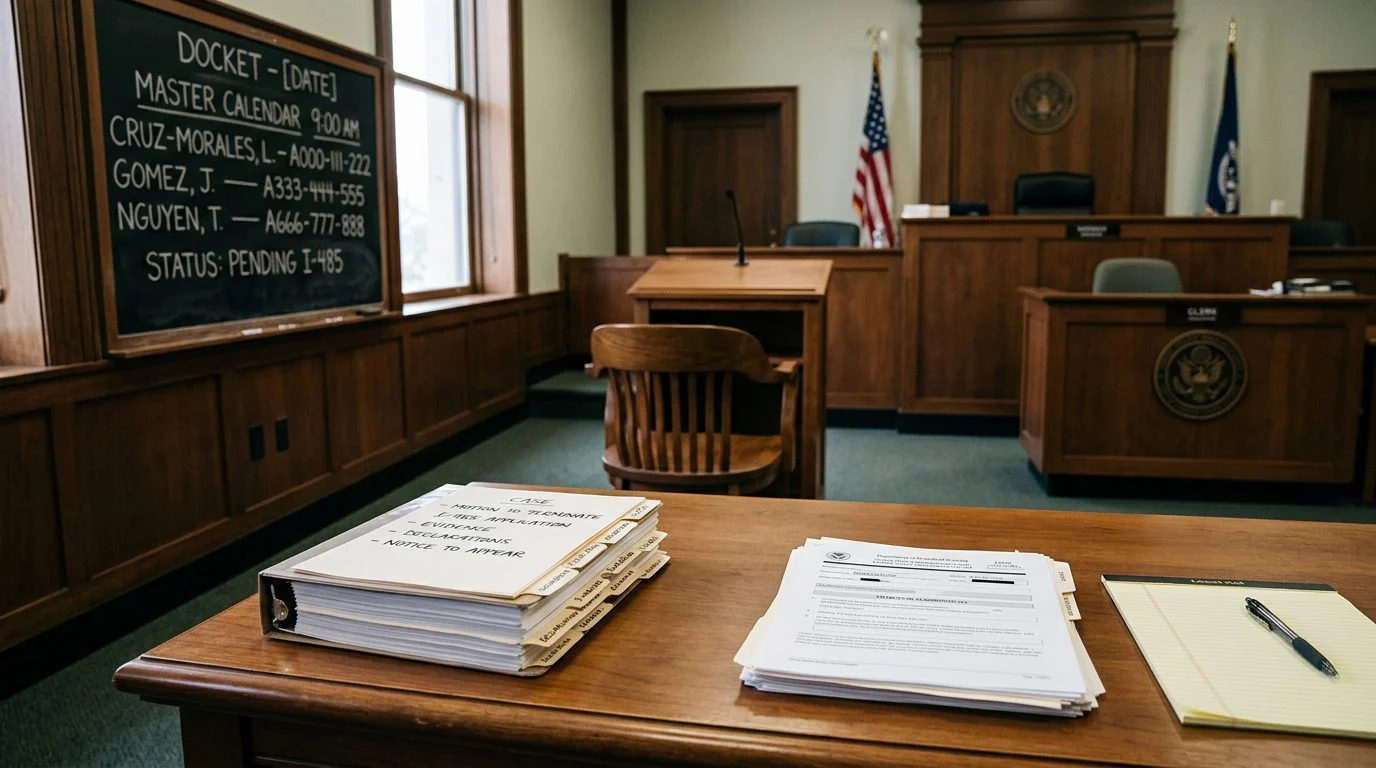
Sometimes, but the place you file depends on where your case sits. Can I file I-485 while my immigration court case is pending? Once removal proceedings start, the immigration judge generally has exclusive authority over an adjustment of status application, unless you are an arriving alien; for an arriving alien, the judge has no jurisdiction unless the conditions listed in the rule are met. That can mean the court, not USCIS, is the right place to file. 8 CFR 1245.2 sets out this rule. 8 CFR 245.2 explains that USCIS handles these applications unless the judge has jurisdiction.
Your Notice to Appear, the charges in it, and the current status of your case all shape the answer. A case that is still open may follow a different path than one that has been closed or terminated. Confirm the filing path before you send anything.
If your removal case is still open and you're unsure whether your green card application can move forward, you don't have to sort it out alone. Contact our office to talk through your situation. Talk it through with our team — we can walk you through how a situation like yours is usually handled and what your options are.

What Form I-485 Is and Who It Covers
Form I-485 is the application for adjustment of status. It lets an eligible person in the United States apply for a green card without leaving the country. An immigrant visa must also be immediately available when the application is filed.
Three questions come up in most cases:
- Is there a qualifying basis, such as family, work, or asylum?
- Is an immigrant visa available in that category when the application is filed?
- Is the person admissible, or can a waiver address the problem?
Not everyone starts from the same place. One listed group is a person who was not admitted or paroled after inspection. For the wider framework, see our adjustment of status overview.
Asylum, Family, and Other Pending Cases: How Timing Changes
Asylum has its own timing rules, separate from the general I-485 rules. An asylee may apply to adjust after being physically present in the United States for at least one year after the asylum grant, under 8 U.S.C. § 1159. The asylee regulation also requires that the applicant not be firmly resettled in another country and be admissible at the time of examination. Under 8 U.S.C. § 1159, the applicant must also continue to be a refugee within the meaning of section 1101(a)(42)(A) of this title or a spouse or child of such a refugee. See 8 CFR 209.2.
Confusion often starts when a pending asylum case and a pending I-485 exist together. Each filing has its own rules and its own receipt, so the order matters. Keep every receipt notice and check which basis each application rests on.
Many people ask about work permits. Under 8 CFR 274a.12(c), USCIS may set a validity period for employment authorization, and that period may include a pending appeal or judicial review. 8 CFR 274a.12 states this. Anyone in a class that must apply for work authorization still needs to apply.
Family cases follow their own sequence. Some family-based applicants file an I-130 petition alongside the I-485. Some cases also need a waiver of a ground of inadmissibility.
How the Process Works: Step-by-Step and What to Expect
Most cases move through the same basic steps, in this order.
- Review your Notice to Appear. Federal immigration law requires the notice to specify the nature of the proceedings against you, the acts or conduct alleged to be in violation of law, and the charges against you. Read each charge closely.
- Confirm the forum. Decide whether the immigration judge or USCIS has jurisdiction over the application. If you are in deportation or removal proceedings (other than as an arriving alien), the immigration judge hearing the proceeding has exclusive jurisdiction to adjudicate the application. Confirm the forum. Decide whether the immigration judge or USCIS has jurisdiction over the application. Under 8 CFR 1245.2(a)(2)(i)(C)(3), when the visa petitioner filed a Form I-140 visa petition, for which a visa number has become immediately available, on, before, or after July 31, 2002, the adjustment application is treated as concurrently filed if the applicant files it with the Immigration Court or the Board of Immigration Appeals when jurisdiction lies under paragraph (a)(1), together with proof of payment of the filing fee with the Service and a copy of the Form I-797 Notice of Action establishing the receipt and acceptance of the underlying I-140 petition.
- Build the package. Gather receipts, prior filings, evidence of your basis for filing, and proof of your address. Our support staff help organize these records.
- Track every date. Court hearings, appointments, and notices all matter. A missed hearing can change the outcome of both the removal case and the adjustment case.
- Plan for the decision. Timing varies widely by office and category. Under 8 CFR 245.2, no appeal lies from a director’s denial, but an applicant who is not an arriving alien may renew the application in removal proceedings, and an applicant who is a parolee and meets the two conditions described in § 245.2(a)(1) may also renew a denied application in removal proceedings to determine admissibility. We discuss realistic timing for your case, not a predicted date.
Common Mistakes That Put a Pending Case at Risk
- Missing a court hearing. The judge can order removal in absentia when the government shows clear, unequivocal, and convincing evidence of removability and proper written notice. See 8 CFR 1003.26.
- Missing a hearing can lead to an order of removal in absentia. An in absentia removal order can affect the relief you may be able to seek, so questions about notice should be raised with counsel promptly.
- Ignoring address changes. You must give your address and phone number, and you must report any change right away.
- Filing in the wrong place. A wrong office or an incomplete package can delay or derail the application.
- Relying on general online advice. Two cases can look alike and still differ on one charge or one prior order.
- Leaving the country without advice. Talk with counsel before any trip abroad.
Keep every notice, receipt, and court paper together. Clear records make the review faster and more accurate.
Why Work With AG Immigration Law P.A.
AG Immigration Law P.A. focuses on removal defense. The firm also handles adjustment of status, family petitions, naturalization, removal of conditions on green cards, waivers, and BIA appeals. Adriana Gomez is the responsible lawyer for this page.
Our support staff, including assistants and office staff, help organize filings, notices, and court dates. Our team works with immigrants across the US, including people with cases in Florida, Texas, and New York. The work centers on each person’s charges, filing history, and goals.
Not sure what your next step is?
Talk it through with our team — we can walk you through how a situation like yours is usually handled and what your options are.
Frequently Asked Questions
Can I apply for an I-485 while in removal proceedings?
Possibly. The immigration judge may have jurisdiction, so confirm the filing path before you file.
How long after asylum approval can I get a green card?
An asylee may apply after one year of physical presence in the United States following the asylum grant. Other requirements also apply.
Can I apply for a work permit while my I-485 is pending?
It depends on your category and filing history. Ask about your eligibility before you file.
Why is USCIS taking so long to process my case?
Processing times vary by office and category. Ask about the timing that applies to your specific case.
Is a consultation paid?
Yes, consultations are paid. Contact our office for current details before you book.

Talk to Our Team About Your Pending Case
If you’re waiting on a court date, worried about a pending asylum case, or helping a relative whose I-485 seems stuck between the court and USCIS, you don’t have to sort it out alone. Reach out through our contact form, call the office, or message us on WhatsApp to book a consultation.
Questions to Settle Before You File
Where is your case?
Whether your case is before an immigration judge or has moved to a different stage changes which path may be available to you.
Which forms apply?
An I-485 filed with the wrong office or at the wrong time can create problems. Confirm the forms and filing location first.
What supporting evidence do you have?
Gathering your records early helps us assess your situation and prepare a complete filing.
What happens next?
We will explain the options that apply to your case and how each one could affect your court proceedings.
Do Not File on Your Own Assumptions
Filing an adjustment application while removal proceedings are open involves jurisdiction and timing questions. Speak with our team before you submit anything to USCIS or the court.
How We Can Help
Focused removal defense practice
Our practice focuses on removal defense, adjustment of status, family petitions, naturalization, waivers, and BIA appeals.
Clear explanations
We explain the filing path, the forms, and the open questions in plain language so you can make informed decisions.
Support from our team
Our team, including assistants and office staff, helps keep your documents, deadlines, and communications organized.
Multiple ways to reach us
Call the office, send a message on WhatsApp, or complete the contact form to get started.