

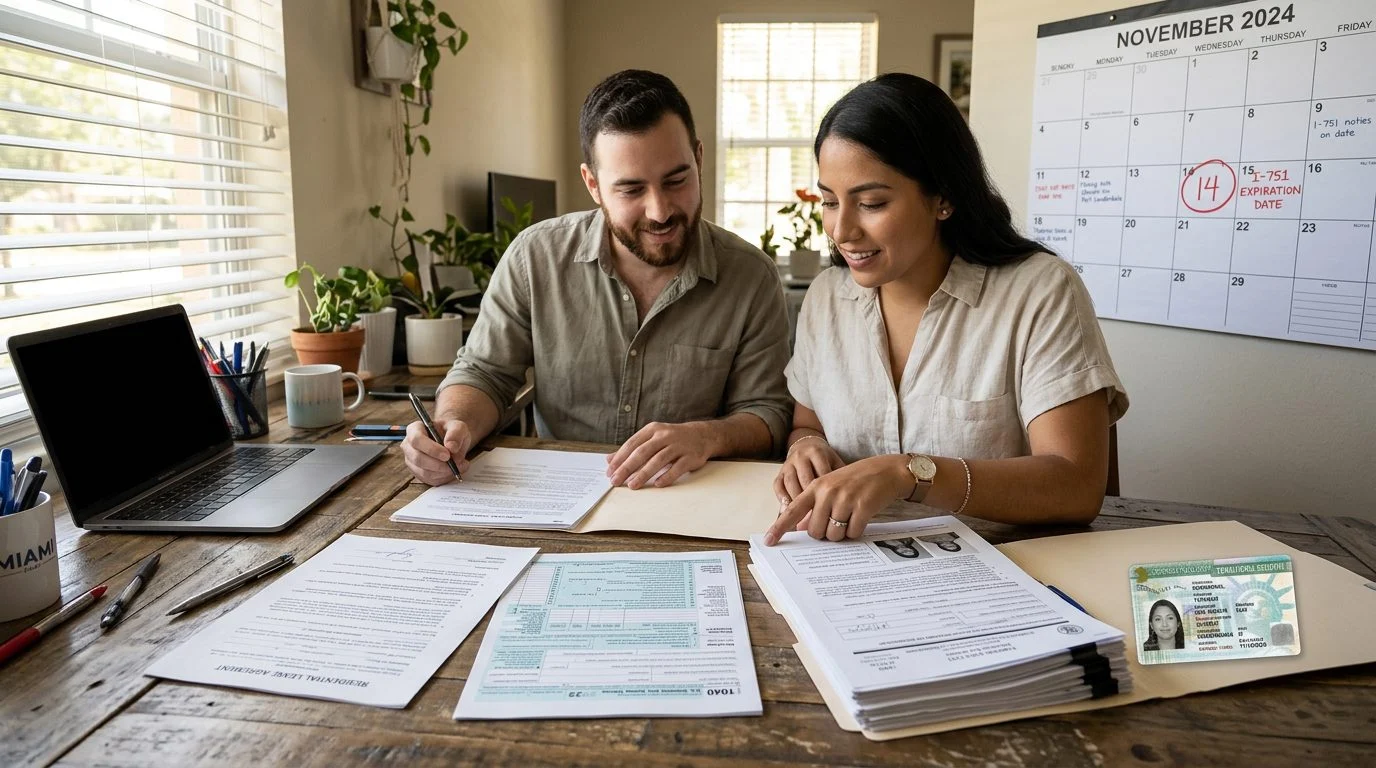
Green Card Guide
Find the Right Green Card Route Before You File
Each path to permanent residence asks different questions of your history, your status and your family. Here is how the main options compare, and where your next step begins.
By Adriana Gomez · Published November 12, 2026
If you are asking how to apply for a green card, you may be researching for yourself or for a spouse, parent, or child. Most applications follow one of two broad routes: a family petition followed by adjustment of status inside the United States, or consular processing at a US embassy or consulate abroad.
Which route fits turns on where you are and what your history looks like. This guide explains each step in plain language.
What Is a Green Card and Who Can Apply?
A green card proves that a person is a lawful permanent resident of the United States. That status lets them live and work here on a permanent basis.
Eligibility usually rests on a family relationship, a job offer, or another recognized basis. The Migration Policy Institute explains the main federal pathways, including family and employer sponsorship.
A green card is different from a temporary visa. A visa usually allows a stay for a set purpose and period. A green card is the step toward permanent residence.
Where you are physically located also shapes the case. A person already in the United States may be able to apply here. A person living abroad usually finishes the process through a US consulate.
Before you gather any paperwork, name your basis in one sentence: a spouse, a parent, a child, an employer, or another category. That one step keeps the rest of the file on track.
If a green card question for your family is weighing on you, our office can help you sort out the route and the records. Reach out through our contact page. Talk it through with our team — we can walk you through how a situation like yours is usually handled and what your options are.
Is It Hard to Apply for a Green Card?
The process is document-heavy, and how hard it feels depends on the facts in your file. Your category, your prior immigration history, your criminal history, and how complete your documents are all shape the work ahead.
The law puts the burden on you. Under 8 U.S.C. § 1361, a person applying for a visa, another document required for entry, or admission to the United States must establish that they are eligible to receive it or are not inadmissible. You cannot simply state a fact and move on. You must back it up.
Adjustment of status adds a legal test. The statute says an applicant who was inspected and admitted or paroled into the United States, or any other alien with an approved petition for classification as a VAWA self-petitioner, may have status adjusted, at the Attorney General’s discretion, if they are eligible for an immigrant visa, admissible for permanent residence, and an immigrant visa is immediately available when the application is filed. See 8 U.S.C. § 1255(a). See 8 U.S.C. § 1255(a). See 8 U.S.C. § 1255(a).
Common sources of complexity include several forms that must match, evidence for each claim, earlier unlawful presence, and medical requirements. A mismatch in names or dates can slow a file.
What Are the Different Types of US Visas?
Nonimmigrant visas allow temporary stays. Immigrant visas lead to permanent residence and a green card.
A student, visitor, or worker visa does not, by itself, make someone a permanent resident. People often hold a temporary visa and then start a separate immigrant process.
For most people seeking a green card through family, the path is one of two. They either adjust status inside the United States, if they are physically present in the United States, are not ineligible to apply for adjustment of status, are eligible to receive an immigrant visa, and an immigrant visa is immediately available when they file, or they go through consular processing abroad.
Adjustment means the person moves from their current status to permanent residence without leaving the country. Consular processing means the case is completed at a US embassy or consulate in the person’s home country.
You do not need to sort through every visa category to start. Focus on one question: is your current status temporary, and what immigrant basis could lead to permanent residence?
Choosing Your Route: Family Petition and Adjustment of Status
A family-based green card usually starts with a petition filed for a qualifying relative.
A United States citizen or a green card holder may file a petition on behalf of a spouse, as 8 C.F.R. § 204.2 states.
After an investigation, the petition is approved if the facts stated in it are true and the beneficiary qualifies, under 8 U.S.C. § 1154.
Adjustment of status is the request to become a permanent resident from inside the United States. Under 8 C.F.R. § 245.1, a person who is physically present in the country may apply, except an alien who is ineligible to apply for adjustment of status under paragraph (b) or (c) of this section, if they are eligible for an immigrant visa and one is immediately available when they file.
For preference applicants, the regulation says the current Visa Bulletin from the Department of State Bureau of Consular Affairs is consulted to check availability.
Your location, your status, and your eligibility decide which route fits. Do not assume that one route fits every case.
Documents You Need Before You Apply
Your documents should show who you are, how you are related to your sponsor, and your immigration history. Start with the basics.
Gather a valid passport, a birth certificate, and marriage or divorce records if they apply. Collect any earlier immigration papers, such as past visas, entry records, and notices from government offices. Add recent passport-style photographs.
Make the list early. Requesting records can take time, so start before you need them.
Keep originals and copies in labeled folders, sorted by category. Note the date you requested each record. Use one spelling of your name throughout. A name that changes between your passport and your marriage record raises a question someone must answer.
Documents not in English often need an English translation, so build that time into your plan.
The burden of proof rests with you. Supporting records can help document the key facts in a case.
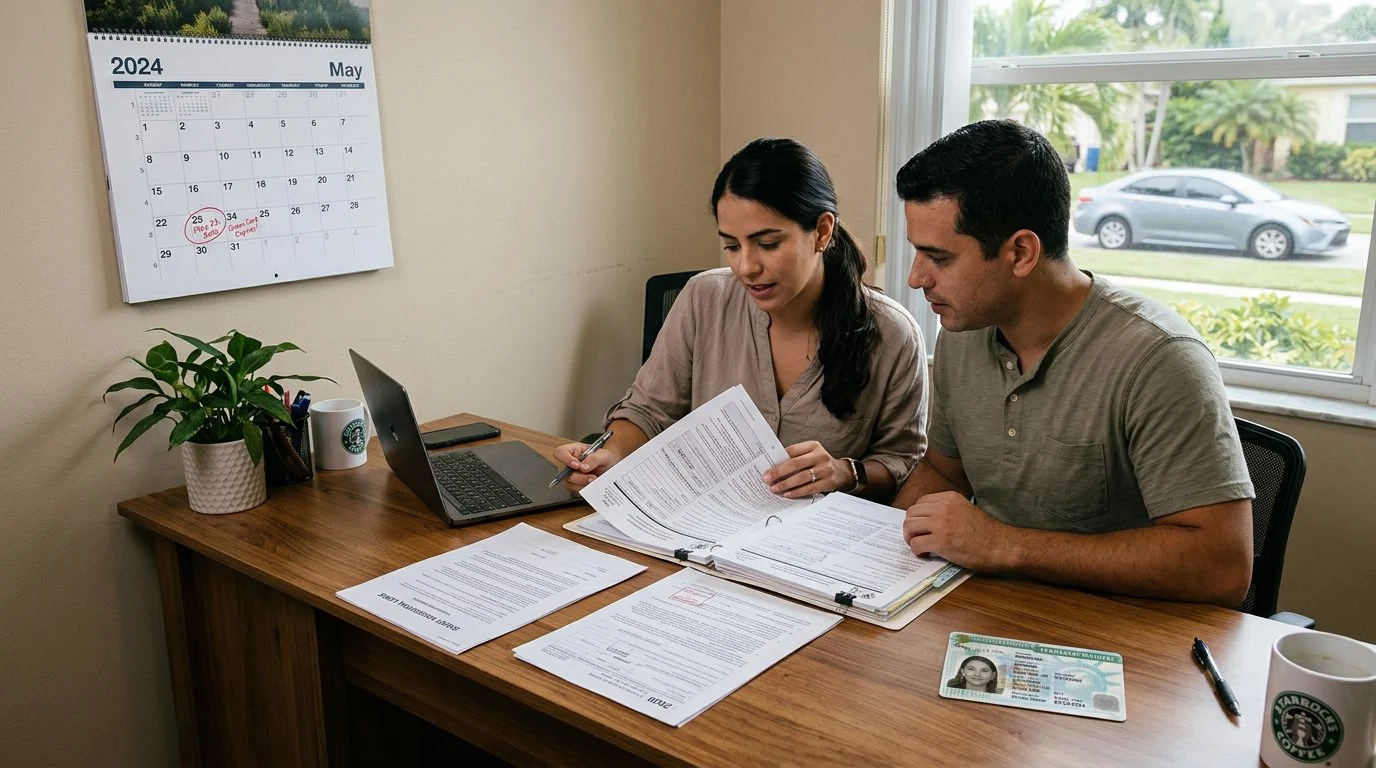
Types of Proof for Common Situations
Proof needs change with your facts, but each key claim needs a record behind it.
In a marriage-based case, evidence of a real marriage often includes joint bank accounts or bills, a shared home, and photographs taken over time.
If the marriage took place during deportation or related court proceedings, the bar is higher. Under 8 C.F.R. § 245.1, the bar on such marriages no longer applies in several situations, including if a federal court grants a petition for review or a habeas corpus action on judicial review, if the applicant has lived outside the United States for 2 or more years after the marriage, or if the applicant proves with clear and convincing evidence that the marriage was entered into in good faith, under the laws of the place where it took place, not to obtain the applicant’s entry as an immigrant, and with no fee paid (other than to an attorney) for filing the petition.
Proof of entry follows the same logic. In a removal proceeding, the burden is on you to show the time, place, and manner of your entry into the United States, under 8 U.S.C. § 1361.
Your current status needs proof too. Keep the documents that issued that status and any notices that followed, in date order.
Gaps or conflicting dates in your records can lead to requests for more evidence. Explaining a gap in writing, with supporting proof, is the stronger approach.
Not sure what your next step is?
Talk it through with our team — we can walk you through how a situation like yours is usually handled and what your options are.
The Medical Exam for Adjustment of Status
Applicants for adjustment of status generally must have a medical exam by a designated civil surgeon.
The report sets out findings on the applicant’s mental and physical condition, as 8 C.F.R. § 245.5 explains.
A narrow exception applies to certain nonimmigrant fiancés and spouses of US citizens. They do not need a new exam if they were medically examined prior to, and as a condition of, the issuance of the nonimmigrant visa, and the exam occurred not more than 1 year before filing. 8 C.F.R. § 245.5 reads: “A medical examination shall not be required of an applicant for adjustment of status who entered the United States as a nonimmigrant spouse, fianceé, or fianceeé of a United States citizen or the child of such an alien as defined in section 101(a)(15)(K) of the Act and § 214.2(k) of this chapter if the applicant was medically examined prior to, and as a condition of, the issuance of the nonimmigrant visa; provided that the medical examination must have occurred not more than 1 year prior the date of application for adjustment of status.”
A person certified for certain health grounds may appeal to a Board of Medical Officers of the U.S. Public Health Service. The regulation provides that route.
Plan this step early. The exam is part of the filing, so a delayed appointment can hold up the rest of the file.
Filing Steps and What Happens After You File
Your case goes to USCIS unless you have been placed in removal or deportation proceedings (other than as an arriving alien) and an immigration judge has jurisdiction over it.
Under 8 C.F.R. § 245.2, USCIS has jurisdiction to decide an adjustment application, unless an immigration judge has that jurisdiction.
If you are in removal proceedings (other than as an arriving alien), the immigration judge has exclusive jurisdiction to adjudicate any application for adjustment of status you file, under 8 CFR 1245.2(a)(1).
The usual sequence is to prepare and sign the forms, file them, receive a receipt notice, attend any biometrics appointment, and attend an interview if one is scheduled.
Some forms are filed online and others by mail, so follow the filing instructions for your exact form. Keep copies of everything you send and proof of delivery. Processing times vary, and no general estimate applies to every case.
Common Mistakes That Slow Green Card Applications
Most slowdowns come from three areas: work and status problems, missing evidence, and answers that do not match across the file.
Work and status matter a lot. Under 8 U.S.C. § 1255, adjustment does not apply to someone who continues in or accepts unauthorized employment before filing (other than an immediate relative as defined in section 1151(b) of this title or a special immigrant described in section 1101(a)(27)(H), (I), (J), or (K) of this title), is in unlawful status on the filing date, or has not kept lawful status since entry, other than an alien with an approved VAWA self-petition. The exception covers a failure to maintain continuously a lawful status that was through no fault of the person or for technical reasons.
The statute carves out immediate relatives from some of these bars, so the family category can change the analysis.
Denials need planning too. The regulation says no appeal lies from a director’s denial, but certain applicants may renew the application in removal proceedings, under 8 C.F.R. § 245.2.
Answer every question on every form completely. Omitted addresses, travel history, or past issues can create serious problems later.
A request for more evidence does not mean your case has failed. Answer it accurately and on time.
Talk With Our Team About Your Green Card Application
The first step is matching your route to your facts before you file.
If you are gathering this for a spouse, parent, or child, you may be juggling a medical exam date, a court notice, or a status that no one in the family fully understands. That is a heavy load to carry while you read forms.
AG Immigration Law P.A. focuses on adjustment of status, family petitions, removal defense, naturalization, removal of conditions on green cards, waivers, and BIA appeals. Adriana Gomez is the responsible lawyer for this page.
Consultations with our office are paid.
Is it hard to apply for a green card?
It can be. The forms and evidence are detailed, and the right route turns on your history.
Do I need a medical exam?
If you apply for adjustment of status, you generally need one from a designated civil surgeon.
Can I apply while I am in the United States?
Some people can apply for adjustment of status from inside the country if they meet the legal requirements.
What happens if my application is denied?
A director’s denial generally cannot be appealed. Certain applicants may renew the application in removal proceedings.
If you are holding a family’s green card questions right now, you do not have to work through the route, the records, and the forms alone. Contact our office through the contact form, by phone, or on WhatsApp to talk through your own facts.
Responsible lawyer: Adriana Gomez.
The Basic Steps of a Green Card Application
1. Identify Your Route
Start by matching your history, current status and family ties to the available paths, such as adjustment of status, a family petition or another route.
2. Gather Your Records
Collect passports, prior immigration documents, marriage or birth records, and any notices from government agencies. Missing records often slow a case.
3. Prepare and File the Forms
Small errors can lead to requests for more evidence or delays.
4. Respond to Next Steps
After filing, you may receive appointment notices, requests for evidence or interview dates. Responding accurately and on time keeps your case moving.
Read Before You Sign
Do not file a form or respond to a government notice until you understand how it affects your case. A form that looks routine can shape later decisions, including removal proceedings.
How AG Immigration Law P.A. Can Help
Route Review
We discuss your history and goals so you understand which immigration paths may apply to you.
Removal Defense
AG Immigration Law P.A. focuses on removal defense, including representation in immigration court and related appeals.
Family and Status Matters
Our practice handles family petitions, adjustment of status, naturalization, removal of conditions on green cards and waivers.
Support From Our Team
Our team of assistants and office staff helps keep your documents, deadlines and communications organized throughout your case.
Clear Communication
We explain each step in plain language so you know what is happening and what comes next.
Talk With Our Office About Your Green Card Path
Related practice areas
- Current Status of a Green Card: How to Read and Check It