


Removal Defense | Florida, Texas & New York
Missed Your Immigration Court Hearing? Find Out If the Order Can Be Reopened
Understand how a motion to reopen works, what to gather first, and how our team can review your file and discuss your options.
By Adriana Gomez · Published November 12, 2026
If you missed your immigration court hearing and received a removal order, you may think your case is over. It may not be. An in absentia removal order can be reopened through a motion filed with the immigration court, on one of two main grounds: lack of notice, or exceptional circumstances that kept you from attending. This guide explains each path, the deadlines, the evidence to gather, and the mistakes that cause motions to fail.
Our team at AG Immigration Law P.A. handles removal defense, including motions to reopen.
What an In Absentia Removal Order Means
An in absentia removal order is a removal order entered when a person does not attend a scheduled immigration court hearing. The judge issues it because of the absence, after finding two things. The person is removable, and proper written notice of the hearing was given.
The government must prove both points by clear, unequivocal, and convincing evidence. Under the removal proceedings statute, written notice counts if it was sent to the most recent address the person gave. That rule matters later, when we look at reopening.
Your first question is probably whether the order is final. Under 8 C.F.R. § 1003.39, except when certified to the Board, a judge’s decision becomes final when you waive appeal, or when the time to appeal runs out if no appeal is taken, whichever comes first. A final order can still be challenged by motion. A removal order can also lead to detention and removal, so timing matters.
Adriana Gomez is the responsible lawyer for this page. Our team handles removal defense matters for clients across the United States.
Not sure what your next step is?
Talk it through with our team — we can walk you through how a situation like yours is usually handled and what your options are.
The Two Main Grounds for Reopening a Removal Case
Under 8 U.S.C. § 1229a, an in absentia order may be rescinded only upon a motion to reopen filed within 180 days after the date of the order of removal if the failure to appear was because of exceptional circumstances beyond the alien’s control, or upon a motion to reopen filed at any time if the alien shows that they did not receive proper notice or were in Federal or State custody and the failure to appear was through no fault of their own. Each ground has its own rules and its own clock.
Lack of notice. This motion asks the judge to find that you did not get proper notice of the hearing. Under 8 C.F.R. § 1003.26, if you did not provide the address the rules require, no written notice may be needed for an in absentia hearing.
Exceptional circumstances. This ground covers a missed hearing caused by something outside your control. Less compelling reasons do not count. This motion must be filed within 180 days after the date of the order.
The facts you can prove decide which ground fits. Gather them early, because the two grounds need different proof.
Motion to Reopen vs. Motion to Reconsider: Which Approach Works?
A motion to reopen must state the new facts that will be proven at a hearing if the motion is granted, and must be supported by affidavits or other evidence. That is the route for both missed-hearing grounds in this guide.
The regulation says the motion must state the new facts that will be proven at a hearing. It must be supported by affidavits and other evidence. The judge will not grant it unless the evidence is material and was not available and could not have been discovered or presented at the earlier hearing.
A motion to reconsider asks the judge to look again at the decision itself. Filing the wrong motion can waste time on a short deadline, so know which one you are filing before you start.
Filing a motion to rescind an in absentia order on these grounds pauses removal while the judge decides it. You may file only one motion under that paragraph. 8 C.F.R. § 1003.23 sets that rule.
Documents to Gather Before Filing
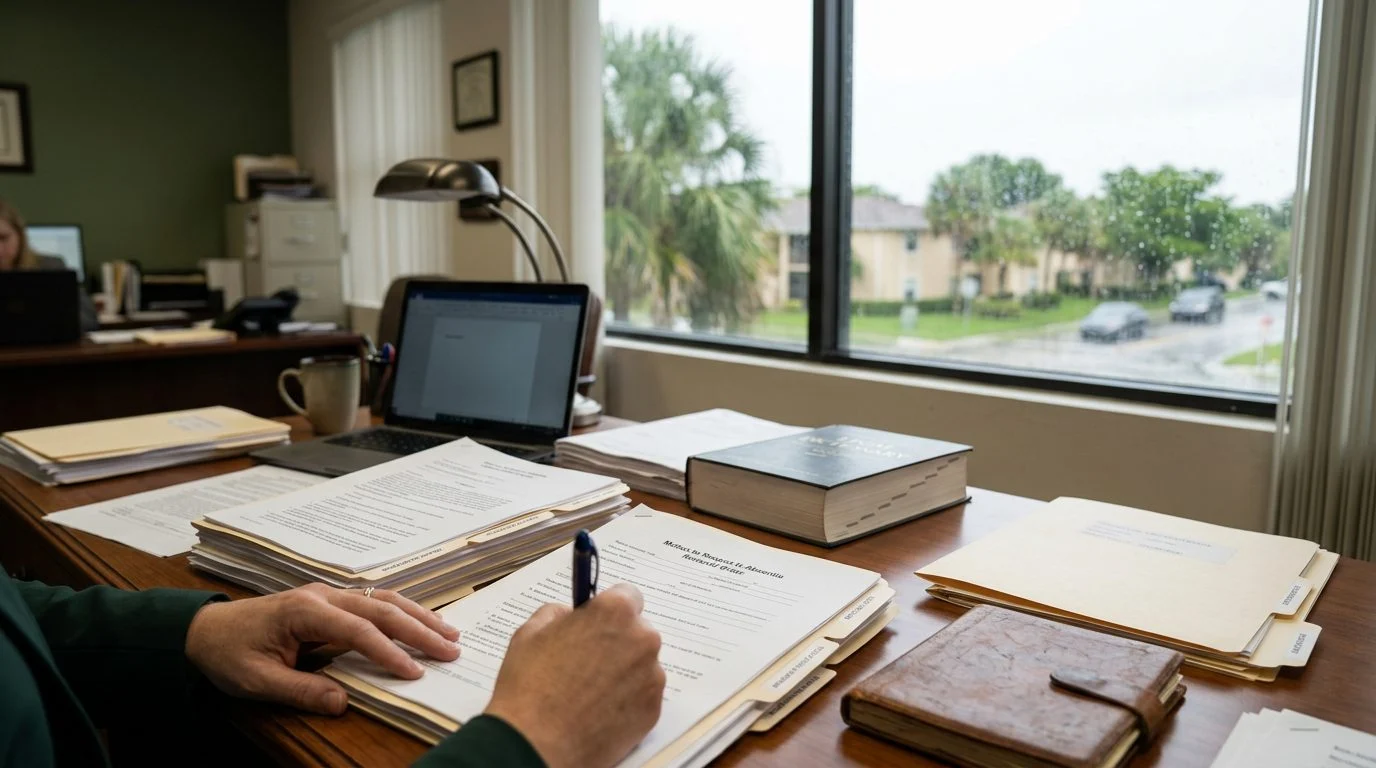
Gather your notice papers, your address history, proof of the reason you missed court, and a sworn statement of what happened.
Start with the notice papers. That means the notice to appear, any hearing notice, and any envelope or mailing record you kept. Removal proceedings start when a notice to appear is filed with the immigration court. See 8 C.F.R. § 1239.1.
Next, build a clear address history.
Under 8 U.S.C. § 1305, a person required to register must notify the government in writing of each change of address within ten days. Keep proof that you did.
For exceptional circumstances, collect records that match the missed date. Medical records, hospital or treatment papers, and death certificates should show dates that line up with the hearing.
Finally, write a sworn declaration. Describe what happened, when it happened, and why you could not attend. Add statements from people with direct knowledge if you have them. Vague dates make the motion harder to support.
Common Mistakes That Sink Reopening Motions
Three mistakes weaken these motions: filing late, relying on vague proof, and letting your address fall out of date.
- Missing the 180-day window. An exceptional-circumstances motion has a firm deadline. Count from the date of the order.
- Filing on the wrong ground. Lack of notice and exceptional circumstances need different proof. Mixing them up can leave gaps in the record.
- Letting the address go stale. Under the removal proceedings statute, written notice sent to the most recent address you gave can be treated as sufficient. An old address can work against you.
- Filing a second motion under the same paragraph. The rule allows only one motion under that paragraph.
- Leaving the facts vague. The motion must state the new facts and support them with evidence. A loose account gives the judge little to weigh.
- Waiting on a pending green card case. A removal order can complicate adjustment, as the next section explains.
What Happens After the Court Grants or Denies Reopening
If the judge grants the motion, the order can be rescinded, and your case continues in immigration court. If the judge denies it, you can appeal to the Board of Immigration Appeals.
An appeal starts with a Notice of Appeal on Form EOIR-26. Under 8 C.F.R. § 1003.38(b)(1), the Notice of Appeal (Form EOIR-26) must be filed within 10 calendar days of the Immigration Judge’s decision, except as provided in paragraph (b)(2) for certain asylum cases; the deadline runs from the date of the oral decision or the mailing or electronic notification of a written decision. If the last day falls on a weekend or legal holiday, it moves to the next business day. See 8 C.F.R. § 1003.38.
Under 8 C.F.R. § 1003.38(b)(3), any issue not raised in the Notice of Appeal (Form EOIR-26) is deemed waived. Plan your arguments with that in mind.
While the time to appeal runs, a decision cannot be carried out unless you waive appeal, except as provided under 8 CFR 236.1, 8 CFR 1003.19(i), and paragraph (b) of 8 CFR 1003.6. See 8 C.F.R. § 1003.6. The Board may also stay removal in its discretion while an appeal from a denied motion to reopen is pending, if no stay has been granted by the Immigration Judge or a Service officer. See 8 C.F.R. § 1003.6. See 8 C.F.R. § 1003.6.
Not sure what your next step is?
Talk it through with our team — we can walk you through how a situation like yours is usually handled and what your options are.
How an In Absentia Order Affects a Pending Adjustment of Status Case
An in absentia order can complicate a pending green card case. It can also bar adjustment of status for ten years.
Under 8 U.S.C. § 1229a, a person given oral notice of the consequences of not attending cannot get certain relief for 10 years after a final in absentia order. Adjustment of status is one of the listed forms of relief. The bar does not apply when the absence was because of exceptional circumstances.
According to ICE guidance on adjustment of status, an adjustment application in removal proceedings is made before an immigration judge. Some documents may also need to go to USCIS.
If you have an I-485 pending, don’t assume it will move forward as before. Review the order’s status before the next filing. Timing matters because the ten-year period runs from the final order.
Talk With AG Immigration Law P.A. About Your Missed Hearing
A missed hearing and a removal order can start deadlines that are already running. Those deadlines are the reason to act early.
Can an in absentia removal order be reopened?
Yes, through a motion to reopen based on lack of notice, exceptional circumstances, or Federal or State custody where the failure to appear was through no fault of yours. The exceptional-circumstances motion must be filed within 180 days after the order.
Does filing a motion pause removal?
Filing a motion to rescind on these grounds pauses removal while the judge decides it. Only one motion is allowed under that paragraph.
Can an in absentia order affect a green card case?
Yes, it can complicate a pending adjustment case.
If your removal order came after a hearing you could not attend, or you never saw the notice, contact AG Immigration Law P.A. to talk through your notice history and the deadlines on your case. You can use the contact form, call the office, or message on WhatsApp. Consultations with the firm are paid.
How AG Immigration Law P.A. Can Help
Removal Defense Focus
Our practice focuses on removal defense for immigrants facing proceedings in immigration court.
Motions and Filings
We prepare and file motions to reopen and related papers, and we review the notices and records in your case.
Supported by Our Staff
Our assistants and office staff help keep your file organized and your questions moving to the right person.
Reach Us Your Way
Contact us by phone, through our contact form, or by WhatsApp to get started.
Act Promptly
An in absentia order can affect your options quickly. Contact our office as soon as you learn about it, and bring every notice and court paper you have received.
Steps to Take After an In Absentia Order
Gather Your Papers
Collect every notice, hearing date, and court document you have, including envelopes or proof of mailing if you still have them.
Write Down What Happened
Note where you were, when you learned of the hearing, and any events that kept you from attending, while the details are fresh.
Ask About Your Options
Ask whether a motion to reopen fits your facts and what filing it could mean for removal.
Contact Our Office
Reach out by phone, form, or WhatsApp so our team can review your situation and schedule a paid consultation.