


Removal Defense | Florida, Texas & New York
I-212 Permission to Reapply: Returning After Removal
AG Immigration Law P.A. focuses on removal defense and related immigration matters. Adriana Gomez is the responsible attorney for this page. Talk with our team about your history before you decide on a next step.
By Adriana Gomez · Published November 8, 2026
Form I-212 is the application for permission to reapply for admission into the United States. People who were removed, deported, or who left after building up unlawful presence may need it before they can return. This guide explains the form, the events that trigger it, and what the process looks like. If you are looking into an I-212 permission to reapply, these basics come first.
What Form I-212 Is and Who Needs It
Form I-212 is the Application for Permission to Reapply for Admission after deportation or removal. USCIS says an applicant who files a waiver application and is also inadmissible because of a prior removal or unlawful reentry must file it. It is also called consent to reapply (USCIS Policy Manual, Volume 9, Part A, Chapter 4).
“Inadmissible” means the law bars you from entering or getting a green card right now. Most people who need the I-212 fall into one of three groups:
- People with a prior removal or deportation order
-
- People who file a waiver application and also have unlawful reentry after a previous immigration violation
- People who want to return before the bar period has ended
The I-212 deals with inadmissibility under INA 212(a)(9)(A) and (C). Some people also need a waiver, often called the I-601. Under 8 CFR 212.7, except as provided in paragraph (e) for certain provisional unlawful presence waivers, an applicant for an immigrant visa, adjustment of status, or a K or V nonimmigrant visa who is inadmissible on a ground with an available waiver may apply for that waiver on the form USCIS designates. The two filings are separate, and one may be needed alongside the other.
If you are looking for a family member held in immigration detention, ICE’s Online Detainee Locator System is the official tool for finding people in ICE custody.
A removal order you did not expect, or a return date that has passed, can leave you feeling stuck. Our team is ready to review your history with you. Talk it through with our team — we can walk you through how a situation like yours is usually handled and what your options are.
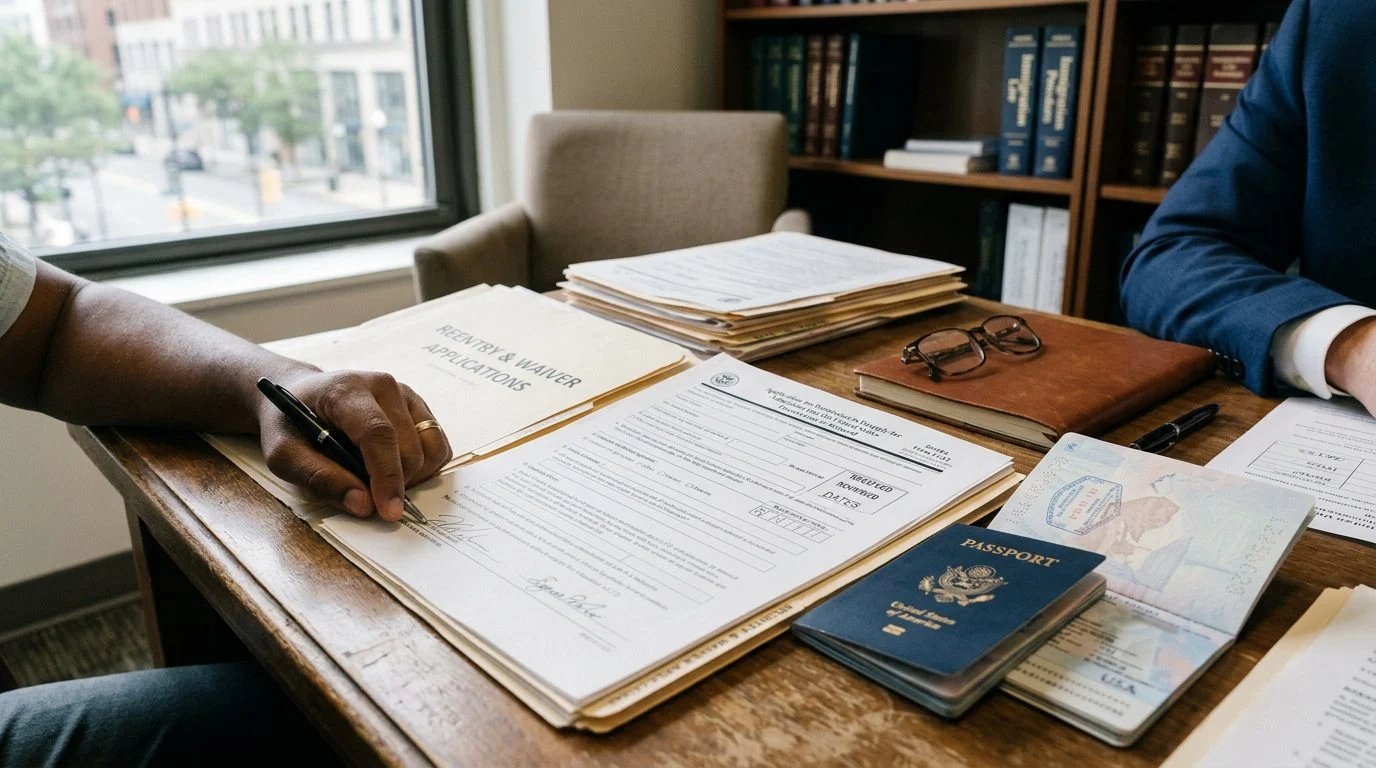
Events That Can Trigger the Need for an I-212
The two most common triggers are a removal or deportation, and time spent in the U.S. without legal status before leaving. Each one starts a bar with its own clock.
Removal or deportation. Under 8 CFR 212.2, a person who was deported or removed is inadmissible unless they stayed outside the U.S. for five consecutive years. A person convicted of an aggravated felony must stay out for twenty consecutive years.
Unlawful presence. According to USCIS Policy Manual, Part O, Chapter 6, a person who accrued more than 180 days but less than a year of unlawful presence during a single stay in the United States is inadmissible if they again seek admission within 3 years of departing. A person who accrued one year or more of unlawful presence during a single stay in the United States is inadmissible if they depart or are removed and again seek admission within 10 years of that departure or removal.
The clock starts on the day of departure or removal. It keeps running whether or not the person came back during that time, and how they returned can create new problems.
Illegal reentry. Under 8 CFR 241.8, a person who illegally reenters after being removed, or after leaving voluntarily while under an order of exclusion, deportation, or removal, shall be removed by reinstating the prior order. One exception: the prior order may not be reinstated while certain HRIFA or NACARA adjustment applications are pending, unless and until a final decision denies the application. That person has no right to a hearing before an immigration judge in such circumstances. Illegal reentry. Under 8 U.S.C. § 1326, reentry without the Attorney General’s consent can bring a fine, imprisonment of up to 2 years, or both; for certain removed aliens, subsection (b) provides higher penalties, including imprisonment not more than 10 years or not more than 20 years depending on the category.
Which bar applies depends on the facts of each case. Dates, exits, and prior orders all matter. Talk with a lawyer about your record before any reentry attempt.
What the Application Covers
An I-212 filing combines the form, proof of your past removal or departure, and evidence that supports a favorable decision. Here is what usually goes in.
- The form and fee. The form is filed with the fee that 8 CFR 212.2 ties to 8 CFR 106.2.
- Proof of the removal or departure. This includes the removal order itself and entry and exit records.
- When making a discretionary determination, the officer should consider all of the factors cumulatively to determine whether the favorable factors outweigh the unfavorable ones, as the USCIS Policy Manual, Part A, Chapter 5 explains.
- Supporting records. Court and police records, tax records, and proof of family ties such as marriage or birth certificates often matter.
There is no specific type or amount of evidence required to establish eligibility for a waiver; typically, the evidence should support all eligibility requirements, be specific, come from a credible source, and substantiate what the applicant claims, and when evidence is unavailable, the applicant should give a reasonable explanation for why it is missing (USCIS Policy Manual, Waiver Eligibility and Evidence).
The filing path changes with where you are and what you have already filed. Some people apply through a consular officer abroad, while others file from inside the United States.
How the Process Works, Step by Step
Most cases move through five stages, from record review to decision.
- Record review. We check removal orders, entry and exit dates, and every bar that may apply.
- Evidence gathering. You receive a written checklist, and our support staff helps organize the documents.
- Filing. The I-212, along with any waiver, goes in on the correct path.
- Waiting. USCIS may ask for more evidence while your case is pending.
- Decision. A denial notice explains the reasons and your right to appeal.
If the I-212 is denied, an appeal goes on Form I-290B. Under 8 CFR 103.3, the complete appeal must be submitted within 30 days after service of the decision. A motion to reopen has its own rules. Under 8 CFR 103.5, a motion to reopen must state the new facts to be provided in the reopened proceeding and be supported by affidavits or other documentary evidence, and a motion to reopen or reconsider filed by an applicant or petitioner must generally be filed within 30 days of the decision.
Timing varies with the filing path and current processing times. We explain the expected timeline for each case as the facts come in.
Why Work With AG Immigration Law P.A.
AG Immigration Law P.A. focuses on immigration matters. The practice covers removal defense, adjustment of status, family petitions, naturalization, removal of conditions on green cards, waivers, and BIA appeals.
That mix matters for an I-212. A removal order can lead to a waiver request, a denial, a motion to reopen, or a BIA appeal. Our work across these areas lets us look at the full path, not just one form.
Our support staff helps with document organization for each file. Adriana Gomez is the lawyer responsible for this page.
Common Questions About the I-212
Here are the questions readers ask most.
Can I apply for an I-212 from outside the United States?
Some people file through a consular officer abroad. Others file from inside the United States. The right path depends on your history.
How long does an I-212 take?
Timing varies with the filing path and processing times. We explain the expected timeline for your case as the facts come in.
What happens if my I-212 is denied?
The denial notice explains the reasons and your right to appeal. Under 8 C.F.R. § 103.3, the affected party must file the appeal on Form I-290B and must submit the complete appeal, including any supporting brief as indicated in the applicable form instructions, within 30 days after service of the decision.
Do I need a lawyer to file an I-212?
Your filings must match your past entries, orders, and records. A lawyer can check each bar and each form before anything is filed.
Is a consultation a commitment to hire?
Government filing fees are separate, and we disclose them before anything is filed. You can ask questions before you decide whether to move forward.
Not sure what your next step is?
Talk it through with our team — we can walk you through how a situation like yours is usually handled and what your options are.

Talk With Our Team About Your Situation
A removal order you did not expect, or a return date that has already passed, can leave you feeling stuck. You do not have to sort through the rules alone. Reach out through our contact page, call the office, or message us on WhatsApp. Our team can review your history with you and explain your options.
How we approach an I-212 matter
Review your full history
An I-212 depends on the details of your removal, prior entries, and any other immigration filings. We start by reviewing those facts carefully.
Identify the right filing path
Some people file from outside the United States and others file from inside. We explain which path fits your circumstances before anything is filed.
Clear timing updates
Processing times vary. As your facts come in, we explain what to expect for your case.
Support for you and your family
Our team helps you understand each step and keeps your questions moving toward a clear plan.
Do not file on your own without a review
Past removal orders, reentry history, and other filings can change what is possible for you. Speak with our office about your record before you submit any form.
Ways to reach AG Immigration Law
Fill out our contact form
Share a few details about your situation and our team will follow up with next steps.
Call the office
Speak directly with our staff about your questions and how to move forward.
Message us on WhatsApp
Send a message to start the conversation at a time that works for you.
Book a paid consultation
Meet with our team for a detailed discussion of your history and options. A consultation fee applies.
Take the first step toward your return
Related practice areas
- Immigration Waivers in the US: I-601, I-601A and Other Options Explained
- I-212 Permission to Reapply for Admission After Removal