

Family Petitions & Removal Defense | Florida, Texas & New York
Married to a U.S. Citizen While in Court? Let's Talk About Your Options
A U.S. AG Immigration Law P.A. focuses on immigration law for immigrants across the United States, including removal defense and adjustment of status.
By Adriana Gomez · Published November 4, 2026
Under 8 U.S.C. § 1154(g), notwithstanding subsection (a), except as provided in section 1255(e)(3), a petition may not be approved to grant an alien immediate relative status or preference status by reason of a marriage entered into during the period described in section 1255(e)(2), until the alien has resided outside the United States for a 2-year period beginning after the date of the marriage. Marriage alone does not create a green card, though. Your entry history, your record and your filings all shape the path.
Who this page is for and what it covers
If you’re in immigration court and married to a US citizen, you’re probably asking one question. Can this marriage get me a green card without leaving my case? This page explains how that process can work and what decides the path.
Family members often read pages like this for a spouse, parent or child. If that’s you, this page is for you too. It explains the steps and the paperwork. It does not promise a result, because every case turns on its own history.
This page covers:
- Adjustment of status (applying for a green card from inside the US) before the immigration judge, for aliens placed in deportation or removal proceedings (other than as an arriving alien)
- Facts that affect eligibility, including entry history and criminal records
- Evidence and forms for the case file
- Timing, denials and appeals to the Board of Immigration Appeals (BIA)
If your spouse is in court right now, you don't have to sort out the forms and deadlines alone. Reach out to our team to talk through your case. Talk it through with our team — we can walk you through how a situation like yours is usually handled and what your options are.
Can a US citizen spouse get you a green card while your case is in immigration court?
Under 8 CFR 1240.11, you may apply to the immigration judge for adjustment under section 245 of the Act.
The process has two parts. Your US citizen spouse files a petition for you. Under 8 CFR 204.2, a citizen may file a petition on behalf of a spouse.
You then file the adjustment application, Form I-485. Under 8 CFR 1245.2, the application must include the fee the form instructions list.
Marriage to a green card holder works differently. A spouse of a permanent resident is generally not an immediate relative. That can change the timing and the path, so it’s worth reviewing early.
Factors that decide whether you can adjust status
Several facts decide whether adjustment is possible. Entry history matters most.
Other bars still apply, so each one needs review.
Your criminal record also matters. A conviction after admission for a crime of domestic violence, stalking, or child abuse, neglect or abandonment makes a person deportable. Other convictions can raise separate issues. Bring every court record to your first meeting.
Prior removal orders matter too. Exceptional circumstances can change that result.
Waivers may help in some cases. Section 1255 allows the Attorney General to waive certain grounds of inadmissibility for individual aliens for humanitarian purposes, family unity, or when otherwise in the public interest, but only for the categories of aliens and under the conditions the subsection specifies. The statute excludes some grounds from that waiver.
These factors are reviewed together. The same marriage can lead to different options for two people with different histories.
How adjustment of status works inside immigration court
Here is the usual order of steps. Timing varies from case to case.
- The petition is filed. Your US citizen spouse files the petition for you with USCIS. Under 8 CFR 245.1, for immediate relative or preference status, the green card request can move forward only if you are the beneficiary of a valid unexpired visa petition filed in accordance with part 204 of this chapter.
- The adjustment application is filed. You file Form I-485 and the required forms with the immigration judge, and the fee goes with it. Under 8 CFR 245.1, for immediate relative or preference status, an application under section 245 of the Act is not available unless you are the beneficiary of a valid unexpired visa petition filed in accordance with part 204 of this chapter. The fee goes with it.
- Biometrics and background checks. These happen when required.
- Hearings. The judge reviews eligibility, testimony and evidence, and any issues the government raises. Under 8 U.S.C. 1361, you carry the burden of showing how and when you entered the US.
- The decision. Published decisions from the BIA and Attorney General guide how immigration judges rule. If the immigration judge approves an alien spouse’s application under section 245, that spouse receives conditional permanent residence. You then file a Petition to Remove the Conditions on Residence with the director, as 8 CFR 1240.11 explains.
Each stage has deadlines and evidence rules. Missing one can hurt the case.
Documents and evidence to prepare
The statute asks for proof that the marriage is genuine. Under 8 U.S.C. 1255, an alien seeking an immigrant visa based on a marriage entered into during the period described in paragraph (2) may not have status adjusted, unless the alien establishes by clear and convincing evidence that the marriage was entered into in good faith and in accordance with the laws of the place where the marriage took place, was not entered into for the purpose of procuring the alien’s admission as an immigrant, and no fee or other consideration was given (other than a fee or other consideration to an attorney for assistance in preparing a lawful petition).
Useful evidence often includes:
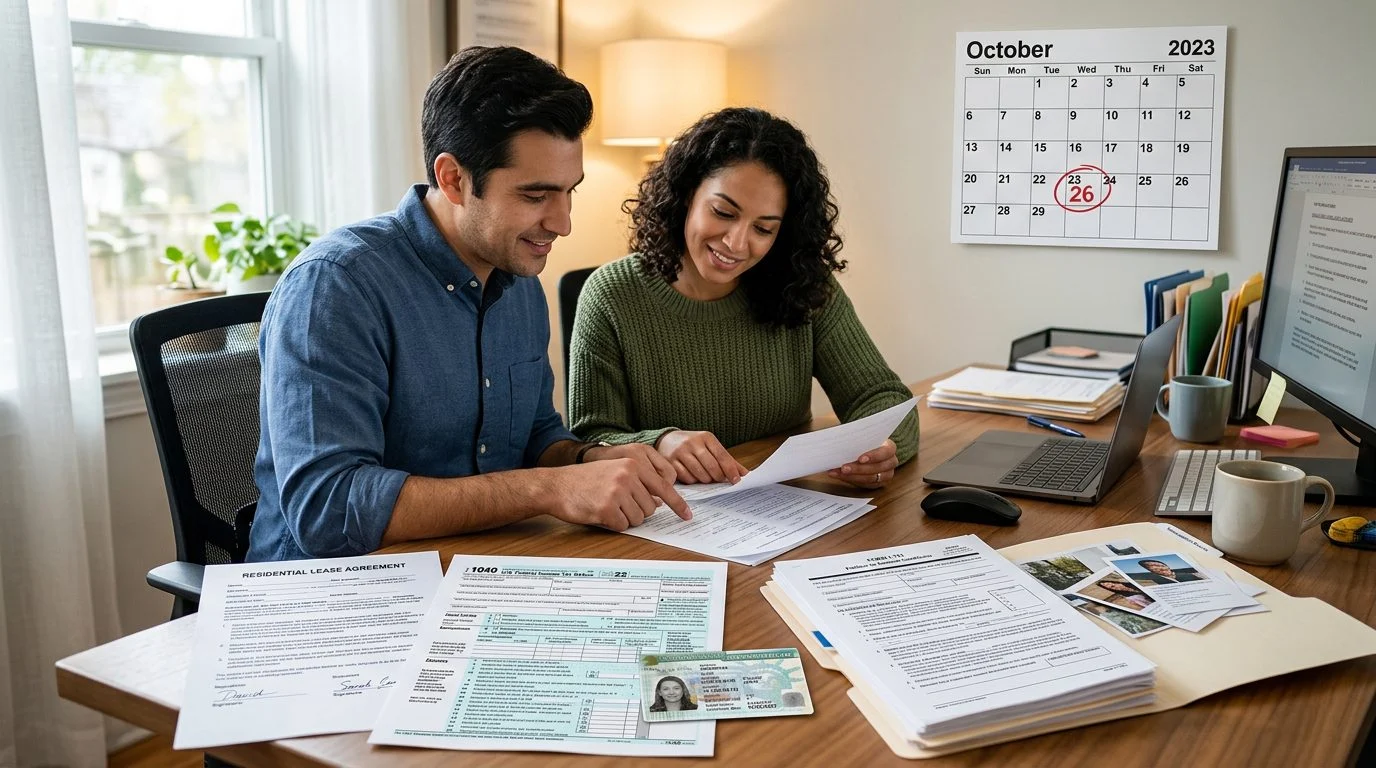
- A joint lease or mortgage
- Joint bank, insurance or tax records
- Photos over time
- Affidavits from people who know the couple
The Form I-864 affidavit of support is also needed. Under 8 CFR 213a.2, in any case specified in paragraph (a)(2), an intending immigrant is inadmissible as likely to become a public charge unless a qualified sponsor, or a substitute sponsor and if necessary a joint sponsor, signs an affidavit of support.
Other records to gather:
- Passports, prior visas and entry records
- The Notice to Appear and all court filings and orders
- Court records for any criminal matter, with a clear explanation of each
The judge can require corroborating evidence.
Timing, possible outcomes and what happens if the judge denies
Timing varies with USCIS workload, the court’s schedule and whether more evidence is requested. No one can give a fixed decision date.
Possible outcomes include approval with conditional residence, denial with removal proceedings continuing, or another path that fits the facts.
If the judge denies the request, you can appeal to the BIA. Under 8 CFR 1003.3, you file Form EOIR-26 within the time the rules set. For many appeals without a transcript, briefs are due within 20 days of the Board’s briefing order, and no more than 35 days after the appeal was filed.
If a USCIS director denies an application from a person who is not an arriving alien, the person may renew it in removal proceedings, under 8 CFR 1245.2.
If your spouse is held in immigration detention, the ICE Online Detainee Locator System is the official tool for finding them.
Not sure what your next step is?
Talk it through with our team — we can walk you through how a situation like yours is usually handled and what your options are.
Why AG Immigration Law handles these cases
AG Immigration Law P.A. focuses on removal defense and related immigration matters. That includes adjustment of status, family petitions, naturalization, removal of conditions on green cards, waivers and BIA appeals.
Adriana Gomez is the responsible lawyer for this page. Our team includes support staff who help organize filings, deadlines and evidence. Our lawyers review the facts of each matter with the client.
Some matters may need to go to another lawyer or firm. If that applies to your case, we will tell you so.

Frequently asked questions
Can I get a green card if I’m in removal proceedings and married to a US citizen?
If you are in removal proceedings, you may ask the immigration judge to consider adjustment of status based on that marriage, but special rules apply to marriages entered into during proceedings. Eligibility is never automatic.
Does marriage alone give me a green card?
No. The petition is the first step, and you must also qualify for adjustment.
Can I appeal if the judge denies my request?
Yes. You can appeal to the BIA by filing Form EOIR-26 directly with the Board under 8 CFR 1003.3 if you are a party covered by the immigration judge’s decision and specifically named on the Notice of Appeal, but not if you waived appeal. The appeal must be received at the Board, with all required documents, fees or a fee waiver request, and proof of service, within the time specified in 8 CFR 1003.38.
Does a marriage to a green card holder work the same way?
Usually not. A spouse of a permanent resident is generally not an immediate relative.
How much does this cost?
Costs may include government filing fees set by the form instructions, attorney fees for representation, and the fee for a paid consultation, so please contact our office to learn what applies to your matter.
If your spouse is in court right now, the forms and deadlines can feel like a lot. You don’t have to carry them alone. Use our contact form, call the office, or message us on WhatsApp to talk through your case.
How AG Immigration Law P.A. Can Help
Removal Defense
We represent immigrants facing removal proceedings and look at every available path before any filing is made.
Adjustment of Status
We prepare and file adjustment of status applications, including requests made while proceedings are pending, when the facts support them.
Family Petitions
We handle petitions filed by U.S. citizens and permanent residents for eligible family members.
Waivers & BIA Appeals
We evaluate waivers and review Board of Immigration Appeals options so that decisions are made with full information.
Important: Do Not File Before You Talk to a Lawyer
Filing the wrong form, or missing a court date, can affect your case. Speak with our team before you submit anything to USCIS or the immigration court.
Common Questions About Marriage and Removal Proceedings
Can I apply for a green card while in removal proceedings?
It may be possible to ask the immigration judge to consider adjustment of status based on a marriage to a U.S. citizen. Each case depends on its own facts and history.
Does marriage alone give me a green card?
No. A marriage is one factor in an immigration case. Your entry history, prior orders, and eligibility all matter.
Why does timing matter?
When a marriage took place, and where your case stands in court, can change the options available to you. Early advice helps you plan.
What should I bring to a consultation?
Bring copies of your immigration documents, court notices, marriage certificate, and any prior applications or decisions.
Ready to Talk About Your Case? Contact AG Immigration Law P.A. to Book a Paid Consultation
Related practice areas
- Deportation Defense Attorney for Immigration Court: Removal Proceedings Explained