

Removal Defense | Florida, Texas & New York
Facing an Immigration Court Hearing? Know the Risk of Detention Before You Walk In
AG Immigration Law P.A. focuses on removal defense and related immigration matters. Learn when custody can happen at court and how to prepare, then contact our office to discuss your case.
By Adriana Gomez · Published October 27, 2026
Short Answer: Can ICE Detain You at Immigration Court?
Yes, in some situations ICE can take a person into custody at or after an immigration court hearing. Whether that happens depends on the facts of each case and the enforcement situation at the time.
If you have a removal case, this fear makes sense to raise. Knowing how these arrests work can help you plan ahead. This page covers how court arrests happen, the difference between detention and deportation, how custody is decided, and what to do before your next hearing.
Many people hear stories about arrests at court and feel panic. The facts matter. Your record, the stage of your case, and the notices you have received all shape what can happen next. Under 8 U.S.C. § 1226, on a warrant issued by the Attorney General, a person may be arrested and detained pending a decision on whether they are to be removed from the United States. That rule is the starting point for most questions about custody during a case.
If a hearing date is coming up and you fear being taken into custody at court, we can talk through your options and the next steps in your case. Talk it through with our team — we can walk you through how a situation like yours is usually handled and what your options are.

How Immigration Court Arrests Happen
An arrest can happen at more than one point in a removal case, not only on the day of a hearing. Under 8 C.F.R. § 1236.1, a respondent may be arrested and taken into custody under Form I-200, Warrant of Arrest, at any time up to the point removal proceedings are completed.
Removal proceedings start with a Notice to Appear. Under 8 C.F.R. § 1239.1, the case begins when that notice is filed with the immigration court. Officers do not need a final order before custody can be considered. The rules allow custody during the case itself.
At the hearing, the judge must make sure you understand your rights. You have a reasonable chance to examine and object to the evidence against you, present your own evidence, and question the government’s witnesses. Under 8 C.F.R. § 1240.10, removal hearings are open to the public, though a judge may close them in some cases.
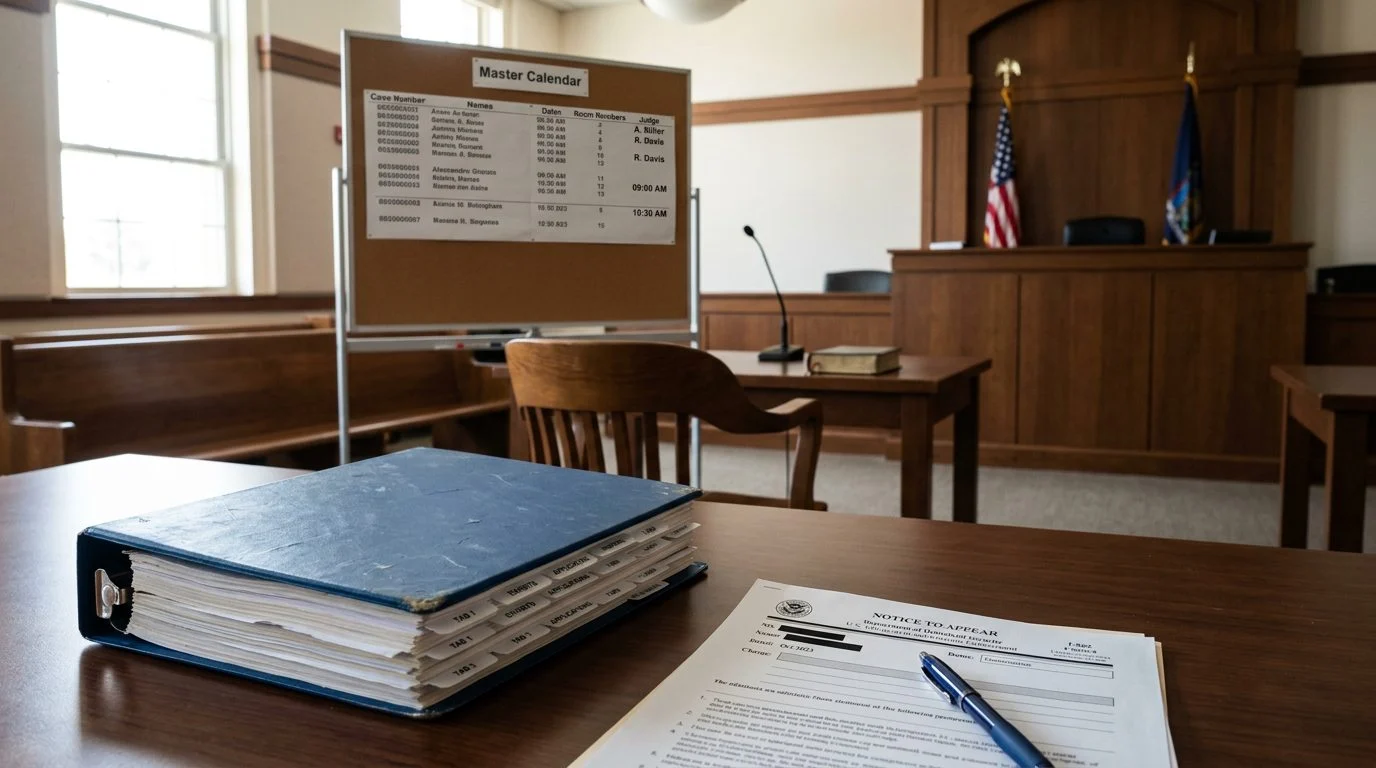
Keep your Notice to Appear and every hearing notice in one place. These papers show the court, the judge, and your next date.
Detention vs. Deportation: What Is the Difference?
Detention means being held in custody. Deportation, which the law calls removal, is the formal process of sending a person out of the United States after a removal order. The two are separate steps.
A person can be detained while the case is still pending. Being held does not, by itself, mean a removal order has been entered.
If you are trying to find a family member, the Online Detainee Locator System is ICE’s official tool for locating people held in immigration detention. Searching it early can save time when a relative has missed a call or a hearing.
Keeping these two ideas apart helps you read your own case. A custody question is about where and whether you are held now. A removal question is about whether the government can send you out of the country and on what basis.
What Happens If You Are Detained at a Hearing?
A detained person is held, and a custody decision follows. Under 8 C.F.R. § 1003.19, an immigration judge can review custody and bond. That review is kept separate from the removal hearing itself.
While any proceeding is pending before the Executive Office for Immigration Review, the government must immediately notify the immigration court in writing when a person’s custody location changes or when the person is released or taken back into custody. This is set out in 8 C.F.R. § 1003.19 as well.
Under 8 CFR 1236.1, a person may request changes to release conditions at any time before a final order becomes final, and if the person has been released from custody, that request must be filed within 7 days of release. Release can also be revoked at any time by listed officials, and the person can then be taken back into custody. 8 C.F.R. § 1236.1 reads: “(9) When an alien who, having been arrested and taken into custody, has been released, such release may be revoked at any time in the discretion of the district director, acting district director, deputy district director, assistant district director for investigations, assistant district director for detention and deportation, or officer in charge (except foreign), in which event the alien may be taken into physical custody and detained.”
Bond amounts carry their own rules. An immigration judge’s custody decision can also be appealed to the Board of Immigration Appeals.
How to Prepare Before Your Next Hearing
Keep every notice, the hearing date, the courtroom location, and the court’s contact information in one folder. Bring that folder to each hearing. Write down the date of your next appearance the day you get it.
Attending every scheduled hearing matters. If you miss one, the judge may order you removed in absentia, meaning without you present.
The consequences can last a long time. Suppose a final removal order is entered against someone who was not at the hearing. At the time of the required notice, that person had been given written notice of when and where the proceedings would take place and what would happen if they failed to attend.
Your address matters too. Under 8 C.F.R. § 1003.26, written notice sent to the most recent address you provided is considered sufficient. Update your address with the court whenever it changes.
Getting Help With Your Removal Case
Detention at a hearing raises questions about custody, bond, and what comes next in the case. Those questions move quickly, so timing matters. Prompt legal advice helps you respond to each step.
AG Immigration Law P.A. focuses on removal defense. The practice also handles related matters, including adjustment of status, waivers, BIA appeals, family petitions, naturalization, and removal of conditions on green cards. Our removal defense work covers the court process, custody questions, and the relief that may be available.
Some relief questions turn on Board and Attorney General decisions. The EOIR precedent decisions page lists those published decisions, which cover topics such as adjustment of status and waivers. Consultations are paid.
Quick Answers
Can ICE arrest someone at immigration court?
Yes, in some situations the law allows custody at or after a hearing. The facts of the case and the enforcement situation at the time matter.
Does being detained mean I was ordered removed?
No. Detention is custody during a case. Removal is a separate step that follows a removal order.
Not sure what your next step is?
Talk it through with our team — we can walk you through how a situation like yours is usually handled and what your options are.

Contact the Office About Your Hearing
If your hearing is coming up and you’re worried about being taken into custody at court, or a family member was detained after a hearing, you don’t have to sort out the next steps alone. Adriana Gomez is the lawyer responsible for this page. Call the office, send a message through the contact form, or message us on WhatsApp to talk through your options.
How We Can Help You Prepare
Removal Defense Focus
Our practice focuses on removal defense, so your hearing preparation is handled by immigration attorneys who work in this area every day.
Review of Your Records
We look at your immigration file, prior filings and any notices you have received so we understand what the court will consider.
Planning Ahead
Early planning gives you time to gather documents and address custody concerns before your hearing date arrives.
Support for Your Family
We help families understand what to expect and how to keep important information organized during a difficult time.
Do Not Go to Court Unprepared
Custody can occur at or after an immigration hearing in some situations. Speak with an immigration attorney about your specific risk before your hearing, and bring every notice you have received.
Ways to Reach Our Office
Fill Out the Contact Form
Share a brief summary of your situation and the date of your next hearing so our staff can follow up.
Call the Office
Speak with our staff directly about your hearing and the next steps available to you.
Message Us on WhatsApp
Send a message with your questions and our team will respond as soon as possible.
Book a Paid Consultation
Meet with the firm to discuss your removal case in detail. Consultations are paid, and our staff can confirm the current fee when you schedule.