

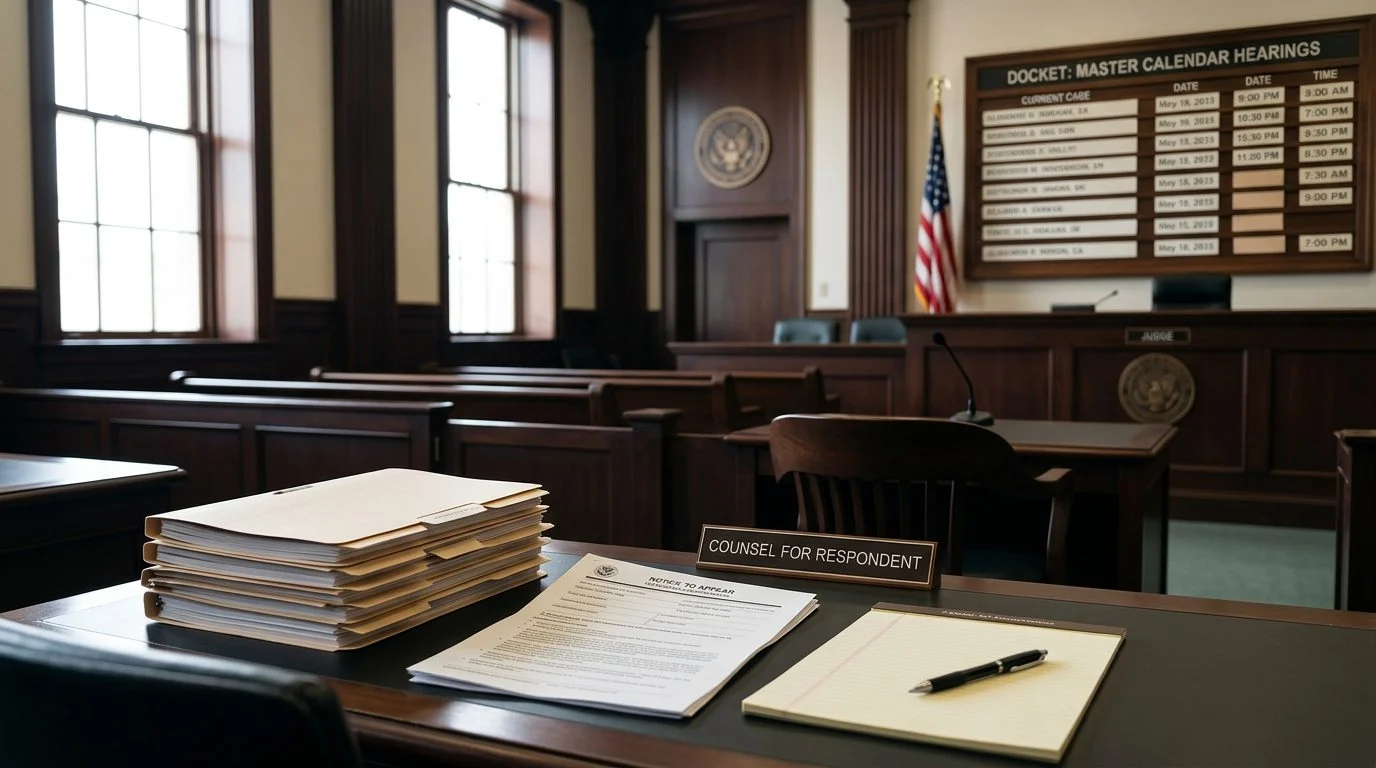
Immigration Court Guide | Florida, Texas and New York
Which Court Hears Your Immigration Case?
A plain-language walkthrough of immigration court, the Board of Immigration Appeals and federal court, from AG Immigration Law P.A., which focuses on removal defense and related immigration matters.
By Adriana Gomez · Published October 31, 2026
The short answer: which court hears immigration cases
Removal cases start in immigration court, and an immigration judge decides them. Those judges work within the Executive Office for Immigration Review (EOIR), which sits inside the Department of Justice (8 C.F.R. § 1003.0).
If the judge’s decision is appealed, the Board of Immigration Appeals (BIA) reviews it. After the BIA issues a final order of removal, a federal court of appeals may review the case. So the path runs in order: immigration court, then the BIA, then a federal appeals court.
Not every immigration matter goes to a judge. Many applications, such as green card and citizenship filings, go to U.S. Citizenship and Immigration Services (USCIS), a separate agency. For the broader picture, read our removal defense guide.
If a Notice to Appear, a court date, or a detained relative has you stuck, we can talk through where your case stands and what comes next. Talk it through with our team — we can walk you through how a situation like yours is usually handled and what your options are.

Who runs the immigration court system
The Attorney General sits at the top of this system through the Department of Justice. The Attorney General appoints the head of EOIR. EOIR includes both the Board of Immigration Appeals and the Office of the Chief Immigration Judge (8 C.F.R. § 1003.0).
The Board’s members are attorneys. The Attorney General appoints them to act as delegates, and the Board works under the general supervision of the EOIR Director (8 C.F.R. § 1003.1).
This structure is why immigration courts are called administrative courts. They are not federal district courts. Their procedures come from immigration statutes and regulations. Rules you may know from a federal lawsuit don’t always apply, so a case here follows its own steps.
What an immigration court hearing is
A removal case begins when the government files a charging document with the immigration court. Jurisdiction vests and proceedings commence at that filing (8 C.F.R. § 1003.14). In removal proceedings, the government gives the person a written notice to appear.
Two early rules matter. Second, the first hearing cannot be set earlier than 10 days after the notice is served, unless you ask for an earlier date in writing (8 U.S.C. § 1229).
At the hearing, the judge administers oaths and receives evidence. The judge can question the person and any witnesses (8 U.S.C. § 1229a). The person may be represented, at no expense to the government, by counsel of their choosing who is authorized to practice in such proceedings (8 U.S.C. § 1229a). The person must admit or deny the factual allegations and the charges (8 C.F.R. § 1240.10). DHS counsel presents the government’s evidence (8 C.F.R. § 1240.2).
For more on the right to a hearing, see do immigrants get a hearing before deportation.
Detained cases and where they are heard
A person held in immigration detention still has a case in immigration court. The court schedules cases and gives notice of the time, place, and date of hearings (8 C.F.R. § 1003.18).
On a warrant issued by the Attorney General, a person may be arrested and detained while the decision on removal is pending (8 U.S.C. § 1226). Bond proceedings are a special case. They can begin without filing a charging document in bond proceedings under 8 C.F.R. §§ 1003.19, 1236.1(d) and 1240.2(b) (8 C.F.R. § 1003.14).
Family members can take three practical steps. First, use the ICE Online Detainee Locator System, the official tool for locating people in ICE detention. Second, gather the person’s A-number, which is the number on their immigration papers. Third, confirm which immigration court holds the case, and track every notice it sends.
How the administrative appeals process works
An appeal from an immigration judge’s decision goes directly to the BIA. The appeal is filed on Form EOIR-26, and it must show proof that the other side received a copy (8 C.F.R. § 1003.3).
Paperwork is where many appeals stall. An appeal is not properly filed until the Board receives it with all required documents, fees or a fee waiver request, and proof of service, within the time the rules set (8 C.F.R. § 1003.3).
The Board generally does not find new facts. If a party needs more factfinding, it must file a motion for remand (8 C.F.R. § 1003.1). No oral argument is allowed in a case assigned for disposition by a single Board member (8 C.F.R. § 1003.1).
Other filings also go to the immigration court. An immigration judge must grant a motion to administratively close or recalendar filed jointly by both parties, or filed by one party where the other party has affirmatively indicated its non-opposition, unless the judge articulates unusual, clearly identified, and supported reasons to deny it (8 C.F.R. § 1003.18). Learn more in our guide to recalendaring an administratively closed case.
When a federal court of appeals gets involved
After the BIA issues a final order of removal, a petition for review may go to a federal court of appeals. The petition goes to the circuit where the immigration judge completed the proceedings (8 U.S.C. § 1252).
A federal appeals court generally does not hold a new hearing; if a genuine issue of material fact about a petitioner’s nationality is presented, the court shall transfer the proceeding to the district court of the United States for the judicial district in which the petitioner resides for a new hearing on the nationality claim (8 U.S.C. § 1252). Judicial review of a final order of removal (other than an order of removal without a hearing pursuant to section 1225(b)(1) of this title) is governed only by chapter 158 of title 28, except as provided in subsection (b), and the court may not order the taking of additional evidence under section 2347(c) of that title (8 U.S.C. § 1252).
Briefing has a firm clock. Under 8 U.S.C. § 1252, the brief in a petition for review is due not later than 40 days after the date on which the administrative record is available, and the court may extend that deadline only on a motion showing good cause. Under 8 U.S.C. § 1252, if an alien fails to file a brief within the time provided, the court shall dismiss the appeal unless a manifest injustice would result.
Federal law also limits court review.
Not sure what your next step is?
Talk it through with our team — we can walk you through how a situation like yours is usually handled and what your options are.
Which court handles which type of case
Removal defense happens in immigration court. Immigration judges can decide several kinds of applications in removal proceedings. Those include applications under sections 208, 212(h), 212(i), 240A, and 245 of the Act (8 C.F.R. § 1240.1). Under 8 C.F.R. § 1240.1(a)(1)(ii), sections 212(h), 212(i) and 245 of the Act are among the applications an immigration judge may determine in removal proceedings.
Many other filings go to USCIS. These include family petitions, naturalization, and removal of conditions on green cards. Which forum applies depends on the facts, especially where the case stands. To learn how the court with jurisdiction is found, read how to know which immigration court has jurisdiction.
When you file anything, put the A-number on every page. Then follow the filing instructions on the court’s notice.
Talking with AG Immigration Law about your situation
Reading court rules while you worry about a case or a loved one is hard. Understanding the court map is a real first step.
AG Immigration Law P.A. focuses on removal defense, adjustment of status, family petitions, naturalization, removal of conditions on green cards, waivers, and BIA appeals. The firm focuses on immigration matters for people in Florida, Texas, and New York. Adriana Gomez is the responsible lawyer for this page.
Consultations are paid. The office explains the consultation fee when you reach out.
Frequently asked questions
What court hears immigration cases first?
Removal cases start in immigration court, where an immigration judge decides them.
Can an immigration judge’s decision be appealed?
Yes. The appeal goes to the Board of Immigration Appeals on Form EOIR-26.
Does a federal court hear every immigration case?
No. A federal court of appeals may review a final removal order, but only on the administrative record.
How can I find a detained relative?
Use the ICE Online Detainee Locator System, the official tool for locating people in ICE detention.
If a Notice to Appear, a court date, or a detained family member has you stuck, you don’t have to sort out this court maze alone. Reach out to AG Immigration Law P.A. by the contact form, by phone, or on WhatsApp, and describe where your case stands.
The Three Places Immigration Cases Can Go
Immigration Court
Removal cases start here. An immigration judge hears the case, weighs the evidence and issues a decision.
Board of Immigration Appeals
A decision from an immigration judge can be appealed to the BIA, which reviews the record and the legal arguments.
Federal Court
Some immigration decisions can later reach federal court.
How to Reach Our Office
Call the Office
Speak with our team by phone about your immigration question or your case.
Message on WhatsApp
Send a message through WhatsApp to start the conversation at your convenience.
Fill Out the Contact Form
Share basic details through our online form and our staff will follow up with you.
Book a Consultation
Schedule a consultation with our office to discuss removal defense, appeals, family petitions and other matters we handle.
Do Not Wait to Get Advice
Immigration procedures move in specific steps, and missing one can affect your case. Contact our office early so we can review what you have and explain the next steps.