

Removal Defense and BIA Appeals
BIA Appeal Dismissed? Understand Your Next Steps
Learn which paths may remain open after the Board's decision, and how a clear plan can keep your case moving.
By Adriana Gomez · Published November 9, 2026
If the Board of Immigration Appeals (BIA) has dismissed your appeal, you’re probably asking what happens next. In short, the immigration judge’s removal order stays in place and becomes final.
The BIA can dismiss an appeal in a short written order, so the news may feel abrupt. If that letter is in your hands or a relative’s, you’re facing firm deadlines and fewer options. This page explains what the dismissal does, when the order becomes final, and which steps remain.
What a BIA dismissal means for the removal order
A BIA dismissal ends the appeal and leaves the immigration judge’s removal order in force. A single Board member can summarily dismiss an appeal that fails essential statutory or regulatory requirements. 8 CFR 1003.1 sets out this process.
For appeals of decisions issued on or after March 9, 2026, the Board must summarily dismiss an appeal unless a majority of its permanent members votes to accept it for a decision on the merits, except for appeals pursuant to paragraphs (b)(5), (6), (7), and (14) of 8 CFR 1003.1. When that happens, the Board adopts the immigration judge’s decision. That decision states the reasons for removal, and those reasons are what a federal court can review.
So a dismissal doesn’t start a new case. It confirms the removal order you already have. For the wider process, see our removal defense overview.
If a BIA dismissal has your family worried about what comes next, you don't have to sort out the deadlines alone. Reach out to our office to talk through your case. Talk it through with our team — we can walk you through how a situation like yours is usually handled and what your options are.

When the removal order becomes final
The removal order becomes final on the day the BIA dismisses the appeal. 8 CFR 1241.1 lists dismissal of an appeal by the Board as one way an order of removal made by the immigration judge at the conclusion of proceedings under section 240 of the Act becomes final.
Finality matters because the clocks that follow depend on it. Judicial review of removal questions is available only through review of a final order. The judicial review provisions of 8 U.S.C. § 1252 address petitions for review of final orders of removal.
Write down the decision date printed on the BIA order. Keep the envelope, any cover letter, and proof of when it arrived. If someone else opened the letter, make sure every page is saved.
Deadlines that apply after a dismissal
Each remaining path has its own clock, and the two you’ll see most are the motion to reopen and the federal petition’s brief schedule.
- Motion to reopen. You may file only one, and it generally must be filed no later than 90 days after the final administrative decision. The rule has exceptions. 8 CFR 1003.2 sets this limit.
- Petition for review brief. Under 8 U.S.C. § 1252, the alien’s brief in a petition for review must be filed not later than 40 days after the date on which the administrative record is available. You may file a reply brief no later than 14 days after the government’s brief is served. Under the same provision, a court may extend these briefing deadlines only upon a motion showing good cause. 8 U.S.C. § 1252
- Missed brief. If an alien fails to file a brief within the time provided, the court shall dismiss the appeal unless a manifest injustice would result. 8 U.S.C. § 1252
A petition for review in a federal court of appeals has its own deadline. Under 8 U.S.C. § 1252, it must be filed not later than 30 days after the date of the final order of removal, so start early.
Options that remain after a dismissal
After a dismissal, you can ask a federal court of appeals to review the case, or ask the BIA to reopen or reconsider its decision. Each route asks for something different.
- Petition for review. This asks a federal court of appeals to review questions of law and fact. The petition goes to the circuit where the immigration judge completed the case.
- Motion to reconsider. This is a written motion asking the Board to re-examine its own decision. A motion to reconsider based solely on an argument that the case should not have been affirmed without opinion by a single Board Member, or by a three-Member panel, is barred under 8 CFR 1003.2. 8 CFR 1003.2 sets this limit. 8 CFR 1003.2 sets this limit.
- Motion to reopen. This must state the new facts you would prove at a hearing, backed by affidavits or other evidence. The evidence must be material and must not have been available earlier. If you seek relief, attach the application and all supporting documents. The Board may deny a motion even when the case looks strong on paper.
If you’re weighing whether any appeal is still possible, read whether a lost immigration case can be appealed.
Whether removal can be paused while review is pending
Under 8 CFR 1003.6(a), a removal decision generally ‘shall not be executed during the time allowed for the filing of an appeal’ or ‘while an appeal is pending,’ subject to the section’s stated exceptions. This protection covers the time to appeal to the Board and the period while an appeal or certification is pending before the Board; it does not extend to a federal petition for review. Whether this protection applies to your case depends on the facts of your case.
While an appeal to the Board is pending, or a case is before the Board by certification, a decision generally cannot be carried out. 8 CFR 1003.6 covers that protection.
A person under a final order may ask the Department of Homeland Security (DHS) for a stay. 8 CFR 1241.6 governs that request. If DHS denies it, an immigration judge or the Board can still grant a stay tied to a previously filed motion to reopen or reconsider.
Timing matters. A stay granted or communicated after a person has been placed aboard an aircraft, and normal boarding is complete, ceases to have effect. Pending applications can also change which options are open, so raise any filing in progress early.

Acting on a dismissal and contacting the firm
Start by gathering every document and marking each deadline from the decision date, then contact our office about your case.
Gather these items:
- The BIA decision and the immigration judge’s order.
- Every notice you received, with its date.
- Envelopes, receipts, or other proof of when papers arrived.
- A calendar entry for each deadline above; for the brief in a petition for review, the 40-day period runs from the date on which the administrative record is available, not from the BIA decision date.
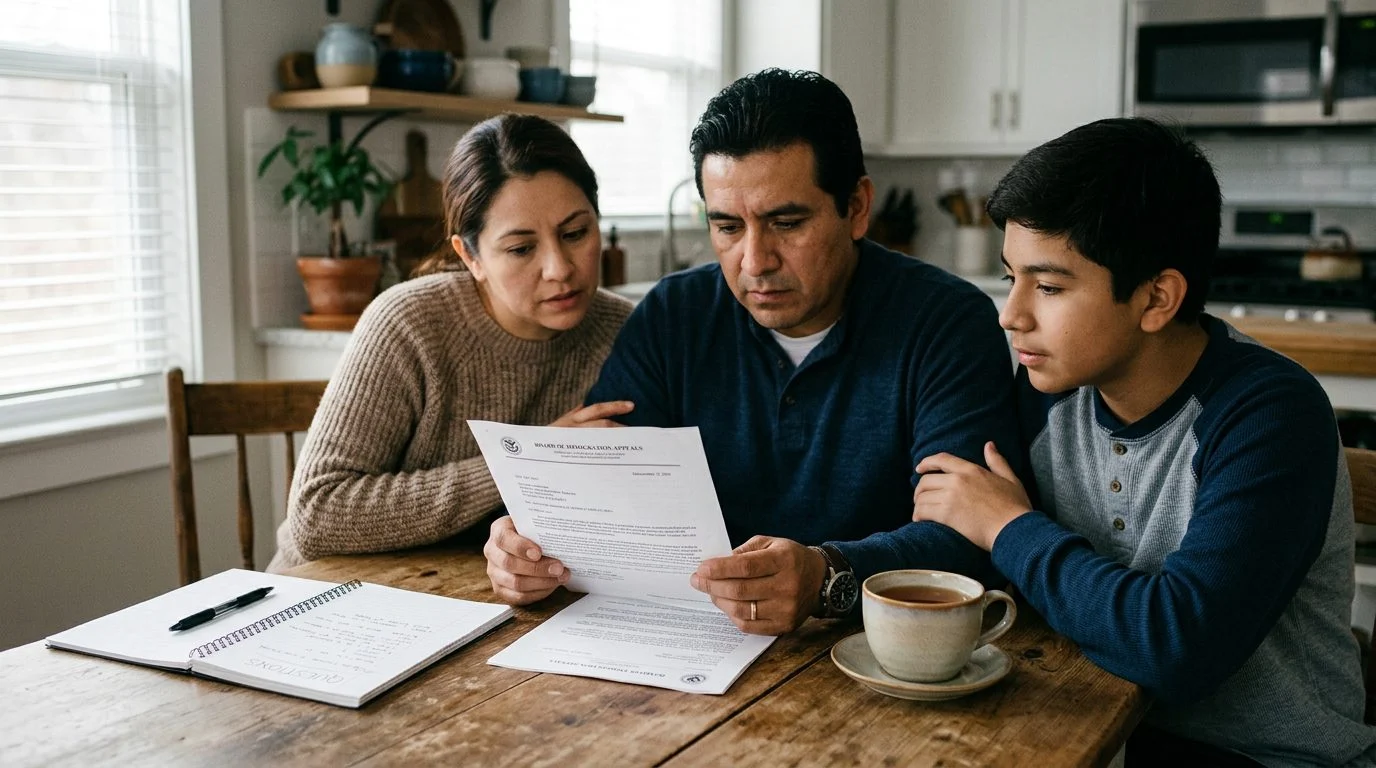
A dismissal often arrives without warning. Sometimes a spouse, parent, or adult child opens it and has to carry the news. That’s a heavy load to hold at once.
If a BIA decision has your family worried about what comes next, you don’t have to work out the deadlines alone. Reach out through our contact form, call the office, or send a WhatsApp message to talk about your case. Consultations are paid. Adriana Gomez is the lawyer responsible for this page at AG Immigration Law P.A.
Frequently asked questions
Can I still appeal after the BIA dismisses my case?
You may still have options, such as a petition for review or a motion to reopen or reconsider. Each one has its own rules and deadlines.
How long do I have to file a motion to reopen?
Generally, you must file one motion to reopen no later than 90 days after the final administrative decision. There are exceptions.
Which court reviews a BIA decision in Florida?
A petition for review goes to the circuit where the immigration judge completed the case.
Why Act With a Plan
Options can narrow over time
Each post-decision path has its own procedural requirements, so early review helps preserve the choices that may apply to you.
Records matter
The Board's decision, your filings, and your immigration history all shape which next step makes sense.
Strategy before filing
A careful review helps you decide whether to seek review, reopen the case, or pursue another route.
Do Not Wait to Get Advice
Waiting after a dismissal can limit the options still available. Contact the office as soon as possible so the next step can be reviewed promptly.
Possible Next Steps
Petition for Review
A request to a federal court of appeals to examine the Board's decision. Whether it is available depends on the facts and procedural history of your case.
Motion to Reopen
A request asking the Board to consider new facts or evidence that were not part of the earlier record.
Motion to Reconsider
A request asking the Board to re-examine its decision based on how the law or the record was applied.
Review With Our Team
We can look at your decision, filings, and goals together to identify the path that fits your situation.