

Removal Defense Explained
Facing Deportation? Understand How Removal Cases Work
A plain-language guide to the stages, the people involved, and how an immigration attorney can help you prepare.
By Adriana Gomez · Published November 9, 2026
If you or someone you love just received papers from immigration court, you probably want to know what happens next. Deportation defense is the legal representation of a noncitizen in removal proceedings, the process that decides whether a person must leave the United States.
This page explains how that process works, what a lawyer’s work involves, and why deadlines matter so much.
What deportation defense means
Deportation defense is the work a lawyer does to protect a noncitizen who faces removal from the United States. “Deportation” is the everyday word. The law calls the same process “removal,” and it is heard in immigration court.
The government carries the first burden. Under 8 CFR 1240.8, a person charged as deportable is found removable only if the government proves it by clear and convincing evidence.
The person also has rights in the hearing. Under 8 U.S.C. § 1229a, the person has a reasonable opportunity to examine the evidence against them, present evidence on their own behalf, and cross-examine government witnesses, but these rights do not entitle them to examine national security information the government offers in opposition to their admission or to an application for discretionary relief.
Defense work covers more than one situation. It can involve people in detention, people with a pending case, and people already ordered removed who want to reopen their case. Reopening has its own deadlines and rules, as AILA on motions to reopen explains.
AG Immigration Law P.A. focuses on removal defense, along with adjustment of status, family petitions, naturalization, removal of conditions on green cards, waivers, and BIA appeals.
If someone you love has been served with removal papers, you don't have to work out the next hearing alone; our team can talk through your options with you. Talk it through with our team — we can walk you through how a situation like yours is usually handled and what your options are.

How removal proceedings begin
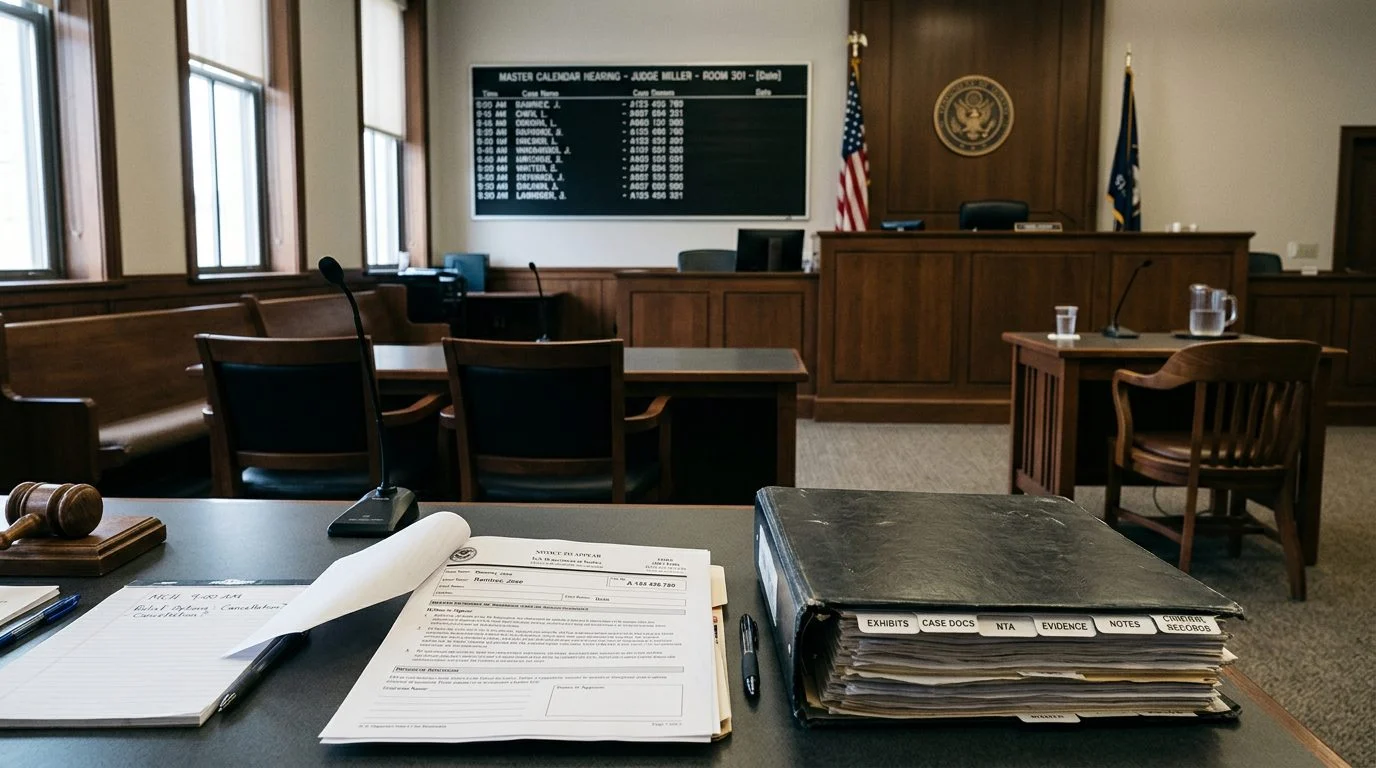
A removal case starts with a Notice to Appear, a written notice that sets out the charges. Under 8 U.S.C. § 1229, the notice must state the nature of the proceedings against the person, the legal authority for the proceedings, the conduct alleged to violate the law, and the charges and statutes involved.
The notice is given in person. If personal service isn’t practical, it can be mailed to the person or to their lawyer of record.
The first hearing cannot be set sooner than 10 days after service. The only exception is a written request from the person for an earlier date. That gap gives the person time to secure a lawyer.
Address matters a great deal. The law requires you to give the government a written address and to update it right away when it changes. If you don’t, the court can hold an in absentia hearing without sending new written notice, under 8 CFR 1003.26.
At the first hearing, the judge confirms who the person is, asks how they respond to the charges, and sets deadlines for filing applications.
Missing a hearing is serious. Under 8 U.S.C. § 1229a, a person who does not attend a hearing after written notice was provided shall be ordered removed in absentia if the government establishes by clear, unequivocal, and convincing evidence that notice was given and that the person is removable. For the case overview, see the removal defense overview.
What the defense work involves
Defense work means building the record, filing on time, and appearing at every hearing for the person in proceedings. It starts with a close reading of the charges.
A lawyer reviews the Notice to Appear and the person’s immigration history, including past entries, status, and any criminal or immigration records. That review shows which charges the record supports and which ones can be challenged.
The lawyer then gathers documents, prepares filings, and prepares the person to testify. Under 8 U.S.C. § 1229a, the judge weighs credible testimony along with other evidence. Where the immigration judge determines that the person should provide evidence corroborating otherwise credible testimony, such evidence must be provided unless the person shows they do not have it and cannot reasonably obtain it.
People held in detention may also ask for a bond hearing. The process differs from case to case.
No lawyer can promise a result. The outcome turns on the individual record, the law, and the judge’s decision.
Forms of relief a removal defense may explore
Relief from removal is a request the person can make to the immigration judge. Each type of relief has its own eligibility rules.
The person carries the burden. Under 8 CFR 1240.8, the respondent must establish eligibility for any requested benefit and that it should be granted in the exercise of discretion.
Adjustment of status can lead to permanent residence, but it has limits. Under 8 U.S.C. § 1255, it is not available to some people who are in unlawful status or who have not kept a lawful status. Exceptions exist, including for certain immediate relatives.
Cancellation of removal runs on its own clock.
Waivers can forgive certain grounds that make a person inadmissible. Eligibility and filing requirements can differ from one situation to another, so each case is reviewed on its own facts.
Which relief fits depends on the person’s history and the current law. A full review is the only way to sort that out.
Appeals after an immigration judge’s decision
A person can appeal an immigration judge’s decision to the Board of Immigration Appeals, but the filing deadline is strict. Under 8 CFR 1003.38, the Notice of Appeal (Form EOIR-26) must come with the required fee or a fee waiver request (Form EOIR-26A).
Under 8 CFR 1003.3, an appeal is not properly filed unless the Board receives it, with all required documents, fees or fee waiver requests, and proof of service, within the time specified in the governing sections of this chapter.
Under 8 CFR 1003.3, an appeal is not properly filed unless the Board receives the fee or fee waiver request, along with all required documents and proof of service, within the time specified in the governing sections of this chapter. That is why the deadline should be checked the day a decision is issued.

If you are facing removal proceedings for someone you care about
If you are helping someone who received court papers, start by keeping every notice and hearing date in one place. Many people reading this are worried about a family member who was detained or served with papers, and the next step can feel urgent and unclear.
Write down each court date and the address on file. Don’t sign anything you don’t understand, and update the government in writing about any address change.
Can a lawyer appear for me at immigration court?
Yes. Under 8 CFR 1240.3, the respondent may be represented at the hearing by an attorney or other qualified representative.
What happens if I miss my hearing?
The judge shall order removal in absentia if the alien does not attend a proceeding and the government shows by clear, unequivocal, and convincing evidence that written notice was given and that the alien is removable. A separate bar on certain relief for 10 years can apply in some cases.
How long do I have to appeal?
Under 8 CFR 1003.38, the Notice of Appeal generally must be filed directly with the Board within 10 calendar days of the immigration judge’s decision, but where the judge adjudicated an asylum application and did not deny it under section 208(a)(2)(A), (B), or (C) of the Act, the deadline is 30 calendar days. A late or incomplete appeal may not be properly filed.
If someone you love has been served with removal papers, you don’t have to work out the next hearing alone. Reach out through the contact form, by phone, or on WhatsApp, or book a paid consultation. The office will explain the fee when you get in touch. Adriana Gomez is the responsible lawyer for this page.
How We Approach Your Case
Focused Practice
Our firm focuses on immigration law, with removal defense at the center of our work.
Support From Our Team
Adriana Gomez and our team of attorneys and staff keep your case organized and your questions answered.
Clear Communication
We explain each step of your case in terms you can understand, in English or Spanish.
Easy Ways to Reach Us
Contact us through our online form, by phone, or on WhatsApp.
Do Not Ignore Immigration Court Papers
Every hearing date and filing matters in a removal case. Missing a court proceeding can have serious consequences, so contact an attorney as soon as you receive any notice from immigration court.
Immigration Matters We Handle
Removal Defense
Representation in immigration court proceedings, from the first hearing through final decisions.
Adjustment of Status and Family Petitions
Help applying for a green card from within the United States and sponsoring qualifying family members.
Naturalization and Green Card Conditions
Guidance on applying for U.S. citizenship and removing conditions from a conditional green card.
Waivers and BIA Appeals
Support with waiver applications and appeals to the Board of Immigration Appeals.