

Adjustment of Status | AG Immigration Law P.A.
Unsure Whether Your I-693 Medical Exam Still Counts?
Medical exam questions can stall a green card case. Here is how we help clients review their forms and plan the next step with confidence.
By Adriana Gomez · Published November 11, 2026
Waiting for a civil surgeon appointment can feel like a deadline you can’t see. You may be the applicant, or you may be helping a spouse, parent, or child with an adjustment of status case.
Under current USCIS policy, a Form I-693 signed by a civil surgeon on or after November 1, 2023 can be used as evidence of health admissibility for the entire time the underlying application stays pending. That is the core answer to I-693 medical exam validity. The sections below explain how signing dates work, what can change the result, and what happens at the appointment.
What Form I-693 Is and When USCIS Requires It
Form I-693 is the Report of Immigration Medical Examination and Vaccination Record. It records a civil surgeon’s findings about your health and your vaccines.
Adjustment applicants generally must have this exam from a designated civil surgeon, although certain applicants who entered as K nonimmigrant spouses, fiancés or children, and were examined before visa issuance, may be exempt. Under 8 C.F.R. § 245.5, pursuant to section 232(b) of the Act, an applicant for adjustment of status shall be required to have a medical examination by a designated civil surgeon, whose report setting forth the findings of the mental and physical condition of the applicant, including compliance with section 212(a)(1)(A)(ii) of the Act, shall be incorporated into the record. A medical examination shall not be required of an applicant for adjustment of status who entered the United States as a nonimmigrant spouse, fianceé, or fianceeé of a United States citizen or the child of such an alien as defined in section 101(a)(15)(K) of the Act and § 214.2(k) of this chapter if the applicant was medically examined prior to, and as a condition of, the issuance of the nonimmigrant visa; provided that the medical examination must have occurred not more than 1 year prior the date of application for adjustment of status. Any applicant certified under paragraphs (1)(A)(ii) or (1)(A)(iii) of section 212(a) of the Act may appeal to a Board of Medical Officers of the U.S. Public Health Service as provided in section 234 of the Act and part 235 of this chapter.
Panel physicians abroad generally handle visa cases processed outside the country, according to USCIS guidance on which benefits need an exam.
The completed form must go in a sealed envelope, as the form’s instructions describe. See USCIS guidance on reviewing exam documentation.
The form is filed with the Form I-485, Application to Register Permanent Residence or Adjust Status. For the wider process, see our adjustment of status overview.
If a civil surgeon visit or a sealed I-693 envelope is waiting in your family's green card case, you don't have to work out the timing alone; our team can talk it through with you. Talk it through with our team — we can walk you through how a situation like yours is usually handled and what your options are.
How Long a Form I-693 Is Valid Under Current USCIS Policy
A Form I-693 signed on or after November 1, 2023 is valid only while the underlying application stays pending. USCIS says it can only be used as evidence of health admissibility for the entire period the application is pending. USCIS says this keeps exam results current, as shown in the USCIS validity rule for Form I-693.
The rule has changed more than once. Older forms follow the rule in force on their signing date:
- From November 1, 2018 until December 9, 2021, a form was valid for two years if the application was filed within 60 days of the signature.
- USCIS waived the 60-day requirement starting December 9, 2021, and removed it permanently on March 31, 2023.
- From December 9, 2021 until October 31, 2023, a form was valid for two years from the signature.
- From April 4, 2024 until June 11, 2025, forms signed on or after November 1, 2023 were valid indefinitely. That period has ended.
Check the signing date on your form first. It decides which rule applies. For example, suppose a civil surgeon signs a form on September 15, 2025. Under the current text, that form supports the case only while the application stays pending. It does not carry a fixed number of years.
Why Timing Still Matters Once the Form Is Signed
A valid form does not end the review of your health. An officer can still ask for more evidence. USCIS officers may request further evidence or a new Form I-693 if they have reason to think your condition has changed since the civil surgeon signed, according to USCIS guidance on Form I-693 review.
Officers generally cannot apply requirements that did not apply to you on the day the civil surgeon signed the form, unless the CDC specifies otherwise. The testing age for certain tests is set by your age on the signing date. An officer should not require those tests later if you were below that age on that date, based on the same USCIS guidance on Form I-693 review.
Under the older 60-day rule, the time between signing and filing mattered a great deal. Under current policy, a properly completed Form I-693 signed on or after November 1, 2023 can only be used as evidence to show that the applicant is not inadmissible under the health-related grounds for the entire period the immigration benefit application with which the Form I-693 is submitted is pending. The bigger risk now is a health change that the form does not reflect.
Keep your appointment paperwork and a copy of the form. Tell your lawyer about any new diagnosis or treatment before the case moves forward.
Medical Conditions That Can Affect the I-693 Result
An applicant must show they are free from any conditions that would render them inadmissible under the health-related grounds.
Under the USCIS Policy Manual, a Class A medical condition is a communicable disease of public health significance per HHS regulation; a failure to present documentation of having received vaccinations against vaccine-preventable diseases; a present or past physical or mental disorder with associated harmful behavior or harmful behavior that is likely to recur; and drug abuse or addiction. See USCIS guidance on Class A and B conditions.
Class B conditions are serious or permanent. They may affect your ability to work, go to school, or care for yourself. A Class B condition alone does not make you inadmissible on health grounds, but it may raise other issues, such as public charge. See USCIS guidance on inadmissibility determinations.
A Class A condition that is treated and later marked as Class B does not make you inadmissible on health grounds. See USCIS guidance on reviewing overall findings.
Some medical grounds can be waived under INA 212(g). In certain cases you must file a waiver application, either with the Application to Register Permanent Residence or Adjust Status (Form I-485) and the Report of Immigration Medical Examination and Vaccination Record (Form I-693), or in response to a Request for Evidence, which is a written USCIS request for more documents. See USCIS guidance on waiver authority. Our waivers practice covers that process.
What Happens at the Civil Surgeon Appointment
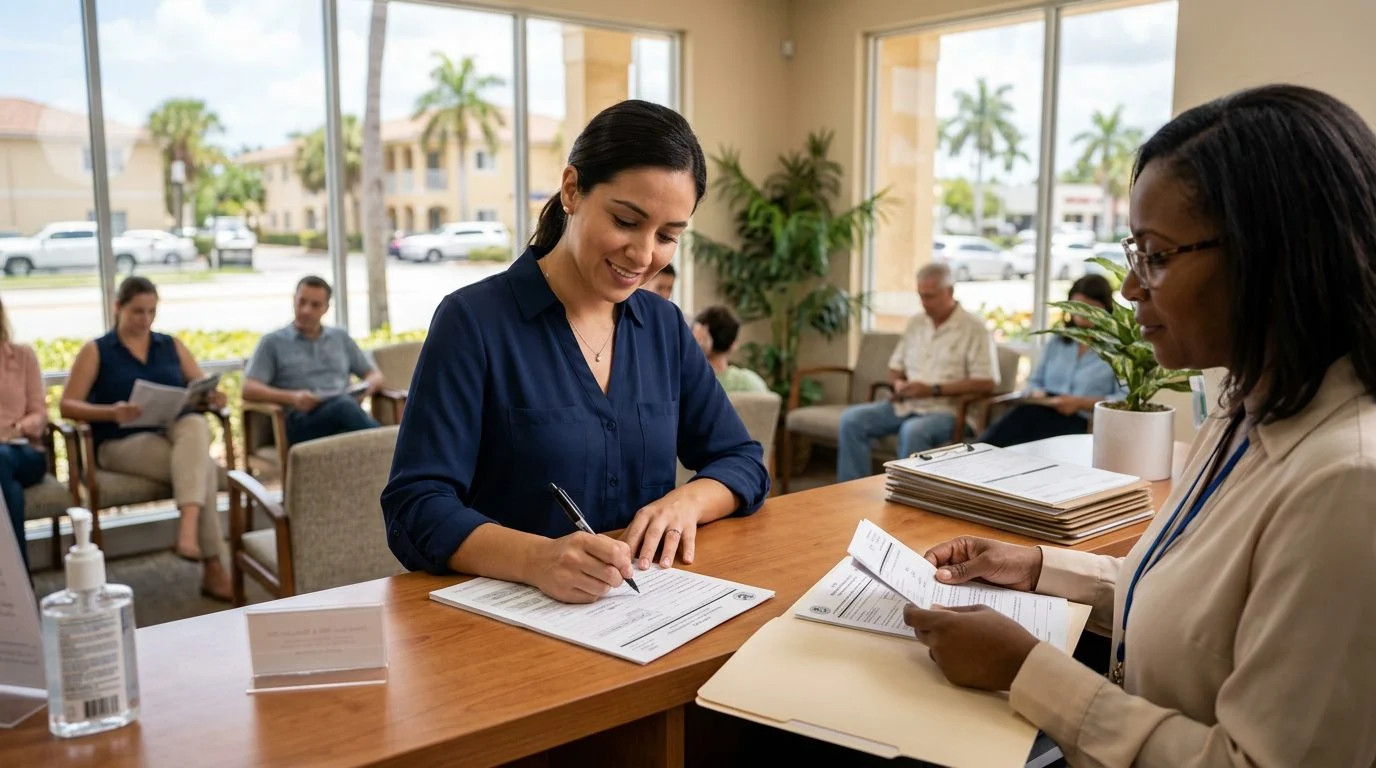
At the appointment, the civil surgeon reviews your health history, examines you, and completes the form. The visit usually includes the screening tests and vaccines the civil surgeon finds needed.
Bring your photo ID, vaccination records, a list of current medicines, and any prior medical records you have. Bring the appointment paperwork you were given, too.
Testing age is set by your age on the day the civil surgeon signs the form. It is not your age on the day USCIS decides the case. See USCIS guidance on communicable diseases.
Once the form is complete, it goes into a sealed envelope. Ask the office how the sealed form will be handed back to you.
How Much the I-693 Exam Costs
The exam is a separate cost from the USCIS filing fee for Form I-485. Ask the civil surgeon’s office what it charges for the exam, any vaccines, and any lab work before you book.
The I-485 filing fee is a USCIS charge. Fee exemptions or waivers may apply to it. For the rules, see the USCIS fee schedule for Form I-485.
Not sure what your next step is?
Talk it through with our team — we can walk you through how a situation like yours is usually handled and what your options are.
Common Questions About I-693 Timing
A properly completed form signed on or after November 1, 2023 can only be used as evidence of health admissibility for the entire period the application is pending.
Does an I-693 expire if I file later?
Under the current text, the form supports the case while the application is pending. It does not run out on a fixed number of years.
Do I need a new I-693 if the first one was incomplete?
The civil surgeon may have to correct it. USCIS can return a form for corrective action if the information conflicts or the officer cannot determine whether the applicant has a Class A condition, and it can send a request for evidence telling you to return to the civil surgeon, as described in USCIS guidance on overall findings.
Do I need COVID-19 vaccine records?
No. USCIS says applicants who are subject to the immigrant vaccination requirements are not required to submit documentation of COVID-19 vaccination for any application pending on or after January 20, 2025. See USCIS guidance on vaccination requirements. See USCIS guidance on vaccination requirements.
Talk With AG Immigration Law About Your I-693 Timeline
AG Immigration Law P.A. can help you talk through how your I-693 timing fits your adjustment case. The firm focuses on removal defense, adjustment of status, family petitions, naturalization, removal of conditions on green cards, waivers, and BIA appeals. Adriana Gomez is the responsible lawyer for this page.
If a civil surgeon visit is ahead, or a sealed I-693 is waiting to be filed, reach out through the contact page. You can use the contact form, call, message on WhatsApp, or book a paid consultation.
How We Can Help With Your Medical Form
Form Review
We look at the timing, the signed civil surgeon information, and the supporting records to identify issues before they reach an officer.
Corrective Action Planning
If a request for corrective action arrives, we help you understand what the notice asks for and how to respond.
Coordinated Filing
We align your medical form with the rest of your adjustment of status or family petition so the pieces fit together.
Support for Your Whole Case
Our team helps clients track documents, deadlines, and communication with the office throughout the process.
Do Not Guess About Your Medical Exam
A medical form that contains errors or conflicting information can create delays in your case. Ask before you file, and bring every notice you have received.
Ways to Reach Our Office
Fill Out the Contact Form
Share a brief summary of your case and the notice you received, and our team will follow up.
Call the Office
Speak with our staff about your medical exam questions and the status of your application.
Message on WhatsApp
Send your questions and documents through WhatsApp for a quick first response from our team.
Book a Paid Consultation
Meet with our attorneys to review your I-693 and map out the steps for your green card case.