

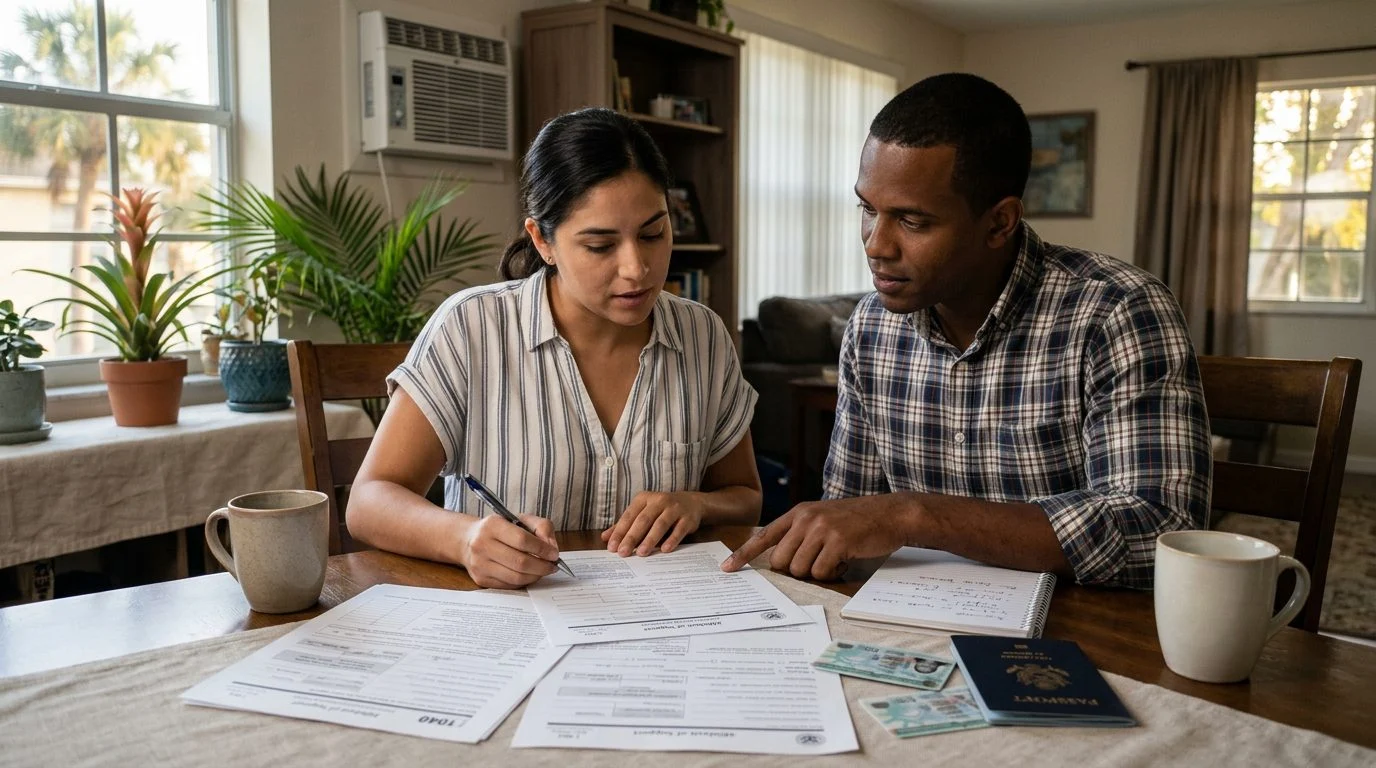
Family Petitions | AG Immigration Law P.A.
Understanding the I-864 Affidavit of Support
A plain-language guide for sponsors and the immigrants they are helping, with a clear path to talk through your family's case.
By Adriana Gomez · Published November 12, 2026
If a relative just told you an I-864 is needed, you may feel rushed and unsure what it asks of you. The I-864 affidavit of support requirement is a federal rule. It asks a U.S. sponsor to promise financial support for the immigrant at a set income level.
Form I-864 is that written promise. This guide explains who signs it, how the income test and household size work, and which errors tend to slow a case.
What Form I-864 Is and Why It Is Required
Form I-864 is a sponsor’s signed contract to support an immigrant. Federal law treats the affidavit as a contract. The sponsor agrees to keep the immigrant at an annual income of at least 125 percent of the federal poverty line, and the promise can be enforced in court (8 U.S.C. § 1183a).
The rule exists because of public charge. In the covered cases, an intending immigrant is inadmissible as likely to become a public charge unless a qualified sponsor, or a substitute sponsor and, if necessary, a joint sponsor, signs the affidavit on the form USCIS designates (8 C.F.R. § 213a.2). Put simply, the government wants a financially responsible sponsor on file.
Adjustment of status inside the United States has its own requirements. The affidavit sits alongside those steps.
If you are helping a relative whose household income may not meet the I-864 test, you do not have to sort it out alone, and our team can talk through your situation. Talk it through with our team — we can walk you through how a situation like yours is usually handled and what your options are.
Who Needs to File an I-864 for a Green Card
In family-based cases, the sponsor is usually the relative who is a U.S. citizen or green card holder. A sponsor must be a citizen, a national, or a lawful permanent resident (8 U.S.C. § 1183a). Family petitions rest on that qualifying relationship (8 C.F.R. § 204.1).
Check who the sponsor is before gathering any papers. The sponsor’s income and household are the ones tested, so the file must match that person.
Some readers are the immigrant rather than the sponsor. An intending immigrant may submit evidence of his or her own assets as part of the affidavit of support, even if the intending immigrant is not required to sign an affidavit of support attachment (8 C.F.R. § 213a.2).
Active-duty military sponsors have a lower threshold. For a spouse or child, the income figure drops to 100 percent of the poverty line (8 C.F.R. § 213a.2). That exception covers active duty, not training.
The 125 Percent Income Threshold and the Household-Size Trap
The sponsor generally needs income of at least 125 percent of the federal poverty line for the household size. The poverty guidelines change each year. USCIS uses the most recent guidelines published in the Federal Register, starting the first day of the second month after publication (8 C.F.R. § 213a.1). Use the current table for the year the application is filed.
Household size counts more people than most readers expect. It includes the sponsor, the sponsor’s spouse and children (unless the children have reached the age of majority under the law of the place of domicile and the sponsor did not claim them as dependents on the last federal tax return), and anyone claimed as a dependent on the last federal tax return. It also includes other immigrants sponsored under affidavits still in effect, and the immigrant you are sponsoring now (8 C.F.R. § 213a.1).
This is the trap. Each added person raises the income figure. A sponsor who counts a spouse, two children, and the immigrant needs more income than the same sponsor counting only themselves.
Income from the immigrant generally does not count. Income from a spouse, or from another household member 18 or older who signed the form, can count (8 C.F.R. § 213a.1). 8 C.F.R. § 213a.1 reads: “The “household income” may not, however, include the income of an intending immigrant, unless the intending immigrant is either the sponsor’s spouse or has the same principal residence as the sponsor and the preponderance of the evidence shows that the intending immigrant’s income results from the intending immigrant’s lawful employment in the United States or from some other lawful source that will continue to be available to the intending immigrant after he or she acquires permanent resident status.” The officer decides whether the affidavit is sufficient based on the sponsor’s reasonably expected household income in the year the intending immigrant filed the application, on the evidence submitted, and on the poverty guidelines in effect when the intending immigrant filed the application (8 C.F.R. § 213a.2). Whether a sponsor meets the test depends on the facts of the household and its income. 8 C.F.R. § 213a.2 reads: “only if, on the basis of specific facts, including a material change in employment or income history of the sponsor, substitute sponsor, joint sponsor or household member, the number of aliens included in affidavit of support that the sponsor has signed but that have not yet entered into force in accordance with paragraph (e) of this section, or other relevant facts, it is reasonable to infer that the sponsor will not be able to maintain his or her household income at a level sufficient to meet his or her support obligations.”
Joint Sponsors and Other Ways to Meet the Requirement
A joint sponsor can help when the main sponsor’s income falls short. A petitioning sponsor who does not meet the income requirement of paragraph (1)(E) may still qualify by accepting joint and several liability together with an individual under paragraph (5)(A) (8 U.S.C. § 1183a). That joint sponsor must demonstrate the means to maintain an annual income equal to at least 125 percent of the Federal poverty line. The 100 percent level applies instead to a sponsor on active duty (other than active duty for training) in the Armed Forces who is petitioning for the admission of the alien as the sponsor’s spouse or child. The joint sponsor may meet this through household income or, where household income falls short, through significant assets (8 C.F.R. § 213a.2). Under 8 C.F.R. § 213a.2, the lower threshold of at least 100 percent of the Federal poverty line applies when a sponsor or joint sponsor serves on active duty (other than for training) in the Armed Forces of the United States and the intending immigrant is the sponsor’s or joint sponsor’s spouse or child. The rules also allow a substitute sponsor (8 C.F.R. § 213a.2).
A joint sponsor does not replace the main sponsor’s form. Both sign, and both carry the support duty they accept.
Assets can count too. A sponsor may submit savings accounts, stocks, bonds, certificates of deposit, or real estate. Assets are counted at their combined cash value after offsetting liabilities, and that value must exceed a set amount (8 C.F.R. § 213a.2). Assets of any person who has signed an affidavit of support attachment may also be considered (8 C.F.R. § 213a.2).
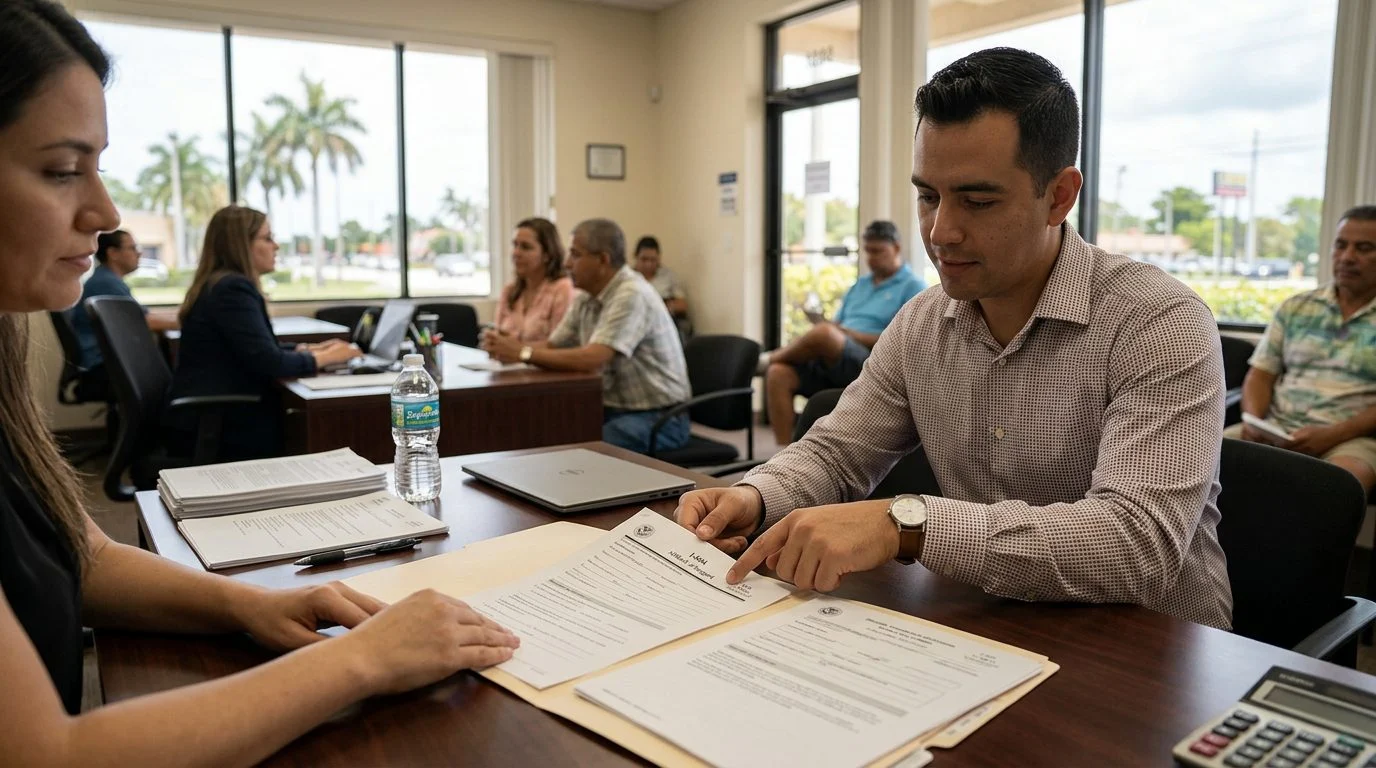
Form I-134 vs Form I-864: The Key Differences
Form I-134 and Form I-864 are different forms. Each case file must name the one it requires, so do not assume they are interchangeable. Form I-134 is a separate financial support form, and its own rules apply.
The rules in this guide come from the I-864 statute and its regulations. Those sources set the 125 percent test, the household count, the assets rule, and the enforcement terms (8 U.S.C. § 1183a). Think of the I-864 as the main sponsor document. Its income test and household count apply to the sponsor and to anyone who signs with them.
Before preparing documents, confirm which form the case needs. Every affidavit must include each sponsor’s social security account number (8 U.S.C. § 1183a). A missing number is a simple error, but it can delay a file.
How Long the Sponsor’s Obligation Lasts and How It Is Enforced
The obligation generally lasts until the immigrant has worked, or can be credited with, 40 qualifying quarters of coverage under Social Security. For quarters after December 31, 1996, the immigrant also must not have received a federal means-tested public benefit in those quarters (8 U.S.C. § 1183a).
Many readers ask whether the affidavit expires. It does not end on a set date. It ends being enforceable once those conditions are met.
Enforcement is broad. The affidavit can be enforced by the immigrant, the federal government, a state or local government, and any entity that provides a means-tested public benefit (8 U.S.C. § 1183a). The sponsored immigrant can bring a case to compel support without first asking the sponsor to comply (8 C.F.R. § 213a.4).
Not sure what your next step is?
Talk it through with our team — we can walk you through how a situation like yours is usually handled and what your options are.
Common I-864 Mistakes That Can Slow a Case
Most delays come from numbers that do not match the rule, and from missing proof. Watch for these errors.
- Using an old poverty guideline table instead of the current one (8 C.F.R. § 213a.1).
- Leaving out a household member who counts, such as a dependent on the last tax return (8 C.F.R. § 213a.1).
- An affidavit of support must include the social security account number of each sponsor.
- Missing the 30-day change of address notice after a move. A civil penalty may apply (8 C.F.R. § 213a.3).
- Submitting weak proof. Primary evidence is expected where available, and secondary evidence may be accepted when primary evidence is not available (8 C.F.R. § 204.1).
Keep the priority date separate. The priority date is the filing date of a properly filed petition (8 C.F.R. § 204.1). It is a different question from whether the I-864 is complete.
Does an I-864 expire?
It does not expire on a set date.
Can a joint sponsor file an I-864?
Yes. A joint sponsor who accepts joint and several liability must still meet an income requirement. Household income generally must equal at least 125% of the Poverty Guidelines for the household size, though significant assets may be used to meet it. A lower threshold applies only when the joint sponsor is on active duty in the U.S. Armed Forces (other than active duty for training) and the intending immigrant is the joint sponsor’s spouse or child.
Can household members’ income count?
Yes, in limited cases. A spouse, or another household member 18 or older who signed the required form, can count.
Talk With AG Immigration Law About Your I-864 Question
If you are the sponsor, the immigrant, or a relative keeping a case moving, you did not pick this step. A household income figure that may fall short, or an affidavit that has been questioned, can stall the whole family plan.
AG Immigration Law P.A. focuses on removal defense, adjustment of status, family petitions, naturalization, and related immigration matters. Consultations with the firm are paid.
Whether you are the one filing or the one being sponsored, bring the household and tax details to the first conversation. To reach the firm, use the contact form, call the office, or send a message on WhatsApp.
How we can help with your family's case
Family petitions
We focus on family-based petitions, from the initial filing through the steps that follow.
Adjustment of status
Our practice includes adjustment of status for applicants who are already in the United States.
Removal defense and waivers
When a case involves removal proceedings or waivers, we review the options with you before any decision is made.
Support for sponsors and applicants
We explain what the affidavit of support asks of each person involved, so the family understands its responsibilities.
Review your situation before you file
Income, household size, and prior filings can all affect how the I-864 applies to a case. Speak with our office before you sign or submit any affidavit.
Ways to reach our office
Fill out the contact form
Tell us briefly about your family's situation and we will follow up with next steps.
Call the office
Speak with our team directly about your I-864 questions and how they relate to your case.
Message us on WhatsApp
Send us a message with your questions and our staff will respond through the office.
Book a consultation
Schedule a paid consultation to review your documents and discuss the options for your case.