

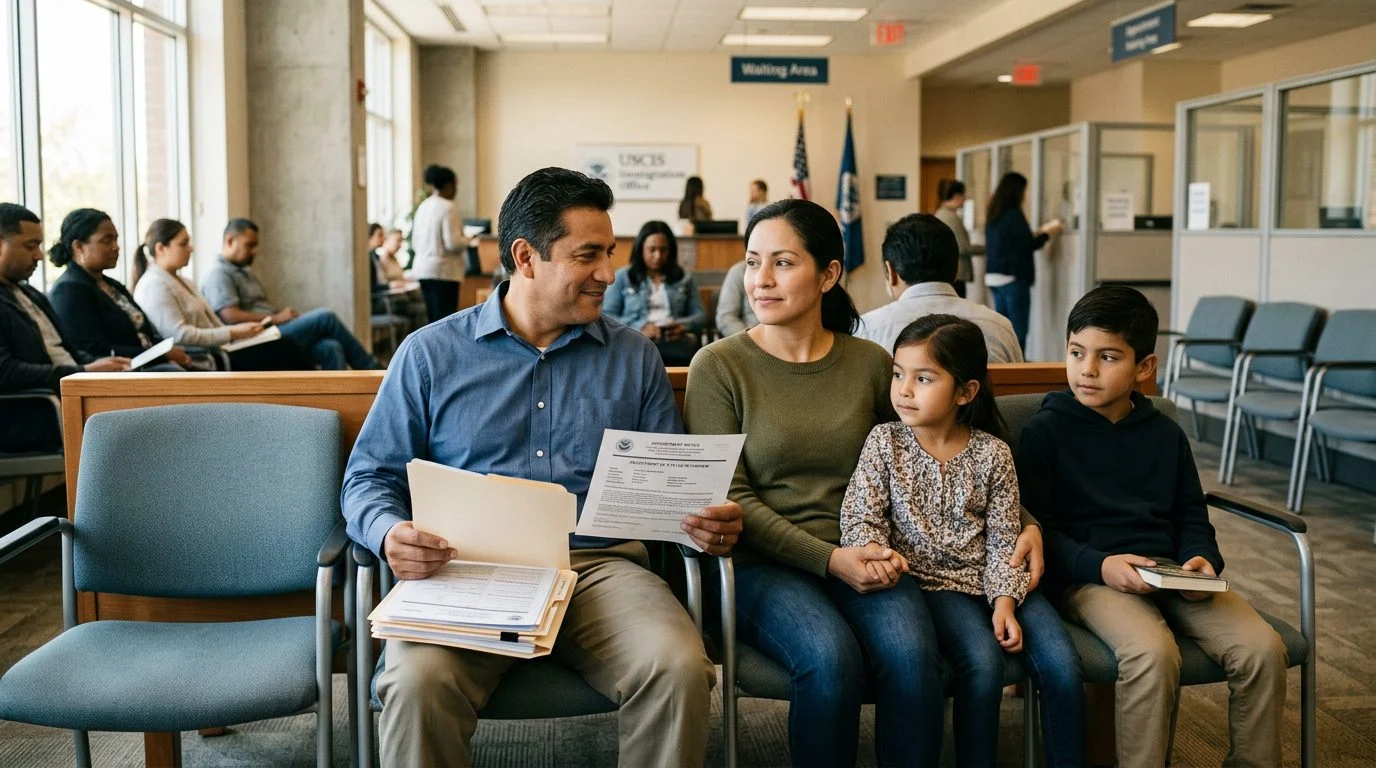
Adjustment of Status | Immigrants Across the United States
Adjustment of status help for immigrants in Florida, Texas and New York
Bring your case to a team that focuses on immigration matters, from filing through each stage of review.
By Adriana Gomez · Published November 12, 2026
Adjustment of Status Lawyer for New York Clients
Already living in the United States and hoping for a green card? If you are already in the United States, you may not need to leave the country to begin the process. That process is called adjustment of status.
An eligible person can ask to become a lawful permanent resident through this process. An applicant who was inspected and admitted or paroled into the United States (or who has an approved VAWA self-petition) may be granted adjustment, in the government’s discretion, if the applicant files an application, is eligible for an immigrant visa, is admissible, and has an immigrant visa immediately available when filing. Except for VAWA self-petitioners, this does not apply to certain people, such as alien crewmen, people admitted in transit without a visa, and visitors admitted without a visa (other than immediate relatives).
If you're already in the United States and weighing a green card filing, reach out by form, phone, or WhatsApp to set up a paid consultation with our team. Talk it through with our team — we can walk you through how a situation like yours is usually handled and what your options are.

What Adjustment of Status Is and Who It Is For
Adjustment of status is a green card request filed from inside the United States with USCIS. It fits people who are physically present in the country, are not in a category barred from adjustment of status, and are eligible to receive an immigrant visa that is immediately available when they file (8 C.F.R. § 245.1).
Common starting points include:
- A family petition (Form I-130) that a relative has had approved
- An employment-based petition
- A visa category where a visa number is current
- A case already in immigration court
For preference categories, the Department of State Visa Bulletin shows whether a visa is available. The applicant’s priority date must be earlier than the date shown in the bulletin, unless the bulletin shows that visa numbers for the applicant’s category are current (8 C.F.R. § 245.1).
Unlawful status is a common obstacle. The statute bars many applicants who are in unlawful status on the filing date, but it also has exceptions, and immediate relatives are treated differently (8 U.S.C. § 1255).
A person in removal proceedings may ask an immigration judge to grant adjustment (8 C.F.R. § 1240.11). Our practice covers removal defense, so these questions are reviewed together.
What Our Adjustment of Status Services Include
Our team handles the adjustment case from the first review through the interview, with attention to the forms and evidence each stage requires.
- Eligibility review: the qualifying basis, the visa category, and the priority date.
- Admissibility review: prior overstays, unlawful presence, and past removal orders.
- Form I-485 filing: the application with civil documents, proof of entry, and relationship or job evidence.
- Medical examination: the applicant must be examined by a designated civil surgeon, and that report becomes part of the record, unless the applicant entered as a K nonimmigrant spouse, fiancé(e), or child of a U.S. citizen and was medically examined before the visa was issued, within 1 year before filing the application (8 C.F.R. § 245.5).
- Related forms: work authorization (Form I-765) and travel authorization (Form I-131), when the case calls for them.
- Waivers: filings and evidence for inadmissibility grounds, when a waiver is needed.
- Interview preparation: organizing documents, anticipating questions, and knowing what to bring. Each applicant is interviewed, with limited exceptions (8 C.F.R. § 245.6).
- Requests for evidence: responses to USCIS requests and updates on case status.
- Removal coordination: aligning filings and deadlines when immigration court is involved.
How the Process Works, Step by Step
The process moves through six stages, from first contact to the USCIS decision.
- Contact the office. Use the contact form, call the office, or send a WhatsApp message describing your case.
- Paid consultation. Your facts, documents, and immigration history are reviewed, and your options are explained.
- Document collection. You gather passports, prior filings, court and police records, and proof of the qualifying relationship or job.
- Filing. The application package is prepared, and each form and exhibit is checked before submission.
- Biometrics and interview. You attend the biometrics appointment and any interview, with preparation for each.
- Decision and next steps. After the decision, the team explains what comes next, such as a Petition to Remove the Conditions on Residence required by section 216(c) of the Act for those granted conditional permanent residence (8 C.F.R. § 1240.11).
Processing times vary by office and case type, so the team gives timing guidance for each filing.
Why Work With This Firm
AG Immigration Law P.A. focuses on immigration law and serves immigrants across the United States. Adriana Gomez is the responsible lawyer for this page.
- Related practice areas: removal defense, adjustment of status, family petitions, naturalization, removal of conditions on green cards, waivers, and BIA appeals. Adjustment work often connects to these matters, so they are reviewed together.
- Lawyers and support staff: our lawyers and support staff handle document collection, scheduling, and client communication.
- Clear steps: you learn what is being filed, why, and what deadline comes next.
- Several ways to reach us: contact form, phone, and WhatsApp.
Questions Clients Ask Before Filing for Adjustment of Status
Most questions come down to eligibility, where the case is filed, and what happens at each stage.
Can I apply if I overstayed my visa?
It depends on the facts. Unlawful status on the filing date can block adjustment, and the statute has exceptions (8 U.S.C. § 1255).
Do I have to leave the United States to get a green card?
Not always. Adjustment of status lets an eligible person who is physically present in the United States, and whose immigrant visa is immediately available at the time of filing, apply from inside the country, while consular processing happens at a U.S. consulate abroad.
Can I get a green card while in removal proceedings?
In some cases, yes. An immigration judge may hear an adjustment application, and an applicant may ask for a waiver there too (8 C.F.R. § 1240.11).
Will there be an interview?
Usually yes. Each applicant is interviewed by an immigration officer, though the rule allows limited waivers (8 C.F.R. § 245.6).
How much does a consultation cost?
Consultations are paid. Government filing fees are separate from our consultation fee.
Not sure what your next step is?
Talk it through with our team — we can walk you through how a situation like yours is usually handled and what your options are.
Common Mistakes That Can Delay or Complicate a Filing
Most avoidable problems come from incomplete packages, missed notices, and travel or status errors.
- Incomplete packages: missing signatures, or names and dates that don’t match across forms.
- Missed appointments: skipping a biometrics appointment or interview notice. Act on any notice right away.
- Travel without checking: leaving the country can affect the case, since the rules for departure differ by the law the application is filed under (8 C.F.R. § 245.2).
- Assuming a pending case protects you: a pending application does not confer lawful status and does not automatically protect against removal if status expires (USCIS Policy Manual).
- Inadmissibility issues: each waiver request depends on the facts of the case, so you may wish to contact our office to discuss your situation.
Talk With the Firm About Your Adjustment of Status Case
If you’re already in the United States and weighing a green card filing, the next step is a paid consultation. If you have an approved family petition, a visa that is becoming current, or an immigration court case, you’re in the right place to start.
Bring your passport, prior USCIS notices, immigration court papers, and any approval notices. Reach out now by filling out the contact form, calling the office, or sending a WhatsApp message to set up a consultation with Adriana Gomez.
How we work with you
Clear review of your file
We look at your immigration history, your current status and the documents you already have so you know where your case stands.
Support from our whole team
Our lawyers and staff keep your filing organized, track deadlines we are aware of, and answer your questions along the way.
Serving clients in key communities
We represent immigrants in Florida, Texas and New York, including Miami, Broward County, Orlando, Houston, San Antonio and New York City.
Talk with a lawyer before you file
Your immigration history, prior visits and any past filings can affect how an adjustment of status application is reviewed. Do not file on your own without first getting advice on your specific facts.
Related immigration services
Removal defense
Representation in immigration court when the government seeks to remove you from the United States.
Family petitions
Help with petitions filed by U.S. citizens and permanent residents for eligible family members.
Waivers and removal of conditions
Support with waiver applications and with removing conditions from a green card when required.
Naturalization and BIA appeals
Assistance with citizenship applications and with appeals before the Board of Immigration Appeals.