

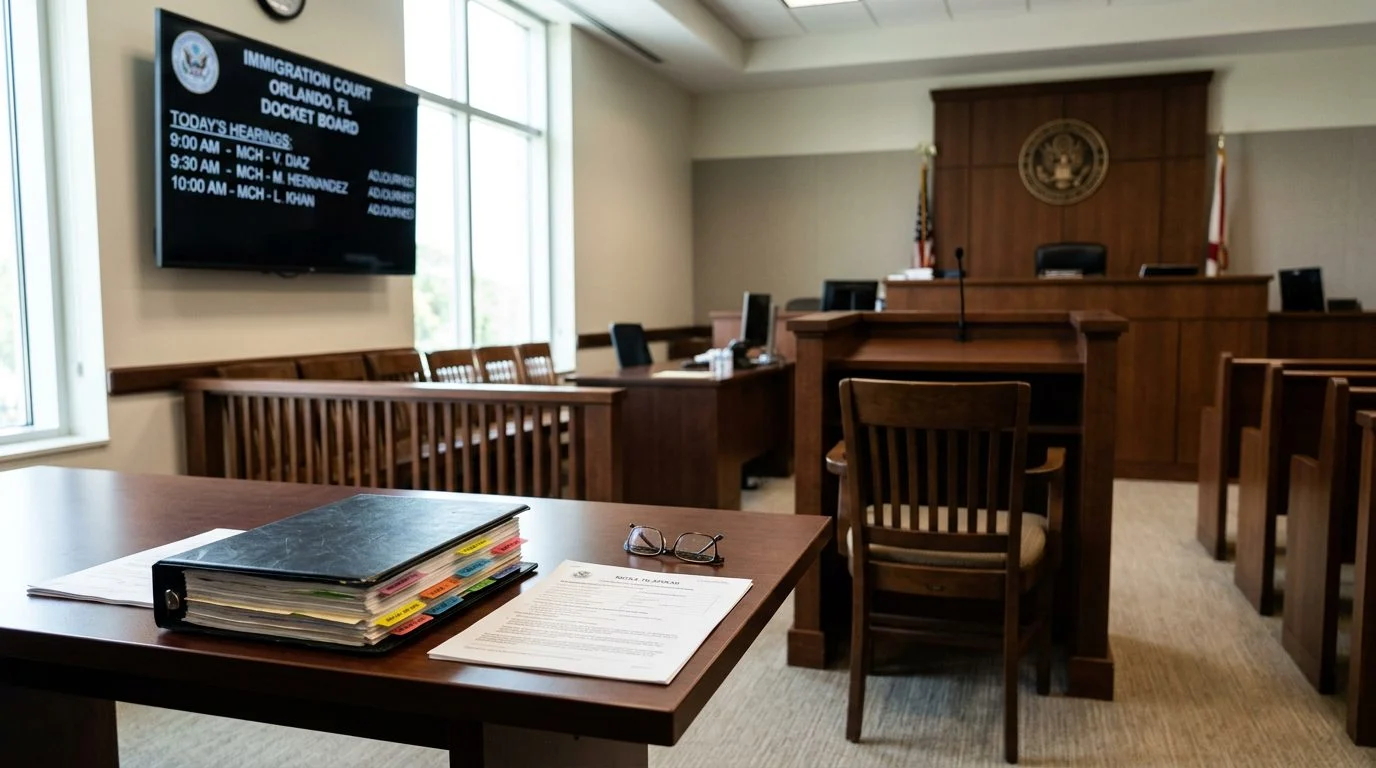
Removal Defense | Immigration Court in Florida
Administrative Closure in Immigration Court: Understand Your Options in Florida
AG Immigration Law P.A. focuses on removal defense and related immigration matters for clients in Florida, including Miami, Broward County and Orlando. Contact our team to talk through your case.
By Adriana Gomez · Published November 1, 2026
Administrative closure lets an immigration judge, in the exercise of discretion and upon the motion of a party, set a removal case aside from the active calendar. Prosecutorial discretion lets the government choose not to pursue enforcement against a person. Both can change the path of a non-detained case in Florida, but neither is automatic. This guide explains how administrative closure immigration court Florida requests work, what judges and DHS weigh, and where people often go wrong.
What Administrative Closure and Prosecutorial Discretion Are
Administrative closure is a judge’s tool to pause a case. Prosecutorial discretion is a government decision not to enforce against someone.
- Administrative closure. An immigration judge may, in the exercise of discretion, close a case upon the motion of a party (8 CFR 1003.18).
- Prosecutorial discretion. USCIS describes it as the authority of an agency to decide whether to enforce, or not enforce, the law against someone (USCIS prosecutorial discretion guidance).
- Termination. This is a different step. It ends the proceedings, so it is not the same as closing a case.
Removal proceedings under section 240 of the Act begin when a notice to appear is filed with the immigration court (8 CFR 1239.1). This page is written for people in non-detained removal proceedings and for relatives who help them.
If a removal case has you looking for a way to pause it, our team can review your record with you in a paid consultation. Talk it through with our team — we can walk you through how a situation like yours is usually handled and what your options are.

What This Service Covers
This service covers motions to close a case, requests for prosecutorial discretion, and the filings and evidence that go with them.
- Review of your notice to appear, prior filings, and hearing dates.
- Drafting a motion for administrative closure and filing it with the court. DHS and attorneys and accredited representatives of record must electronically file all documents in cases eligible for electronic filing; unrepresented respondents may do so but are not required to (8 CFR 1003.31).
- Requests to DHS for prosecutorial discretion. USCIS generally will not consider deferred action for someone in removal proceedings. In the absence of a specific contradictory regulatory provision, this policy governs deferred action requests. Deferred action is exercised judiciously and only in extraordinary circumstances where a USCIS officer makes an independent case-by-case decision based on the totality of the circumstances. USCIS deferred action guidance)
- Evidence that supports the facts in your case, such as proof of residence, family ties, work history, and community ties.
- Coordination with your other defense filings, so each request fits the rest of the record.
Who May Be Able to Pursue a Pause
A pause is possible in some cases, but the judge decides, and no outcome is promised. Under 8 CFR 1003.18(c)(3), an immigration judge shall grant a motion filed jointly by both sides unless the judge articulates unusual, clearly identified, and supported reasons for denying the motion. The same is true when one side files and the other says it does not oppose, unless the judge gives unusual, clearly identified, and supported reasons to deny it (8 CFR 1003.18).
In other cases, the judge looks at the totality of the circumstances. No single factor decides the question. A judge can grant closure even over a party’s objection.
A pending petition or application outside court is not required. Closure may fit where one is pending, but the rule does not demand it.
Prosecutorial discretion is case by case. USCIS uses deferred action only in compelling circumstances, after an individual review. Whether a pause fits your record depends on the facts of your case and how the judge or DHS applies current rules.
How the Process Works, Step by Step
The process starts with your notice to appear and moves through a motion or request, a hearing, and a ruling you track.
- Review the record. Read the notice to appear, every prior filing, and your next hearing date.
- Choose the route. Decide whether a motion to close, a discretion request, or both fit your record.
- Gather evidence. Collect documents that prove the facts you rely on, then draft the motion or request.
- File and serve. File with the immigration court. A paper filing must include a certificate of service showing the other side was served (8 CFR 1003.32).
- Attend and track. Go to every hearing unless the court tells you otherwise. Check the ruling and status after each filing.
Timing varies with each court’s docket, so no single timeline fits every case.
Florida Immigration Court Context and Timelines
- Continuances. A judge may grant a continuance for good cause shown (8 CFR 1003.29).
- Change of venue. A judge may change venue for good cause, but only on a party’s motion. The other side must have notice and a chance to respond. The request must give a fixed street address where the person can be reached (8 CFR 1003.20).
- Docket timing. The time between a hearing and a ruling on a motion varies by court and docket.
- Return timing. When a closed case returns to the active calendar depends on why it was closed and what has happened since.
What Happens After a Case Is Paused, and What Can Go Wrong
A paused case is still open, so you still have duties.
- Attendance. The statute allows removal in absentia when a person does not attend after written notice. In an in absentia proceeding, the government must establish by clear, unequivocal, and convincing evidence that written notice was provided and that the person is removable. Keep your address current.
- Motion limits. A party may generally file one motion to reconsider and one motion to reopen. Reconsideration is due within 30 days and reopening within 90 days of a final order, subject to exceptions (8 CFR 1003.23).
- No automatic stay. Except in cases involving in absentia orders, filing a motion to reopen does not stop a decision unless a stay is specifically granted (8 CFR 1003.23).
- A denial. If a motion or request is denied, the case stays on the active calendar. The next hearing and filings still apply.
Not sure what your next step is?
Talk it through with our team — we can walk you through how a situation like yours is usually handled and what your options are.
Why Work With AG Immigration Law P.A.
AG Immigration Law P.A. focuses on removal defense and related immigration matters. These include adjustment of status, family petitions, naturalization, removal of conditions on green cards, waivers, and BIA appeals.
Adriana Gomez is the lawyer responsible for this page. Our team includes support staff who help with office work, documents, and client communication. The firm works with immigrants across the United States.
If your matter may be better handled by another lawyer or firm, we will tell you so.
Common Questions About Pausing a Removal Case
Does administrative closure end my case?
No. Administrative closure sets a case aside, and it is a different step from termination.
Can I request both administrative closure and prosecutorial discretion?
Yes. Each request goes to a different decision-maker and follows its own rules.
Will my status change while my case is closed?
Not by closure alone. A grant of deferred action does not confer immigration status, so any status question needs its own review.
Do I still have to attend hearings?
Yes, until the court says otherwise. Notice goes to the most recent address on file.
Can a closed case be reopened later?
Timing matters.

Talk With Our Team About Your Case
Facing a removal case is stressful, especially when you are reading this for a parent, spouse, child, or friend. If you are weighing whether a pause fits your record, reach out through the contact page, by phone, or by WhatsApp. Consultations are paid, and you can book one to review your case with Adriana Gomez.
How We Work With You
Case Review Discussion
We look at your immigration history, your court paperwork and your next hearing date so you know where your case stands before any filing is made.
Clear Strategy
We explain the options available in your removal proceedings, including administrative closure, and the risks and steps that come with each one.
Open Communication
Our team keeps you informed about filings, court dates and decisions, and answers questions in English or Spanish.
Focused Practice
Our practice concentrates on removal defense, adjustment of status, family petitions, naturalization, waivers and BIA appeals.
Important: Closure Is Not Termination
Administrative closure sets a case aside. It does not end your case. Before you rely on any request, speak with our team about how it fits your situation and what happens next.
Questions to Bring to Your Consultation
Your Court Status
Bring your Notice to Appear, hearing notices and any orders from the immigration judge so we can confirm where your case is pending.
Your Immigration History
List prior applications, petitions, entries and any relief you have already requested, including any family petitions filed for you.
Other Possible Relief
Ask whether a request for prosecutorial discretion, an adjustment of status, a waiver or another form of relief could be considered alongside closure.
Your Next Steps
Discuss how an appeal to the Board of Immigration Appeals may affect your options if the immigration judge issues a decision you disagree with.
Talk With Our Team About Your Removal Case
Related practice areas
- Deportation Defense Attorney for Immigration Court: Removal Proceedings Explained
- Immigration Court Venue and Court Assignment in Florida and Texas: How to Confirm Which Court Hears Your Case
- What Is Administrative Closure in Immigration Court? A Plain-Language Guide for Non-Detained Asylum Seekers
- Can an Immigration Judge Set a Deadline for My Asylum Application (Form I-589)?