

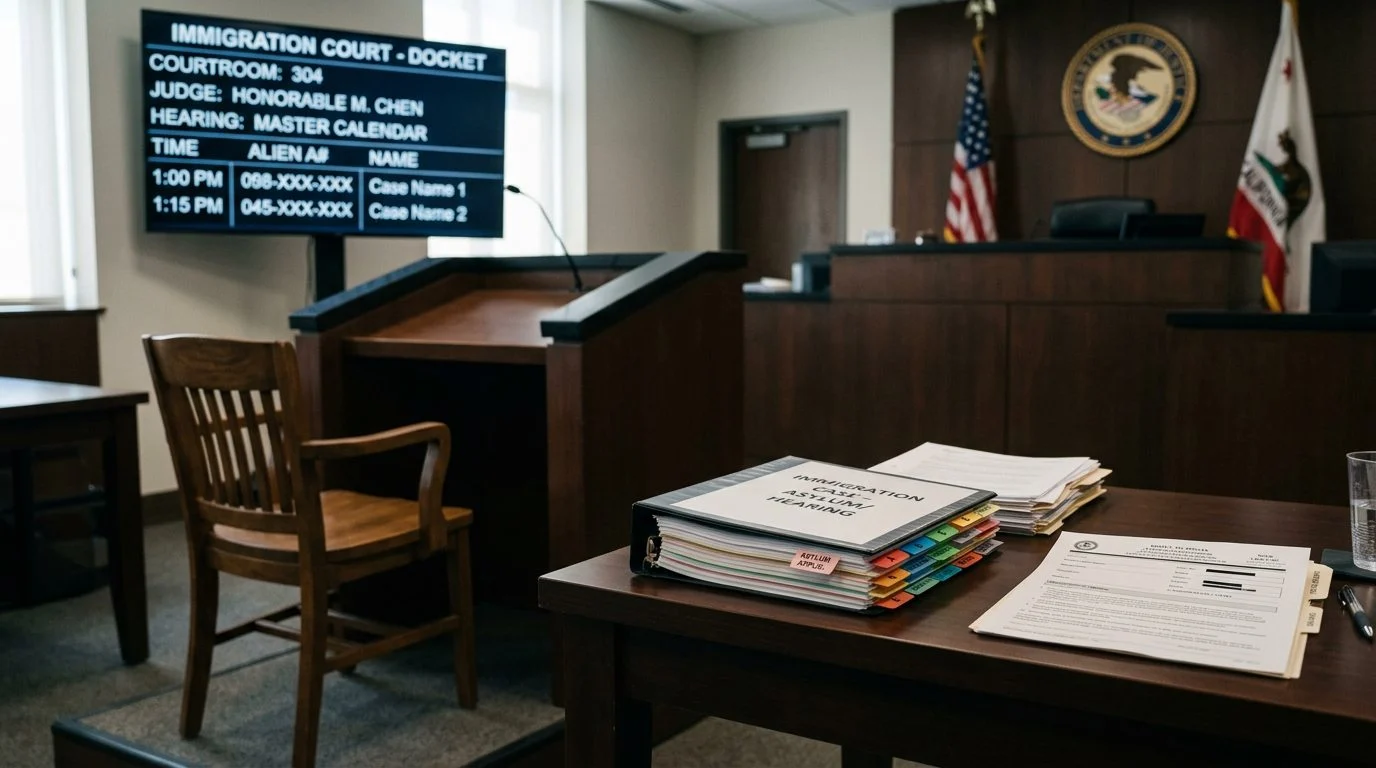
Removal Defense | Immigration Court
An Arrest Record Can Affect Your Immigration Case. Get Answers Before You Act.
AG Immigration Law P.A. focuses on removal defense and related immigration matters, including asylum hearings in immigration court. This page is under the responsibility of Adriana Gomez.
By Adriana Gomez · Published October 31, 2026
An old arrest can come up in an asylum hearing, even when it seems minor or long past. Immigration court can review police and court records, not only what you remember. This guide explains how the court treats an arrest compared with a conviction, what your asylum application asks, and what to gather before your hearing. It is general information, not advice about your own file.
Why an Old Arrest Can Come Up in an Asylum Case
Under 8 CFR 1240.7, the immigration judge may receive any statement that is material and relevant to the case. That includes statements made earlier by you or any other person during an investigation, examination, hearing or trial.
A statement you gave to police years ago could fall into that group. Many people assume old records have disappeared. Records often last longer than memory. Courts, police departments and state repositories may still hold files.
The right time to find out what your records show is well before the hearing date. Early review gives you time to request official copies, build an accurate timeline and plan how to explain each record.
If an old arrest is weighing on you before an asylum hearing, our team can talk through your record and your hearing date with you. Talk it through with our team — we can walk you through how a situation like yours is usually handled and what your options are.

Arrest Versus Conviction: How Immigration Court Treats Each
An arrest is not the same as a conviction. An arrest shows that police took someone into custody. It does not show what a court decided.
Under 8 CFR 1003.41, several kinds of records can prove a conviction. These include a record of judgment and conviction, a record of plea, verdict and sentence, and a docket entry showing a conviction. An abstract prepared by the court or a state official also counts, as does any document prepared by or under the direction of the court.
The same rule says other evidence that reasonably shows a conviction may also be admissible. So the judge does not look at one paper alone. The judge looks at the whole record of what happened.
A dismissed, sealed or expunged case still has a record. Read the final outcome, the exact charge and the date closely. The result of each charge is what gets reviewed, not only the fact of the arrest.
What the Asylum Application Asks and Why Answers Must Be Complete
Your asylum application must answer each required question, and an incomplete one can be rejected. Under 8 CFR 1208.3, for filing with an immigration court, an application is incomplete if it skips a required question, is unsigned, is unaccompanied by required materials, is not completed as the form instructions say, or is unaccompanied by any required fee receipt or other proof of payment. An immigration court must reject an incomplete application.
If you wish to have your application for asylum considered, you must correct the problem and refile within 30 days of the rejection. If you don’t, and no exceptional circumstances apply, the court will find that you abandoned the application and waived the opportunity to file such an application.
Credibility matters too. Under 8 U.S.C. 1158, a judge may compare your written and oral statements. The judge may also check whether your statements match other evidence. An inaccuracy can count even if it does not go to the heart of your claim.
That is why an omitted arrest can cause trouble, even if the charge was later dropped. Read every question slowly. Compare each answer with your records before you sign. If an earlier filing left something out, raise it with a lawyer promptly.
How an Arrest Can Affect Asylum Eligibility
A criminal record can affect asylum, and the effect depends on the facts of your case. The asylum statute, 8 U.S.C. 1158, sets limits on who can receive asylum. Some of those limits involve security concerns.
The inadmissibility rules in 8 U.S.C. 1182 also list serious criminal offenses.
An arrest and a conviction raise different questions. A review of the exact charge, the sentence and the final outcome shows how your record fits the law. Do not assume a record is irrelevant because it is old or minor.
An immigration judge can also deny an asylum application early if the applicant has not made a prima facie claim. Under 8 CFR 1208.13, the judge must give at least 10 days’ notice before doing that on the judge’s own authority.
Gathering Records Before the Hearing
Gather official records for every arrest, including how each case ended. Useful documents include certified court dispositions, charging documents, abstracts of the record, police reports, bail or release papers, and any sealing or expungement orders. The list in 8 CFR 1003.41 shows kinds of records that are admissible in proving a criminal conviction, and any other evidence that reasonably indicates the existence of a criminal conviction may also be admissible.
Request official copies from the court or agency that holds the file. Don’t rely on memory or informal printouts. Official copies match what the court has on file.
Under 8 CFR 1208.13, you carry the burden of proving you are a refugee. Your own testimony, if credible, may be enough without other proof. But if the judge requires corroborating evidence, the asylum statute, 8 U.S.C. 1158, requires you to provide it unless you don’t have it and cannot reasonably get it.
Finally, write a timeline of each arrest. Include dates, places, charges, outcomes and any court dates. Keep the timeline consistent with your application.
How to Address the Arrest in Court
Answer every question about a record accurately, and only about what you can confirm. Say “I don’t know” or “I need to check” when that is true. Guessing creates new problems.
Under 8 CFR 1240.7, testimony at the hearing must be given under oath or affirmation. Your words become part of the sworn record. Your statements should match your application and your records.
Inconsistencies draw scrutiny. A judge may weigh demeanor, candor and consistency when judging credibility. Calm, direct answers are easier to follow than long explanations.
A lawyer can help you prepare to explain the circumstances of an arrest. A lawyer may also decide how and when to raise the record in pleadings or filings. For background on that step, read the pleadings-first hearing guide.
Not sure what your next step is?
Talk it through with our team — we can walk you through how a situation like yours is usually handled and what your options are.
Common Questions About Old Arrests in Asylum Cases
Old arrests raise the same core issue: your answers must match the records. Here are the questions people ask most.
Does a very old arrest still need to be listed?
Age alone does not decide it. Read the exact question on the form and answer it fully. Under 8 CFR 1208.3, an application that skips a required question is incomplete.
What if no charge was ever filed?
Read the wording of the question before you answer. An arrest with no charge can still matter, so check the form’s wording against your records.
What if I didn’t know about a record when I filed?
Tell a lawyer as soon as you learn of it. Filing deadlines can be short. The 30-day refiling period after a rejection is one example.
Can an ICE contact make a record more visible?
An enforcement contact can bring your history to the surface. Review your records before any check-in. For more on that step, see ICE check-in after an asylum referral.

Talk Through Your Record With AG Immigration Law P.A.
If an old arrest is weighing on you before an asylum hearing, you don’t have to sort it out alone. Maybe you’re reading this for a parent, a sibling or a friend with a hearing date coming up. Either way, the records and the timing can feel overwhelming.
Adriana Gomez is the responsible lawyer for this page at AG Immigration Law P.A. You can reach the office through the contact form, by phone or on WhatsApp. Consultations with the office are paid, and the team can explain the fee when you reach out.
For broader background, see the removal defense overview and the Florida removal defense page.
How We Help Clients With Arrest Records and Court Hearings
Removal Defense
We review the charges, the record and the government's case to build a defense in immigration court.
Applications and Forms
We help you answer every question on adjustment of status, naturalization and other filings accurately and completely.
Clear Communication
Our team keeps you informed about each step and answers your questions in plain language.
Florida, Texas and New York
We represent immigrants in Miami, Broward County, Orlando, Houston, San Antonio and New York City.
Warning: Do Not Guess on Your Forms
Read each question carefully and speak with a lawyer before you sign or submit anything to immigration authorities.
Common Questions Before Your Hearing
Old Arrests
Your answer depends on the exact wording of the question.
Arrests With No Charges
An arrest that never led to charges can still matter. We review the record to understand how it may affect your case.
Asylum Hearings in Court
Asylum claims are often raised during removal proceedings. We prepare you for what to expect at each court date.
Reaching Our Office
Contact us by phone, through our online form or by WhatsApp to schedule a paid consultation about your situation.