

Removal Defense | Immigration Court
Pleadings at Your First Immigration Court Hearing, Explained
Learn what the judge will ask at the master calendar hearing, what your options are, and how to prepare before you appear in court.
By Adriana Gomez · Published November 3, 2026
At your first immigration court hearing, the judge asks you to answer the charges against you. That answer is called a pleading. This page explains what a pleading is, what the judge asks, and why your first answers matter. It’s written for you, or for a family member helping you.
What Is a Pleading in Immigration Court?
A pleading is your answer to the factual allegations and charges listed in your Notice to Appear. The judge takes pleadings at the master calendar hearing, which is usually your first hearing. The rule says the judge must ask whether you admit or deny the factual allegations and your removability.
Before you answer, the judge places you under oath. Your words then go into the court record. That’s why the answer you give matters so much.
Your case starts with the Notice to Appear. Removal proceedings under section 240 of the Act begin when the notice to appear is filed with the immigration court. The pleading is your first chance to respond to what it says.
If you just received a Notice to Appear and your first hearing is close, our office can talk through your own case with you. You don't have to face the next step alone. Talk it through with our team — we can walk you through how a situation like yours is usually handled and what your options are.

Where Pleadings Happen: The Master Calendar Hearing
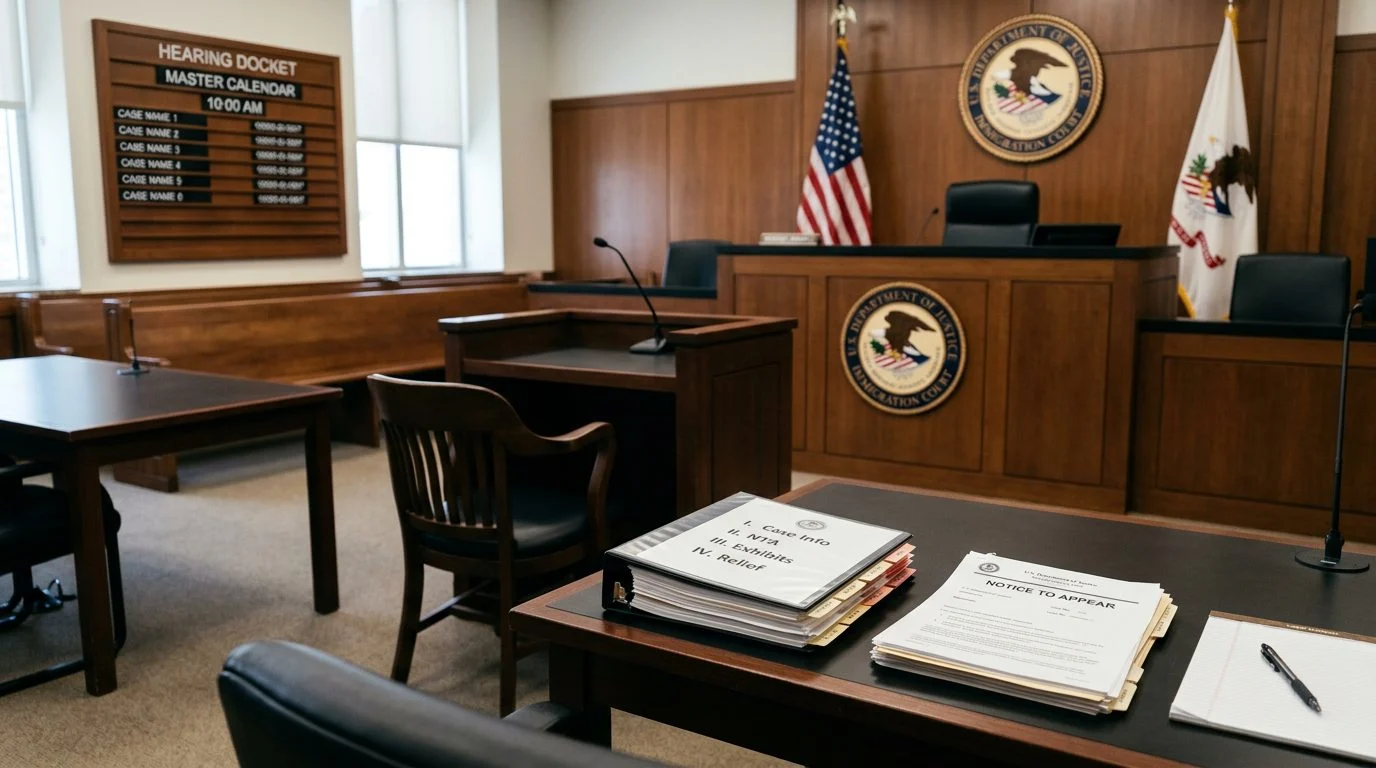
Pleadings happen at the master calendar hearing, the first scheduled hearing in your case. Many cases are heard on the same day, so this hearing is often shorter than people expect.
Your first hearing cannot be set too soon. Under federal law, it cannot be scheduled earlier than 10 days after the notice to appear is served, unless you ask in writing for an earlier date. This gives you time to secure a lawyer.
Tell the court your language early. The Notice to Appear must list the language you understand. If you need an interpreter, the interpreter must swear or affirm to interpret and translate accurately, unless the interpreter is an employee of the United States Government.
Keep every paper you receive. Bring your Notice to Appear and your hearing notice. If your address changes, you must give written notice on Form EOIR-33 within five days to the Immigration Court where your charging document was filed, or, if venue was changed, to the court your case was moved to.
Admitting or Denying the Allegations and Charges
For each factual allegation, you admit or deny it. You also admit or deny that you are removable under the charges. Whether to admit or deny depends on the facts of your case.
If you admit the facts and removability, the judge may find removability established. This happens only if the judge is satisfied that no issues of law or fact remain.
If removability is not decided by your admissions, the judge requests DHS counsel. 8 C.F.R. § 1240.10 reads: “When removability is not determined under the provisions of paragraph (c) of this section, the immigration judge shall request the assignment of DHS counsel, and shall receive evidence as to any unresolved issues, except that no further evidence need be received as to any facts admitted during the pleading.” The judge then receives evidence on the unresolved issues. 8 C.F.R. § 1240.10 reads: “When removability is not determined under the provisions of paragraph (c) of this section, the immigration judge shall request the assignment of DHS counsel, and shall receive evidence as to any unresolved issues, except that no further evidence need be received as to any facts admitted during the pleading.” The rules also protect some people. The judge cannot accept an admission from an unrepresented respondent who is incompetent or under 18, unless an attorney, near relative, guardian, or friend is with them.
DHS can add or change charges in writing at any time. The judge must read them to you and explain them. If you have no lawyer, the judge must tell you that you may have one. The judge may also give you a reasonable continuance to respond.
Designating a Country of Removal and Asking for More Time
The judge asks you to name a country where you would go if you are ordered removed. If you are finally ordered removed, the country you designate will in the first instance be the country of removal, except as otherwise provided under section 241(b)(2) of the Act. The judge must give you a chance to make that designation at the hearing.
If you do not name a country, or the country will not accept you, the judge identifies alternative countries for the record.
Your first hearing is also when the judge learns whether you plan to seek relief. Relief means a form of protection or permission to stay. Asylum is one example.
If you need more time, you can ask. A judge may grant a continuance for good cause shown, provided that no continuance causes the adjudication of an asylum application to exceed 180 days in the absence of exceptional circumstances per the cited rule. After the hearing has begun, a judge may grant a reasonable adjournment on its own instance or, for good cause shown, on application by the respondent or DHS, provided that no adjournment causes the adjudication of an asylum application to exceed 180 days in the absence of exceptional circumstances per the cited rule.
Timing matters for some relief. Eligibility for cancellation of removal depends on the facts of each case, so questions about timing and continuous residence should be reviewed with a lawyer at this office.
Why Early Pleadings Carry Into Later Hearings
Your pleadings stay on the record. They shape what the judge must decide later. No further evidence is needed for facts you admit during pleading. That’s why careful answers at the start save time later.
If issues remain, the case moves toward an individual hearing. At that hearing, the judge hears testimony and evidence on the contested issues.
Your statements can be compared over time. Early answers count as part of that record.
Missing a hearing carries serious risk.
The judge must ascertain at the opening of the removal proceeding that you have received a copy of your appeal rights.
Preparing for Your First Hearing and Next Steps
Before your hearing, gather your Notice to Appear and any hearing notice. Write down your current address, phone number, and the language you understand best. List your questions so you don’t forget them in the courtroom.
Consultations are paid services. Adriana Gomez is the responsible lawyer for this page.
Will the judge ask me to plead at the first hearing?
Yes, the judge asks for your pleadings at the master calendar hearing.
Can I ask for more time?
Yes, you can ask the judge for a continuance for good cause.
Do I need an interpreter?
You can tell the court your language and ask for one before the hearing.
If you have a hearing coming up and you’re deciding what to do next, you can reach our office through the contact form, by phone, or by WhatsApp. We can talk through your own situation with you.
How to Prepare for Your Pleadings
Review Your Notice to Appear
Read every allegation and charge carefully before the hearing. Bring any documents you have, and ask us to explain what each line means for your case.
Gather Your Documents
Collect identity documents, immigration papers, and any records that relate to your case. Keep copies and bring the originals to your consultation.
Tell Us Your Language Needs
Let the court know which language you speak. Interpreter requests should be raised early so the hearing can proceed smoothly.
Plan Your Questions
Write down what you want to ask about relief options, possible continuances, and what happens after the hearing. A prepared list helps you make informed decisions.
How Our Firm Supports You in Immigration Court
Removal Defense Focus
Our practice focuses on removal defense, so your hearing preparation is handled by a team that works on these matters every day.
Full-Scope Immigration Services
We also handle adjustment of status, family petitions, naturalization, removal of conditions on green cards, waivers, and BIA appeals.
Clear Communication
We explain each step in plain language and answer your questions in a way you can understand before you appear in court.
Responsive Office Support
Our assistants and office staff help you schedule, organize documents, and stay informed about your case file.
Do Not Plead Without Advice
Your pleadings can affect the rest of your case. Do not decide how to plead based only on what you hear in the hallway or read online. Speak with a lawyer before the hearing so you understand the consequences of each answer.
Prepare With a Lawyer Before Your First Hearing
Related practice areas
- Deportation Defense Attorney for Immigration Court: Removal Proceedings Explained
- Removal Defense in Florida
- Removal Defense in Texas
- Removal Defense in New York