

Removal Defense | Texas
Removal Defense for Texas Immigrants Facing Deportation
AG Immigration Law P.A. focuses on removal defense in immigration court. Contact our team to talk through your case, your options and the next steps.
By Adriana Gomez · Published November 1, 2026
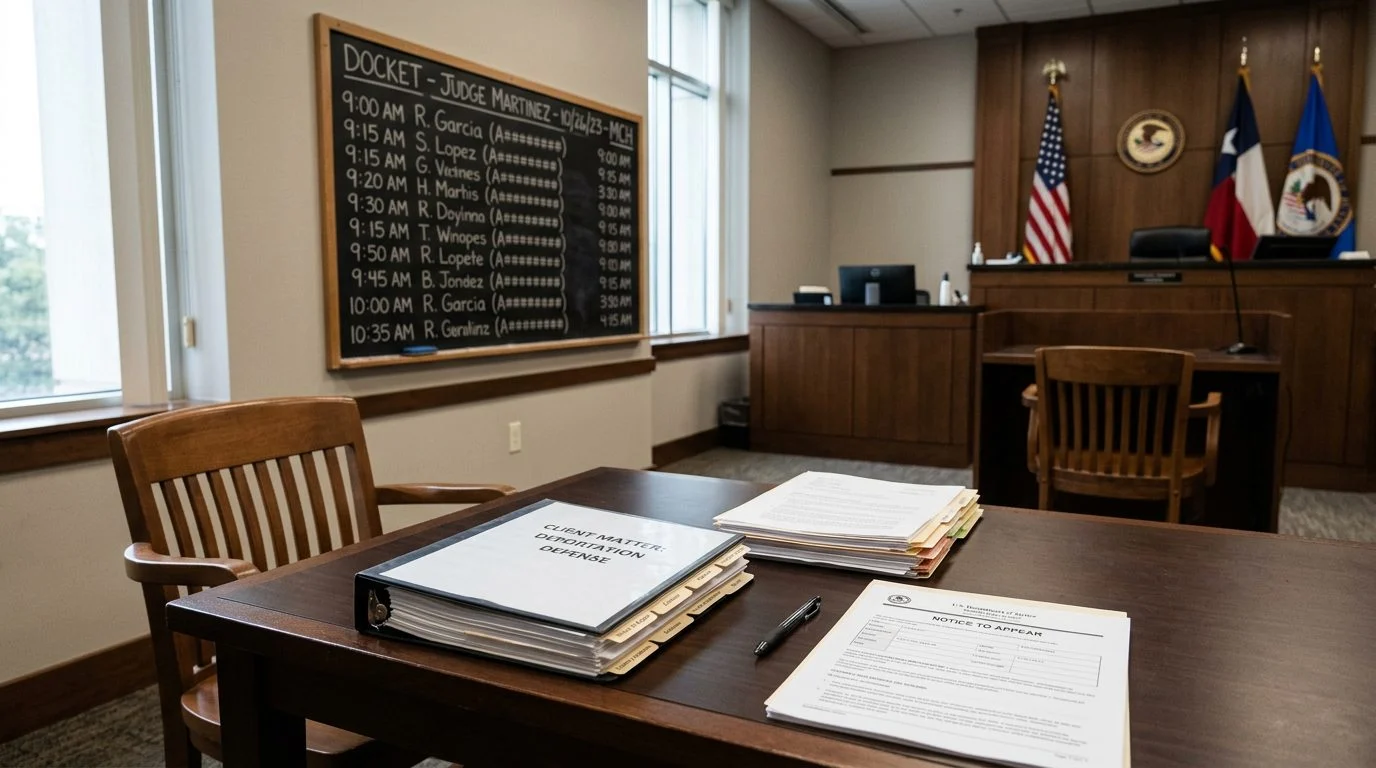
Removal defense in Texas means defending a person against a government case to remove them from the United States. If you received a Notice to Appear, your case has started, and each hearing date matters. The steps below apply to removal defense Texas cases of every kind. AG Immigration Law P.A. represents immigrants across the US.
What Removal Proceedings Mean for Texas Residents
Removal proceedings are the court process where the government asks an immigration judge to order a person removed. The case starts when the government files a notice to appear with the immigration court. 8 CFR 1239.1 sets out that rule.
The notice to appear lists the reasons the government gives for removal. These reasons are called charges. A lawyer for the Department of Homeland Security, called DHS counsel, presents the government’s side.
At your first hearing, the judge places you under oath. The judge then asks whether you admit the facts and the charges. 8 CFR 1240.10 describes this step. Your answer shapes what happens next, so prepare before you respond.
Texas cases go to immigration courts across the state, including the courts that hear Houston and San Antonio cases. Each case depends on its own facts. A Texas case follows the same basic path you would see anywhere in the country.
If a Notice to Appear has come for you or a family member in Texas, our team can review your hearing dates with you. Reach out through the contact form, by phone, or on WhatsApp. Talk it through with our team — we can walk you through how a situation like yours is usually handled and what your options are.

First Steps After Receiving a Notice to Appear
Attend every hearing listed on the notice to appear and on every later notice. If you miss one, the judge can order removal in absentia, meaning removal without you there. The government must prove removability by clear, unequivocal, and convincing evidence.
Written notice sent to your most recent address can be enough. 8 CFR 1003.26 explains this rule. So if you move, tell the court your new address right away, in writing.
Keep every government notice, court letter, and address record in one folder. Bring that folder to every meeting. Write down each hearing date and time as soon as you receive it.
The first hearing is usually a master calendar hearing. It is a short hearing where the judge checks the charges, confirms your details, and sets the next steps. That schedule drives everything that follows, so treat it seriously.
Contact the office early so your deadlines and filings can be reviewed. Waiting until the day before a hearing leaves little time to prepare.
Relief Options Raised in Removal Defense
Relief is a form of legal protection you can ask the judge to grant during removal proceedings. Which relief fits depends on your history, your status, and your family ties.
Cancellation of removal is one option.
Adjustment of status is another route. 8 U.S.C. § 1255 allows adjustment of status for an alien who was inspected and admitted or paroled into the United States, or who has an approved VAWA self-petition, and requires an application, eligibility for an immigrant visa, admissibility for permanent residence, and an immigrant visa immediately available when the application is filed. The statute lists exceptions.
Waivers can be raised when the law allows a ground of inadmissibility to be forgiven. Whether a waiver is possible depends on the ground and the facts.
Be careful with a missed hearing, and contact our office promptly if one has been missed.
Which relief may be available depends on the facts of each person’s history, status, and family ties. Our firm does not predict outcomes or promise any result in a removal case.
Bond Hearings in Texas Detention Cases
Many people held by ICE can ask an immigration judge to review custody and bond, but while the Transition Period Custody Rules remain in effect, 8 C.F.R. § 1003.19(h) bars immigration judges from redetermining custody conditions imposed by the Service for certain classes of detainees, including arriving aliens in removal proceedings and aliens designated in § 1236.1(c) as ineligible to be considered for release. The details of each case matter.
8 U.S.C. § 1226 allows an alien to be arrested and detained, on a warrant issued by the Attorney General, while the decision on removal is pending. Under 8 U.S.C. § 1226(a), except as provided in subsection (c), release may be granted on bond of at least $1,500 with security approved by, and containing conditions prescribed by, the Attorney General, or on conditional parole.
8 CFR 1003.19 lets an immigration judge review custody and bond decisions. The judge can rely on any information available, including information the person or the government presents. In some categories, the person must show by clear and convincing evidence that release would not pose a danger to other persons or property, and then, also by clear and convincing evidence, that they are likely to appear for any scheduled proceeding or interview.
Timing matters. If DHS determines that an alien should not be released or sets bond at $10,000 or more, the judge’s release order is stayed when DHS files its notice of intent to appeal within one business day, and whether to file is up to DHS. That stay keeps release on hold while the appeal is decided.
Gather supporting documents early. Useful papers include proof of address, family ties, work history, and records of past court attendance. Finding a detained relative is the first step. The Online Detainee Locator System is the official ICE tool for locating people in ICE detention.
If a relative is in detention, contact the office quickly so the bond request can be prepared.
Asylum and Other Defenses in Removal Proceedings
Asylum can be raised as a defense in removal proceedings when the legal requirements are met. A filing deadline applies, so timing matters early.
8 CFR 1208.4 counts the one-year period from your last arrival in the United States or from April 1, 1997, whichever is later. The rule also allows an exception if you show you qualify for one. Learn your arrival date now and gather proof of it.
Your credibility matters too. The judge also looks at whether your account is plausible and whether your written and oral statements match.
Other defenses to the charges may apply, depending on the facts. The right defense depends on the facts and documents in each case. Gather identity papers, travel records, and any court papers you already have.
Appeals to the Board of Immigration Appeals
A decision by an immigration judge can be appealed to the Board of Immigration Appeals, called the BIA. In most cases, the Board must receive Form EOIR-26 within 10 calendar days of the Immigration Judge’s decision under 8 CFR 1003.38(b)(1). If the judge adjudicated an asylum application and did not deny it under section 208(a)(2)(A), (B), or (C) of the Act, the deadline is 30 calendar days under 8 CFR 1003.38(b)(2). 8 CFR 1003.38 sets that rule.
The fee rule is strict. The Notice of Appeal must come with the appropriate fee or a Form EOIR-26A fee waiver request. If that is not filed on time, the appeal is not properly filed, and the judge’s decision stands.
After filing, briefs follow. 8 CFR 1003.3 sets this schedule. Workload concerns or travel plans within the control of either party, or their representatives, do not count as exceptional circumstances for an extension.
Act quickly after an unfavorable decision to protect your right to appeal.
Not sure what your next step is?
Talk it through with our team — we can walk you through how a situation like yours is usually handled and what your options are.
Removal Defense for Houston and San Antonio Residents
Houston and San Antonio residents facing removal can share their notice to appear and hearing papers with our team when they get in touch.
Families often have members at different stages. One person may have a notice to appear, a spouse may have a pending family petition, and a parent may be detained. Each case needs its own timeline. Dates in one file can affect the others, so review them together.
A case in Houston or San Antonio often turns on the details of your history. Records of arrival, entries, and prior filings often matter most. Bring every immigration document you have, even if it seems old or unrelated.
Talk With Our Team About Your Texas Removal Case
Adriana Gomez is the lawyer responsible for this page. Consultations with the firm are paid, and you can ask about the fee when you call.
You can reach the office through the contact form, by phone, or on WhatsApp. When you reach out, have your notice to appear, any hearing notices, and any detention papers ready.
If a matter may need to be referred to another lawyer or firm, we will say so.
If a Notice to Appear has arrived for you, or a family member is in ICE detention, contact our team now while hearing and bond dates are still open. Send your papers through the contact form, call the office, or message us on WhatsApp.

Frequently Asked Questions
What is removal defense in Texas?
Removal defense is legal representation for a noncitizen facing deportation in immigration court, where the government seeks to remove them from the United States. A lawyer can challenge the charges and, when a person is eligible, pursue relief such as cancellation of removal or asylum. Contact AG Immigration Law P.A. to discuss your situation.
What should I do if I receive a Notice to Appear in Texas?
Attend every court date, because missing a hearing can lead to a removal order entered in absentia. Contact an immigration attorney promptly by phone, contact form, or WhatsApp to schedule a consultation.
Can a person in removal proceedings in Texas be detained?
Some people in removal proceedings are held in immigration detention, and in certain cases a person may ask an immigration judge for a bond hearing. Eligibility depends on the person’s history and the charges against them. Contact our office to talk through the details of your case.
How long does a removal case in Texas take?
The length of a removal case depends on the court’s schedule, the relief being sought, and the facts of each case, so no specific timeline can be promised. Our team can explain the steps involved and what to expect when you call or message our office to book a consultation.
How We Work With You
Defense Built Around Your Case
We review the charges in your case and look for ways to challenge them in immigration court.
Relief Applications
When you may be eligible, we prepare and present applications for available forms of relief.
Clear Communication
We explain each step of the process in plain language so you know what to expect at every stage.
Support for Your Family
Our team keeps your family informed and helps coordinate the information your case requires.
Act Quickly
Immigration court proceedings can move fast. If you have received a notice to appear or a hearing notice, contact us right away so we can review your situation before your next court date.
Removal Defense Services
Immigration Court Representation
We appear with you at master calendar and individual hearings and handle filings with the immigration court.
Challenging the Charges
We examine the government's allegations and the evidence to identify defenses to removal.
Applications for Relief
We assess applications such as cancellation of removal and asylum for clients who may qualify.
Appeals to the BIA
We handle appeals to the Board of Immigration Appeals when a decision needs to be reviewed.
Talk With Adriana Gomez and Our Team
Related practice areas
- Deportation Defense Attorney for Immigration Court: Removal Proceedings Explained
- Removal Defense in New York