

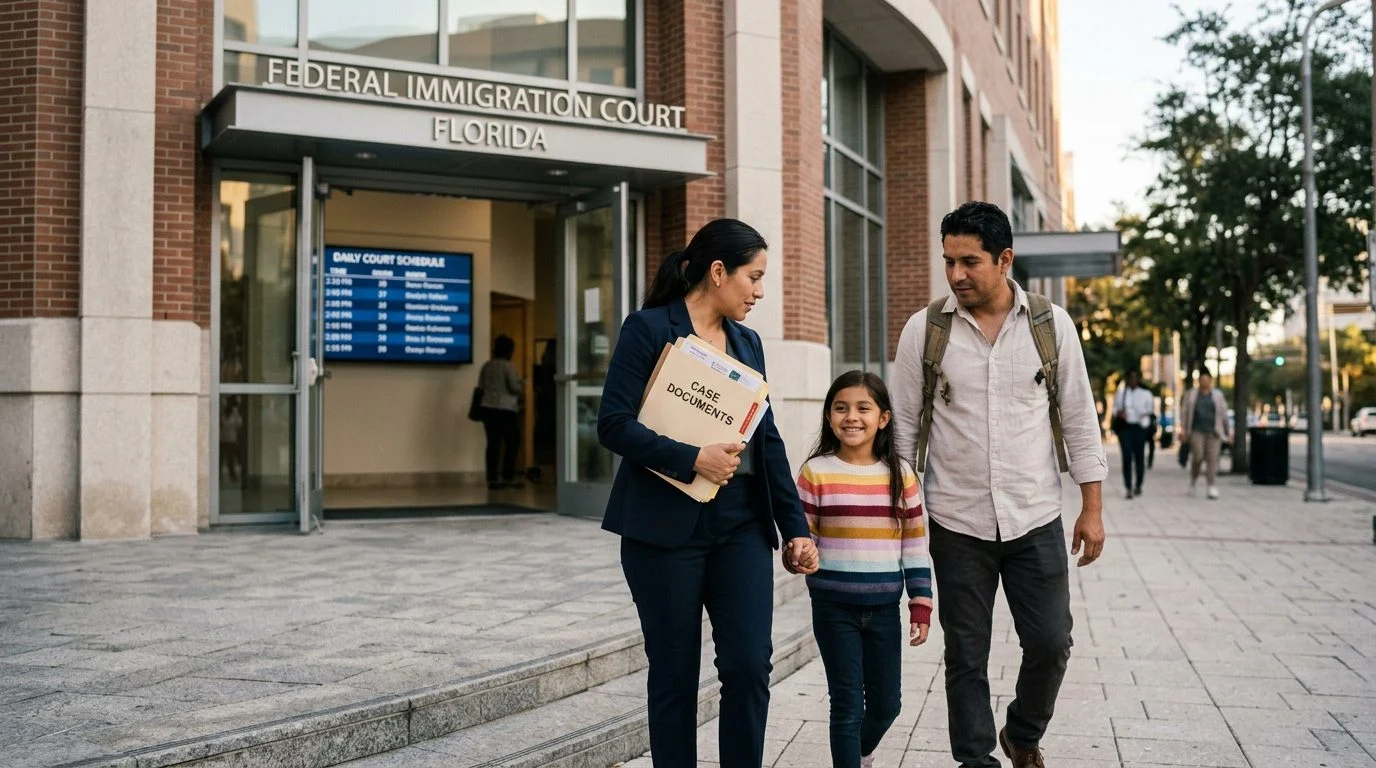
Removal Defense | Florida
Can Family Attend Your Immigration Court Hearing in Florida?
Rules for who may join an immigration court hearing can depend on the court and the type of hearing. Learn what to expect and how our team can help your family prepare.
By Adriana Gomez · Published November 3, 2026
Yes, family can usually attend an immigration court hearing in Florida. Federal rules say removal hearings are open to the public, but the immigration judge may close proceedings as provided in 8 C.F.R. § 1003.27 and can limit who comes in; hearings concerning an abused alien spouse or abused alien child must be closed to the public, unless the abused spouse agrees to have the hearing and Record of Proceeding opened. This guide explains what family can expect, including video and phone hearings, detained cases, and appeals.
Can Family Members Attend an Immigration Court Hearing in Florida?
Family members can generally attend, and a spouse, parent, or adult child may usually sit in the gallery. 8 C.F.R. § 1240.10 says removal hearings are open to the public, except where the judge may close them under 8 C.F.R. § 1003.27. Whether a specific person can sit in on a specific day depends on the facts of the case and the courtroom. Start with the hearing notice. It shows the date, time, courtroom, and format. Then follow any instructions the court gives for that day. Bring a copy of the notice so you can find the right courtroom quickly. Our team can go over the notice with you before the hearing date.
If your relative's hearing is coming up and your family isn't sure who can go in, we're glad to talk it through with you. Talk it through with our team — we can walk you through how a situation like yours is usually handled and what your options are.
When the Immigration Judge Can Limit Who Sits in the Courtroom
The immigration judge can limit who sits in the courtroom. The rules let the judge place reasonable limits on the number of people in attendance. When seats are short, the press gets priority over the general public. The judge may also limit attendance or hold a closed hearing to protect witnesses, parties, or the public interest. 8 C.F.R. § 1003.27 sets out these limits.
Some hearings must be closed. Hearings about an abused spouse stay closed unless the spouse agrees to open them. Hearings about an abused child must be closed. If your case involves one of these situations, family may not be allowed in at all.
Follow the judge’s directions and the court staff’s instructions. If you’re asked to step out, do it calmly. Wait in the hallway or lobby, and ask court staff when you may return. Arguing with staff in the moment only causes delay. Staying calm keeps the hearing moving and keeps you ready if the judge allows you back in.
Children and Minors at an Immigration Court Hearing
A child’s presence in the courtroom is decided case by case by the immigration judge. Plan for the possibility that your child may not be allowed inside. If the case involves an abused child, federal rules require the hearing to be closed to the public. 8 C.F.R. § 1003.27
If children are coming along, bring a responsible adult who can supervise them for the whole hearing. If the child is not permitted inside, you need childcare arranged before the hearing day. Don’t plan to solve it on the way to court. Settle the arrangements well ahead of time, and confirm them with your family.
Tell our office before the date if children will be with you. We can help you plan the day around the notice.
In-Person, Video, and Phone Hearings: What Changes for Family
Hearings can happen in person, by video, or by phone, and the format decides how family can take part. Immigration judges may hold hearings by video conference to the same extent they hold in-person hearings. 8 C.F.R. § 1003.25
Phone hearings are more limited. An evidentiary hearing on the merits by phone needs the respondent’s consent. 8 C.F.R. § 1003.25 reads: “An Immigration Judge may also conduct a hearing through a telephone conference, but an evidentiary hearing on the merits may only be conducted through a telephone conference with the consent of the alien involved after the alien has been advised of the right to proceed in person or, where available, through a video conference, except that credible fear determinations may be reviewed by the Immigration Judge through a telephone conference without the consent of the alien.” The respondent must first be told they can proceed in person or by video, where available. 8 C.F.R. § 1003.25
For video or phone hearings, family may not be able to enter a courtroom. Follow the separate joining instructions on the notice. Check the format before the date, because it changes who can be present and how you prepare. Don’t assume a video hearing lets you sit in a courtroom.
Judges may also waive the respondent’s presence for good cause when the respondent has a lawyer, or when the respondent is a minor child and at least one parent or a legal guardian is present. That decision belongs to the judge, so keep the notice and any later orders together.
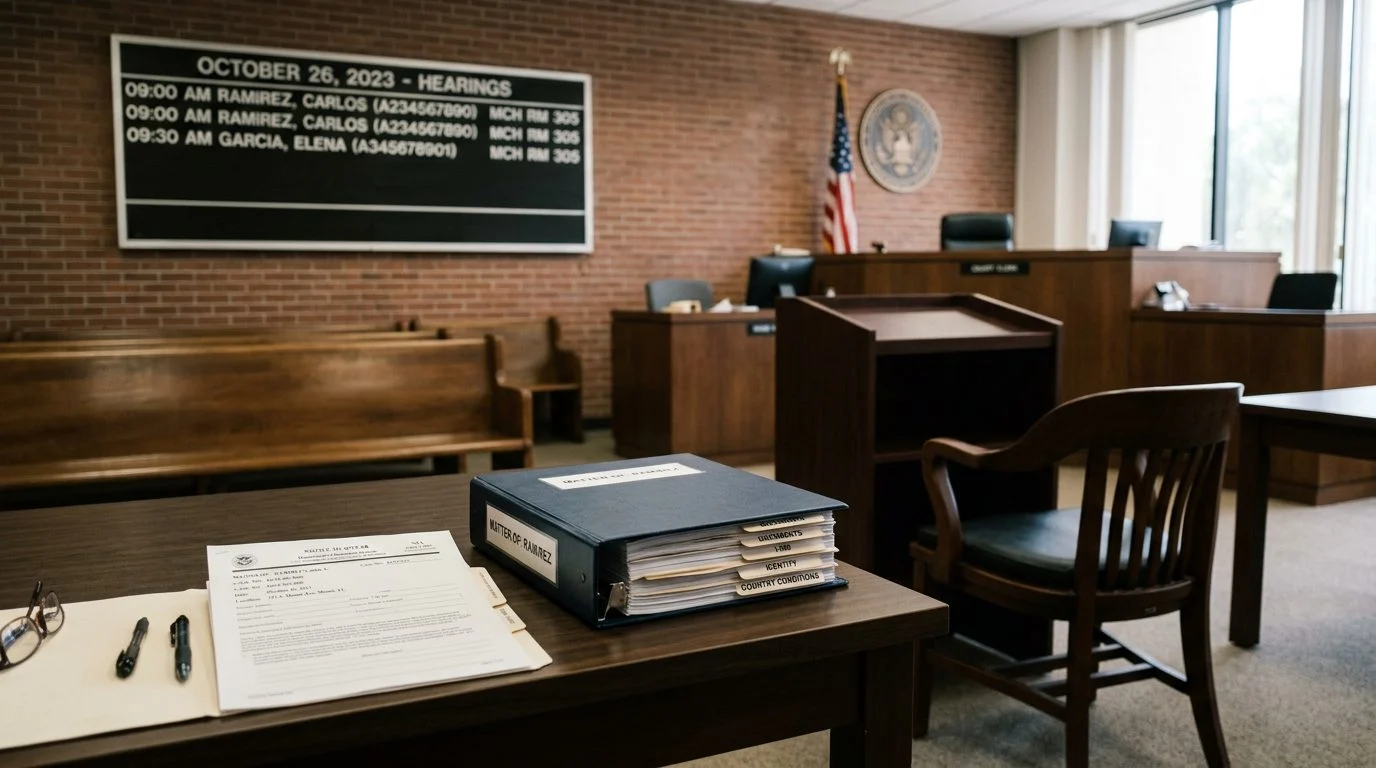
Detained Hearings, Building Security, and Seating
When the person is held in detention, family may face extra screening and fewer seats. Arrive early so you have time for security checks and to find the courtroom. Bring a government-issued photo ID. Leave prohibited items at home, and follow the court’s posted rules.
If you don’t know where your relative is held, the ICE Online Detainee Locator System is the official tool for finding people in ICE detention. Use your relative’s full name and country of birth when you search.
8 C.F.R. § 1003.19 The bond request is considered separately from the removal hearing.
What Happens at an Individual Hearing and After It
An individual hearing is the contested hearing where evidence and testimony are presented. At a removal hearing, the respondent will have a reasonable opportunity to examine and object to the government’s evidence, but is not entitled to examine national security information the government offers in opposition to admission to the United States or to a discretionary relief application. The respondent can also present evidence and cross-examine government witnesses. 8 C.F.R. § 1240.10
8 C.F.R. § 1240.12 The order of the immigration judge directs the respondent’s removal from the United States, the termination of the proceedings, or other such disposition of the case as may be appropriate. 8 C.F.R. § 1240.1
If a party disagrees, the appeal goes to the Board of Immigration Appeals. The Notice of Appeal (Form EOIR-26) must reach the Board within 10 calendar days of the decision. Certain asylum cases have 30 days. The fee or a fee waiver request (Form EOIR-26A) must be filed on time. 8 C.F.R. § 1003.38
Missing a hearing carries its own risk. The judge may order removal in absentia only if the government proves removability by clear, unequivocal, and convincing evidence, and that proper notice was given. 8 C.F.R. § 1003.26 In a removal proceeding, an immigration judge orders the alien removed in absentia when the government establishes by clear, unequivocal, and convincing evidence that the alien is removable and that written notice of the time and place of proceedings and of the consequences of failure to appear was provided to the alien or the alien’s counsel of record. 8 C.F.R. § 1003.26(c)
Not sure what your next step is?
Talk it through with our team — we can walk you through how a situation like yours is usually handled and what your options are.
Can ICE Remove Someone Without a Hearing Before an Immigration Judge?
In certain circumstances, yes. Federal law lets the Attorney General order some people removed without further inquiry or a hearing before an immigration judge.
Families should not assume the person will never be heard. When a person asks for review of a negative credible fear determination, federal law requires that review to be finished within 24 hours where practicable. It must be finished in no case later than 7 days.
Act quickly on any notice or paperwork you receive. Keep every document, the A-number, and the key dates in one place.
Talk With Our Team About Your Relative’s Hearing
If your relative has a hearing date and you’re not sure who can attend, you don’t have to sort it out alone. A court notice can cause worry, especially when someone you love faces a date you didn’t choose. AG Immigration Law P.A. focuses on removal defense, adjustment of status, family petitions, naturalization, removal of conditions on green cards, waivers, and BIA appeals.
Can family attend a hearing by video?
Family may not be able to enter a courtroom for a video hearing. Follow the joining instructions on the notice.
Can ICE deport someone without a hearing?
Act quickly on any notice.
This guide gives general information, and every case has its own facts. Reach out through our contact form, by phone, by WhatsApp, or to book a paid consultation.
How Our Immigration Practice Supports Families
Removal defense focus
Our practice focuses on removal defense, so we work closely with families facing proceedings in immigration court.
Hearing preparation
We help you understand your hearing notice, gather documents, and plan who will attend and how.
Family-based matters
Our work includes family petitions, adjustment of status, and related filings that often affect the whole household.
Clear communication
Our team answers questions about hearing formats, including video hearings, so you know what to expect.
Do Not Wait to Review Your Notice
Read every immigration court notice as soon as you receive it, and bring any questions to our office right away.
Steps to Take Before the Hearing
Read the notice
Review the date, time, location, and any joining instructions printed on your hearing notice.
Confirm who may attend
Check with our office whether family members may enter the courtroom or must join by video.
Gather your documents
Collect identification, immigration papers, and family records that may be relevant to your case.
Reach out to our team
Contact our office through the contact form, by phone, or on WhatsApp to plan your next step.
Have Questions About a Hearing Involving Your Family? Talk With Our Team.
Related practice areas
- Deportation Defense Attorney for Immigration Court: Removal Proceedings Explained
- Removal Defense in Florida
- Removal Defense in Texas
- Removal Defense in New York